
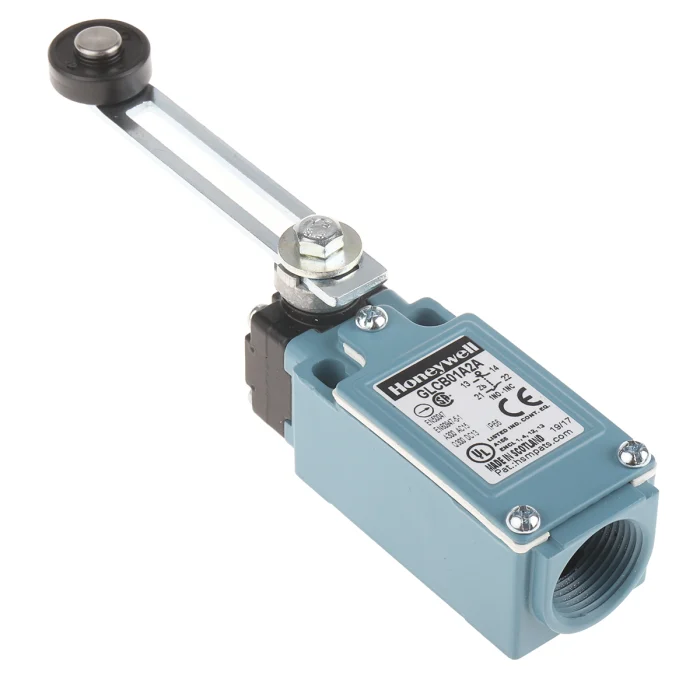
Honeywell ZLEC01A1B Limit Switch Technical Guide
The Honeywell ZLEC01A1B limit switch belongs to the Honeywell ZLS global limit switch family, a series designed to IEC standards for worldwide industrial use. The ZLS documentation states that these switches are available in EN50041 and EN50047 formats, include versions with positive opening of the normally closed contact, and offer protection ratings up to IP65 or IP67 depending on enclosure style. In the ZLS selection structure, ZLE identifies a metal 3-cable entry enclosure, while 01 corresponds to a 1NO/1NC snap-action contact block, and A1B identifies a fixed side rotary lever with metal roller.
What Type of Product Is Honeywell ZLEC01A1B?
The Honeywell ZLEC01A1B industrial limit switch is designed to detect movement, travel limits, and machine position in industrial equipment. Unlike a small panel switch, a global limit switch is intended for tougher environments and mechanical integration with moving components such as cams, levers, brackets, doors, and machine arms. The ZLS family is described by Honeywell as being suited to machine tools, conveyors, elevators, cranes, hoists, packaging machinery, textile machinery, and construction equipment.
Technical Structure of Honeywell ZLEC01A1B
The ZLS series datasheet provides a useful decoding path for the Honeywell ZLEC01A1B limit switch. The enclosure is a ZLE metal housing with 3-cable entry. The contact block type 01 is listed as 1NO/1NC snap action. The actuator code A1B is identified as a fixed side rotary lever with metal roller. The same document shows that ZLE versions in the family are associated with IP67 sealing, AC15 A600, DC13 Q300, mechanical life of 10 million operations, and electrical life of 500,000 operations.
Why This Limit Switch Format Matters
A fixed side rotary lever with metal roller is especially useful when actuation comes from lateral movement or a passing cam surface. In real industrial equipment, that can improve mechanical compatibility and create a more natural interaction between the switch and the moving part. The positive-opening feature of the normally closed contact is also important in applications where defined mechanical contact separation is required. That is one reason the ZLS family is widely recognized in industrial machinery.
Common Applications
The Honeywell ZLEC01A1B limit switch is relevant for machine tools, material handling equipment, packaging systems, lifting equipment, and automated machinery that needs dependable motion confirmation. Where physical contact sensing is acceptable, a limit switch like this offers a durable and easy-to-understand solution for confirming travel, presence, or end position. Honeywell also describes its broader limit switch range as rigorously tested for industrial machinery.
Selection Notes
When evaluating the Honeywell ZLEC01A1B global limit switch, it is important to verify the actuator geometry, enclosure style, conduit needs, and switching duty. The metal 3-cable entry housing can be especially relevant in installations where wiring layout and enclosure durability influence the overall design. For more information about Honeywell, the broader limit switch portfolio provides useful context.
FAQ
What is Honeywell ZLEC01A1B used for?
The Honeywell ZLEC01A1B limit switch is used for machine position detection, end-of-travel sensing, and presence confirmation in industrial equipment.
What actuator does Honeywell ZLEC01A1B use?
This model code maps to a fixed side rotary lever with metal roller, which is useful when a cam or moving machine part approaches from the side.
What contact arrangement does Honeywell ZLEC01A1B have?
The 01 contact block in the ZLS selection guide is listed as 1NO/1NC snap action.
Is Honeywell ZLEC01A1B suitable for industrial environments?
Yes. The ZLS family is designed for industrial applications, IEC-aligned global use, and includes sealing and durability characteristics intended for demanding machinery environments.
Why do engineers choose Honeywell ZLEC01A1B?
They often choose it because it combines a rugged enclosure, side rotary actuation, positive-opening contact behavior, and an industrial format that fits many machine designs without unnecessary complexity.