
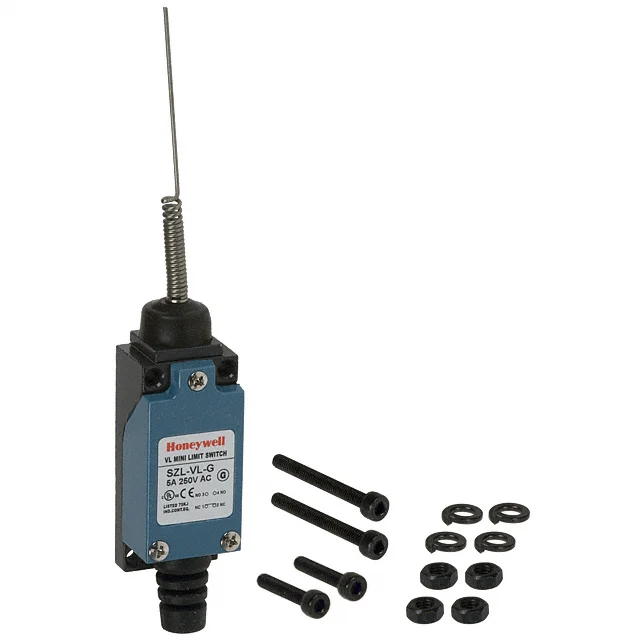
Honeywell SZL-VL-S-G-N-M Miniature Limit Switch Overview
The Honeywell SZL-VL-S-G-N-M miniature limit switch is another member of the Honeywell SZL-VL-S series, a family created for industrial machines that require dependable mechanical switching in restricted spaces. Distributor listings identify this model as an SPDT chassis-mount switch, while Honeywell’s series documentation emphasizes IP67 sealing, space-saving design, and suitability for rugged OEM machinery. For engineers who need reliable end-position or status detection without moving to a larger switch body, the Honeywell SZL-VL-S-G-N-M industrial limit switch aligns closely with that requirement.
Why the SZL-VL-S-G-N-M Is Relevant
Compact limit switches continue to be specified because machine miniaturization has not reduced the need for direct position feedback. In fact, tighter machine packaging often increases demand for smaller, more adaptable switch formats. Honeywell’s SZL-VL-S family is explicitly described as suitable for limited mounting space and rugged OEM machinery, making the Honeywell SZL-VL-S-G-N-M limit switch especially relevant for compact handling systems, assembly modules, packaging machines, and guarded machine sections. A mechanical switch still offers a clear operational advantage: the actuation can be seen, tested, and understood quickly.
Technical Characteristics
The Honeywell SZL-VL-S-G-N-M SPDT limit switch is associated with an SPDT contact arrangement, giving flexibility for both normally open and normally closed signal paths inside one compact device. Honeywell’s SZL-VL-S family is also associated with IP67 sealing, a meaningful specification in industrial environments where dust, splashing liquid, and general contamination are common. The series documentation also notes enhanced wiring space and an optional cable gland concept, showing that installation practicality was considered in the design. These are the types of details that affect not only commissioning, but also long-term service performance.
Applications for Honeywell SZL-VL-S-G-N-M
The Honeywell SZL-VL-S-G-N-M miniature industrial switch can be relevant in OEM machinery, guard monitoring, transfer points, machine travel confirmation, and compact automation assemblies where conventional full-size switches may not fit well. Search demand for phrases such as miniature IP67 limit switch, compact SPDT limit switch, and Honeywell SZL-VL-S-G-N-M remains steady because these components serve ongoing industrial design needs rather than short-term trends. In many cases, the right miniature switch can simplify the entire mechanical layout of a machine.
Engineering and Service Considerations
Successful use of the Honeywell SZL-VL-S-G-N-M limit switch depends on correct actuator matching, proper alignment, controlled overtravel, and thoughtful cable or wiring access. Because miniature switches are often installed in tight spaces, serviceability should be considered during the design phase rather than after commissioning. Maintenance teams tend to value components that are easy to diagnose and quick to replace, and mechanical limit switches continue to meet that expectation. This is one of the reasons compact limit switch families remain central to many OEM equipment designs.
For more information about Honeywell, comparing multiple SZL-VL-S variants can help match the correct actuator and mounting style to the final machine layout.
FAQ
What is Honeywell SZL-VL-S-G-N-M?
It is a miniature industrial limit switch from the Honeywell SZL-VL-S series.
Does Honeywell SZL-VL-S-G-N-M use SPDT contacts?
Yes. Distributor listings commonly identify it as an SPDT chassis-mount switch.
Is the SZL-VL-S family suitable for harsh industrial environments?
The family is associated with IP67 sealing, which supports use in demanding industrial conditions involving dust and moisture exposure.
Why are miniature limit switches still widely used?
Because they provide direct, dependable position feedback in compact spaces and remain easy to troubleshoot in the field.
Where can this model be used?
It can be used in compact OEM machines, guards, assembly units, handling systems, and automation modules requiring mechanical position detection.
What should be checked before installation?
Engineers should confirm actuator compatibility, mounting access, machine travel profile, environmental conditions, and wiring space.