
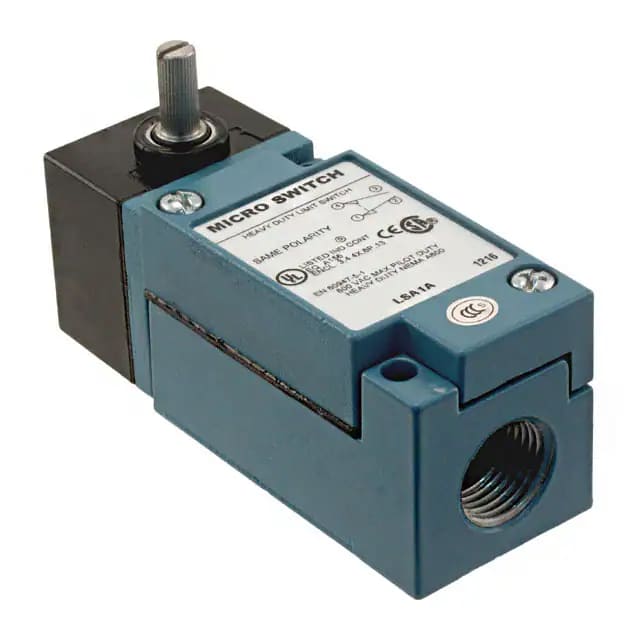
Honeywell LSA1A Limit Switch: Heavy-Duty Side Rotary Performance for Industrial Machinery
The LSA1A limit switch is a heavy-duty industrial switch used where equipment needs reliable motion feedback under demanding mechanical and environmental conditions. Unlike compact miniature switch platforms, the LSA1A heavy-duty limit switch belongs to a more rugged class of industrial controls intended for machine tools, conveyors, process systems, and severe-duty automation equipment. This makes it especially relevant in applications where strength, sealing, and long service life matter more than small size alone.
What Type of Product Is the Honeywell LSA1A?
The Honeywell LSA1A industrial limit switch is commonly described as a heavy-duty side rotary model within Honeywell’s HDLS-style portfolio. Distributor records identify it as a plug-in side rotary design with SPDT snap-action switching. That side rotary format is useful in machines where a moving arm, cam, or transfer member approaches laterally and needs to engage a rotary actuator rather than a vertical plunger.
For engineers, that means the Honeywell LSA1A side rotary limit switch is not just an electrical device. It is a mechanical interface between the machine and the control system, built to survive repetitive motion and environmental exposure over a long service life.
Technical Characteristics of the Honeywell LSA1A
Available technical sources identify the Honeywell LSA1A limit switch with a 10 A current rating, voltage references up to 600 V AC, SPDT contact configuration, and IP67 sealing. Datasheet summaries also place the operating temperature range broadly between approximately -12 °C and 121 °C, which is notable because it shows the product is intended for more demanding industrial conditions than many general-purpose switches.
Honeywell’s HDLS family literature emphasizes features such as robust shaft design, sealing, and industrial durability. These attributes matter in real facilities because heavy-duty switches are often installed where oil, dust, vibration, shock, and repeated mechanical actuation are part of normal operation rather than exceptional conditions.
Where the Honeywell LSA1A Is Commonly Used
The Honeywell LSA1A heavy-duty industrial limit switch is well suited to conveyors, packaging lines, processing equipment, machine tools, and outdoor or harsh-duty installations where a lighter enclosed switch may not offer enough mechanical confidence. The side rotary arrangement makes it especially useful where a machine component passes laterally and can operate the switch with a predictable motion profile.
It is also practical in systems where replacement clarity matters. A heavy-duty industrial switch is often chosen for a specific reason: durability in an exposed location. Matching that intent during maintenance is just as important as matching the mounting holes.
Why Search Interest Exists for Honeywell LSA1A
Users searching for the Honeywell LSA1A limit switch are usually working through specification, replacement, or retrofit questions. They want to confirm whether the product is heavy-duty, whether it is side rotary, whether it offers SPDT contacts, and whether its sealing and temperature capability fit the machine environment. Search phrases such as heavy-duty limit switch, Honeywell side rotary switch, industrial limit switch, IP67 limit switch, and SPDT machine switch are all closely aligned with this model.
That search behavior reflects a simple industrial reality: once a heavy-duty limit switch is designed into a system, replacement must preserve both the electrical and mechanical intent of the original design.
FAQ: Honeywell LSA1A Limit Switch
What type of switch is the Honeywell LSA1A?
The Honeywell LSA1A is a heavy-duty industrial limit switch commonly described as a side rotary model with snap-action switching.
What contact arrangement is associated with the Honeywell LSA1A?
Distributor records identify the Honeywell LSA1A limit switch as an SPDT configuration.
Is the Honeywell LSA1A suitable for harsh industrial environments?
Yes. Available technical summaries associate it with IP67 sealing and a broad operating temperature range, making it relevant for demanding machinery.
Why would a side rotary switch be chosen?
A side rotary switch is useful where machine motion approaches laterally and can operate the actuator more naturally than a top plunger design.
What should users check before replacing a Honeywell LSA1A?
They should verify actuator orientation, plug-in or conduit style, electrical configuration, mounting fit, and the mechanical path of the moving machine component.
For more information about Honeywell heavy-duty switch technologies, comparing actuator and housing families can help ensure the right industrial fit.