
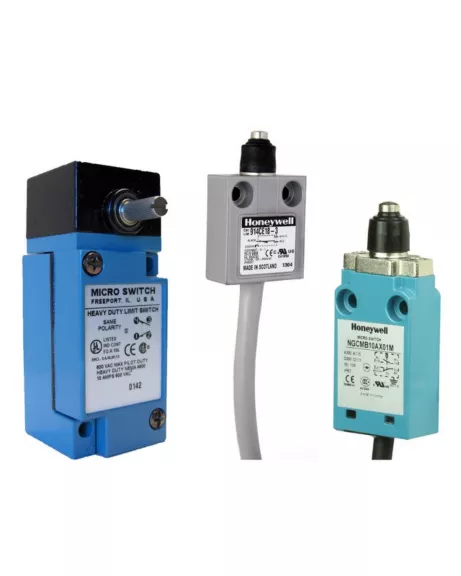
Honeywell Limit Switches: How They Support Reliable Industrial Position Sensing
Honeywell limit switches remain a core product category in industrial automation because they provide dependable mechanical position sensing in applications where direct contact is acceptable. Across factories, material handling systems, doors, conveyors, machine tools, and special-purpose equipment, Honeywell limit switches are used to detect presence, absence, travel limits, and mechanical status with a straightforward operating principle that remains highly effective.
What Are Honeywell Limit Switches?
Honeywell limit switches are precision snap-action switching devices housed in durable enclosures and designed to detect movement or position through physical actuation. Honeywell’s industrial switch portfolio spans miniature, compact, general-purpose, and application-specific families. That breadth matters because not every machine needs the same housing size, sealing class, actuator style, or circuit arrangement.
Some applications require a rugged general-purpose switch with a metal enclosure. Others need a miniature precision limit switch for restricted mounting space. The strength of Honeywell limit switches lies in that portfolio depth and their long-established reputation in industrial switching.
Why Honeywell Limit Switches Are Still Widely Used
Mechanical switching remains important because it is visible, understandable, and proven. Honeywell limit switches are widely used when engineers want clear, direct confirmation that a machine element has reached a defined point. Unlike some non-contact methods, the actuation event is easy to observe, easy to troubleshoot, and easy to validate during commissioning.
Honeywell also emphasizes testing, actuator variety, and industrial durability across the category. That is especially relevant in facilities where repeatability, maintainability, and service familiarity are just as important as raw specifications.
Typical Applications for Limit Switches
Honeywell limit switches are commonly used in:
- Machine tool equipment
- Conveyors and material handling systems
- Valve actuation feedback
- Packaging and assembly machinery
- Food and beverage processing equipment
- Doors, guards, and access systems
These applications show why Honeywell limit switches remain relevant in both new equipment design and ongoing plant maintenance. They solve practical problems in a way that technicians and engineers already understand well.
Key Features Across the Honeywell Portfolio
Across different families, limit switches may offer compact footprints, die-cast housings, actuator options such as plungers and rollers, and environmental sealing that supports indoor or outdoor use. Honeywell’s general-purpose LS series, for example, is positioned around rugged metal construction, IP67 and NEMA sealing options, and consistent repeatability over millions of operations. Other families focus on compact miniature packaging or global standard compatibility.
That means the term Honeywell limit switches does not describe a single product. It describes a broad platform of industrial switching solutions aligned with different operational demands.
How to Choose the Right Honeywell Limit Switch
The best way to choose among limit switches is to start with the application, not the brand alone. Buyers should review environmental exposure, actuator movement, available mounting space, circuit needs, and service expectations. A miniature precision switch may be ideal in one machine, while a general-purpose metal-housed switch may be much better in another.
That selection process helps avoid a common mistake: choosing a switch only by physical resemblance. The most reliable results come from matching the actuator style, sealing level, and switching logic to the machine’s actual operating conditions.
FAQ
What are Honeywell limit switches used for?
Honeywell limit switches are used for detecting position, movement, travel limits, and presence or absence in industrial and commercial machinery.
Are Honeywell limit switches suitable for harsh environments?
Many are. Honeywell offers families with sealed housings, durable materials, and environmental ratings intended for demanding indoor and outdoor industrial conditions.
Why do engineers still use Honeywell limit switches in modern automation?
They remain popular because they are reliable, understandable, easy to troubleshoot, and available in many form factors for different machine designs.
What actuator types are available in Honeywell limit switches?
Depending on the series, actuator options can include pin plungers, roller plungers, side rotary actuators, wobble sticks, and roller levers.
How do I choose the right Honeywell limit switch?
Review the machine’s actuation path, environmental conditions, mounting space, electrical requirements, and maintenance needs before selecting a specific Honeywell limit switch model.
For more information about Honeywell, explore the full industrial switch portfolio.