
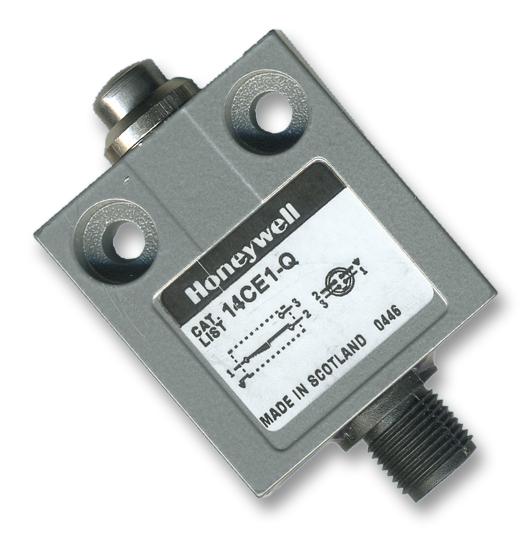
Honeywell 14CE1-AQ Limit Switch Guide for Pin Plunger Industrial Detection
The Honeywell 14CE1-AQ limit switch is a compact enclosed industrial switch designed for applications where protected housing, precise pin plunger actuation, and reliable snap-action switching are required. As a Honeywell 14CE1-AQ limit switch, this model belongs to the MICRO SWITCH 14CE family and is associated with SPDT switching, pin plunger actuation, and an M12 male connection format suited to industrial machine integration.
That combination makes the Honeywell 14CE1-AQ limit switch especially relevant in machinery where connectorized installation and compact enclosed construction help reduce service complexity. In many industrial systems, a pin plunger switch is preferred when the mechanical motion is direct and linear. The actuator does not need the sweeping contact path of a lever or roller. Instead, it delivers straightforward push-based detection.
Technical Value of the Honeywell 14CE1-AQ Limit Switch
Available technical references describe the Honeywell 14CE1-AQ limit switch as a pin plunger model with SPDT configuration, 3 A switching capability, and an M12 male connection. Those details are useful because they indicate a product designed not just for enclosed durability but also for cleaner system-level integration. Connectorized limit switches can reduce installation time and support faster maintenance in equipment where wiring access is limited.
The broader 14CE family is positioned by Honeywell as a compact enclosed switch line with strong sealing performance and versatility across harsh applications. That series-level context matters because it helps explain why the Honeywell 14CE1-AQ limit switch remains relevant in industrial machinery even as sensor technologies continue to evolve. There are still many cases where a rugged electromechanical limit switch is the most practical solution.
Where the Honeywell 14CE1-AQ Limit Switch Fits Best
A Honeywell 14CE1-AQ limit switch is well suited to machine tools, compact industrial assemblies, robotics interfaces, material handling systems, packaging equipment, and installations where direct plunger actuation is the most natural mechanical interface. The M12 male connector style can also be attractive in modular equipment where cable harness standardization is part of the design strategy.
For engineering teams, that means the switch can support both functional reliability and cleaner installation architecture. For additional manufacturer and family information, visit more information about Honeywell.
Why the Honeywell 14CE1-AQ Limit Switch Has Strong Exact-Code Search Intent
Searches for the 14CE1-AQ limit switch usually come from users who need to confirm exact actuator type, connector format, and electrical suitability before making a replacement or specification decision. Those factors matter because even a mechanically similar alternative may not integrate correctly if the connection style or plunger dimensions differ.
That is why product-specific content is useful here. The 14CE1-AQ limit switch solves a precise industrial requirement and should be described in those practical terms rather than through generic category copy.
FAQ: 14CE1-AQ Limit Switch
What actuator does the 14CE1-AQ use?
The Honeywell 14CE1-AQ limit switch is associated with a pin plunger actuator, which is suitable for direct linear mechanical actuation.
What connection style does the 14CE1-AQ use?
Available technical references identify this model with an M12 male connector, which can support modular and service-friendly industrial installation.
What type of contact arrangement does the Honeywell 14CE1-AQ limit switch have?
It is commonly described as an SPDT enclosed industrial limit switch.
Where is this switch commonly used?
It is relevant for machine tools, packaging systems, robotics, compact automation assemblies, and industrial applications needing enclosed plunger-based switching.
Why do engineers search for the exact Honeywell 14CE1-AQ code?
Because actuator type, connector style, enclosure format, and electrical rating all affect installation compatibility in real industrial systems.