
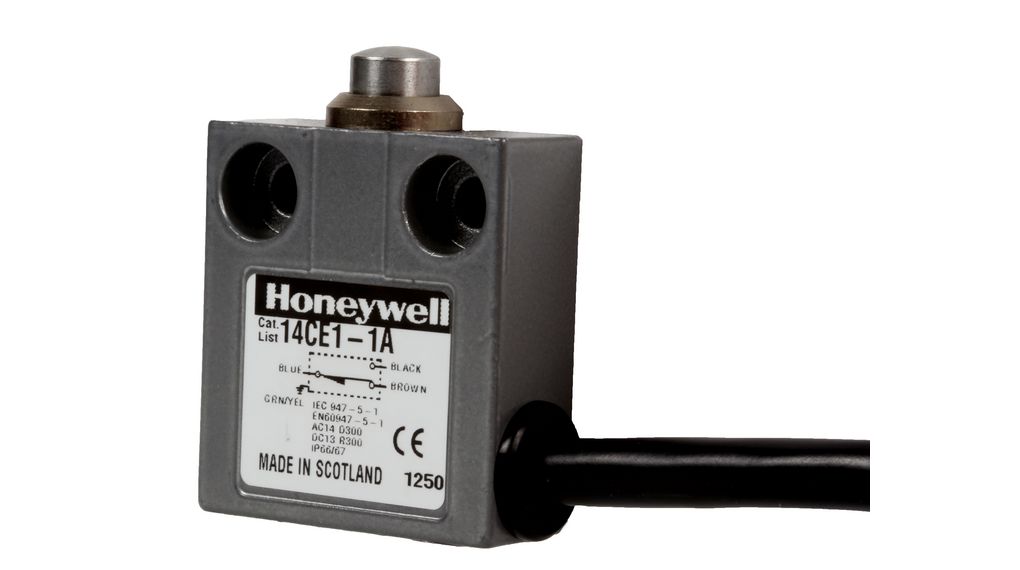
Honeywell 14CE1-3A Limit Switch Explained
The Honeywell 14CE1-3A limit switch belongs to the MICRO SWITCH 14CE family, a compact enclosed switch line developed for industrial position detection. This product type is widely used when a machine needs clear feedback about part presence, end-of-travel position, or movement completion. In that role, the Honeywell 14CE1-3A enclosed limit switch supports reliable mechanical actuation in a relatively compact footprint.
What Kind of Product Is Honeywell 14CE1-3A?
The Honeywell 14CE1-3A industrial limit switch is generally described as an enclosed basic switch with SPDT circuitry, cable lead termination, and an industrial housing intended for equipment environments where a bare open-frame switch would not be ideal. Distributor technical references also associate this part with approximately 5 A current rating, up to 240 V or 250 V AC, and an IP65 level of protection in listed summaries.
Technical Characteristics That Matter
For design and maintenance teams, the practical value of the Honeywell 14CE1-3A limit switch is in its balance between compact size and enclosed durability. Available technical listings note features such as silver contacts, a relatively high operating force, cable connection, and travel figures that support controlled actuation in machine mechanisms. The broader 14CE product family is also described by Honeywell as suitable for worldwide CE-oriented requirements and available in multiple actuator styles.
That is important because enclosed limit switches are often selected not only for electrical switching, but also for their ability to tolerate industrial handling, dust exposure, and routine mechanical cycling. In many real installations, a switch like this becomes a small but mission-critical part of machine sequencing.
Common Applications
The Honeywell 14CE1-3A enclosed limit switch is relevant in conveyors, packaging systems, automation cells, and general machinery where presence or travel confirmation is required. Because it combines an enclosed body with snap-action switching, it can serve as a practical option where machine designers need a defined actuation point and dependable signal output.
Another advantage is maintainability. Many technicians prefer well-established Honeywell limit switch families because documentation, replacements, and cross-checking are usually more straightforward than with obscure low-volume components.
Why Enclosure and Cable Leads Matter
In a busy industrial environment, enclosure choice affects service life. An enclosed body helps protect the internal switching mechanism from routine contamination and handling. Meanwhile, cable lead termination can simplify installation in some equipment layouts, especially where prewired routing is preferred over field-assembled terminal connections.
That is why searches for Honeywell 14CE1-3A limit switch often come from engineers who are not only looking for an electrical match, but also a mechanical and environmental fit.
FAQ
What type of switch is Honeywell 14CE1-3A?
The Honeywell 14CE1-3A is an enclosed industrial limit switch in the MICRO SWITCH 14CE Series.
Does Honeywell 14CE1-3A use SPDT contacts?
Yes. Available technical summaries list the Honeywell 14CE1-3A limit switch with an SPDT contact configuration.
What is the benefit of the enclosed design?
An enclosed body helps protect the switching mechanism and makes the product more suitable for industrial machinery than an open-frame basic switch in many applications.
Is cable lead termination available on Honeywell 14CE1-3A?
Yes. This model is commonly associated with cable lead termination, which can simplify integration in some machine layouts.
Where can I read more about Honeywell industrial components?
For more information about Honeywell, you can explore related industrial switching and sensing solutions.