
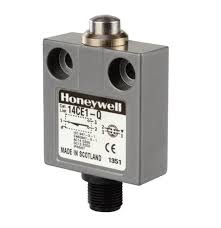
Honeywell 14CE1-2B Limit Switch: Compact Precision for Industrial Control
The Honeywell 14CE1-2B limit switch is a compact industrial switching solution designed for equipment that needs repeatable position detection in a durable enclosure. In many automation environments, engineers look for a Honeywell 14CE1-2B industrial limit switch because it combines precise snap-action performance with a compact body that fits into space-sensitive machine layouts. This makes the unit especially relevant for machine tools, packaging systems, material handling equipment, and general factory automation.
What Makes the Honeywell 14CE1-2B Stand Out?
At product level, the Honeywell 14CE1-2B is listed as an SPDT chassis-mount switch with a round pin plunger actuator, cable lead termination, a 5 A AC current rating, and a 250 V AC rating. It is also specified with an operating force of approximately 1203 gf, an operating position of 0.620 in, pretravel of 0.071 in, differential travel of 0.004 in, overtravel of 0.118 in, and a mechanical life of up to 10 million cycles. Those figures matter because they help maintenance teams and design engineers evaluate consistency, service interval expectations, and fit within a mechanical assembly.
Within the broader Honeywell 14CE Series limit switch platform, the family is known for fluorocarbon diaphragm sealing, rugged construction, and suitability for demanding environments where fluids, dust, and repetitive actuation are common. The series documentation also highlights common use across robotics, agricultural machinery, commercial appliances, access solutions, and print or textile machinery.
Typical Applications
A Honeywell 14CE1-2B enclosed limit switch is typically selected when a machine must detect a fixed end position or confirm that a mechanism has reached a repeatable point in its travel. In conveyor systems, it can support position confirmation. In packaging machinery, it can help verify gate or arm movement. In OEM machine design, it is useful where designers want a proven industrial switch format rather than a larger housing.
Because the product belongs to the 14CE family, users often value it for compact installation, predictable actuation, and long mechanical life. That combination is important in applications where uptime matters more than headline specifications alone.
Installation and Selection Considerations
When evaluating the Honeywell 14CE1-2B limit switch, check actuator alignment, mounting stability, travel allowance, and cable routing. A limit switch can perform very well electrically, but poor mechanical alignment will still reduce real-world reliability. It is also wise to review force requirements and available overtravel in the host equipment so the plunger is not overstressed during repeated operation.
For more information, visit Honeywell.
FAQ
What type of switch is the Honeywell 14CE1-2B?
It is an enclosed industrial limit switch with SPDT snap-action contacts and a round pin plunger actuator.
Where is the Honeywell 14CE1-2B commonly used?
It is commonly used in automation, packaging, machine tools, material handling systems, and OEM equipment that needs reliable position detection.
Why do engineers choose a Honeywell 14CE1-2B industrial switch?
They usually choose it for its compact footprint, repeatable actuation, long mechanical life, and compatibility with demanding industrial machine designs.
Is the Honeywell 14CE1-2B suitable for repetitive motion systems?
Yes. Its long mechanical life makes it a strong candidate for systems with frequent cycling, provided the installation respects the specified force and travel limits.
What should be checked before replacing a Honeywell 14CE1-2B limit switch?
Check the actuator style, contact arrangement, voltage/current rating, mounting method, cable termination, operating force, and travel dimensions to ensure the replacement behaves the same way in the application.