
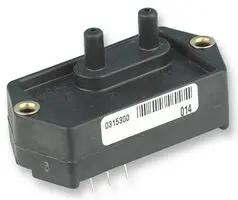
Honeywell 142PC15A MEMS Pressure Sensor Guide
The Honeywell 142PC15A MEMS pressure sensor is an absolute pressure sensing component built for board-mount applications that need stable analog output and dependable environmental performance. As a Honeywell 142PC15A pressure sensor, it is often considered when designers want a compact solution that offers pressure measurement over a defined span without relying on an external atmospheric reference.
What Makes the Honeywell 142PC15A Different?
The Honeywell 142PC15A MEMS pressure sensor is an absolute pressure sensor. That means it references a sealed internal standard rather than ambient air or a second pressure port. In real design work, that distinction matters because absolute pressure sensing is useful where environmental consistency, sealed reference behavior, and accurate pressure tracking over time are priorities.
The Honeywell 142PC15A pressure sensor is specified across a 2 PSI to 15 PSI range, giving engineers a practical measurement span for compact industrial, laboratory, and instrumentation systems.
Core Technical Specifications
The Honeywell 142PC15A absolute pressure sensor operates from 2 PSI to 15 PSI (approximately 13.79 kPa to 103.42 kPa). It uses a 7 V to 16 V supply and provides an analog voltage output of 1 V to 5.33 V. Accuracy is typically listed at ±0.4%, which is a meaningful advantage for applications that need tighter measurement confidence. The sensor includes a male 0.2 inch barbless tube port, PC pin termination, a 3-SIP module package, and an operating temperature range of -40°C to 85°C. Maximum pressure is rated at 45 PSI.
Application Relevance
A Honeywell 142PC15A pressure sensor can fit pressure monitoring systems, instrument enclosures, analytical equipment, and pneumatic assemblies that require absolute pressure feedback rather than simple gauge comparison. Because the signal is amplified and temperature compensated, it can reduce calibration burden in the early stages of product development.
The Honeywell 142PC15A MEMS pressure sensor is also attractive for teams building compact electronics where signal stability and mounting simplicity matter. Rather than forcing a complex front-end design, it gives developers a conditioned analog signal that is easier to integrate into embedded platforms.
Why Engineers Still Search for the Honeywell 142PC15A
There is consistent interest in the 142PC15A absolute pressure sensor because it sits in a useful range for many board-level pressure tasks. It is not just about pressure span. The real value comes from the balance of accuracy, package format, analog output behavior, and operating temperature coverage.
For teams comparing legacy-compatible board sensors or evaluating a proven pressure sensing architecture, the Honeywell 142PC15A pressure sensor remains a technically relevant part. For more information about Honeywell, reviewing related sensing families can help identify adjacent solutions for flow, pressure, and environmental monitoring.
FAQ
Is the 142PC15A an absolute pressure sensor?
Yes. The Honeywell 142PC15A MEMS pressure sensor is an absolute pressure sensor, meaning it measures pressure against an internal sealed reference rather than against ambient atmospheric pressure.
What pressure range does the Honeywell 142PC15A cover?
The Honeywell 142PC15A pressure sensor is specified from 2 PSI to 15 PSI, which is approximately 13.79 kPa to 103.42 kPa.
What output does the 142PC15A provide?
It provides an analog voltage output from 1 V to 5.33 V. This is useful for analog front-end circuits, controller inputs, and general monitoring electronics.
How accurate is the 142PC15A pressure sensor?
The listed accuracy is typically ±0.4%, which makes it attractive for applications that need more refined pressure measurement than basic sensing solutions.
What industries or systems can use the Honeywell 142PC15A MEMS pressure sensor?
It can be relevant in laboratory equipment, industrial instrumentation, pneumatic controls, sealed monitoring systems, and embedded designs that require compact absolute pressure feedback with analog output.
Why is the Honeywell 142PC15A still technically relevant?
It offers a solid mix of measurement span, analog conditioning, temperature compensation, compact board mounting, and good accuracy. That combination keeps it useful for engineers looking for a practical and proven pressure sensing component.