
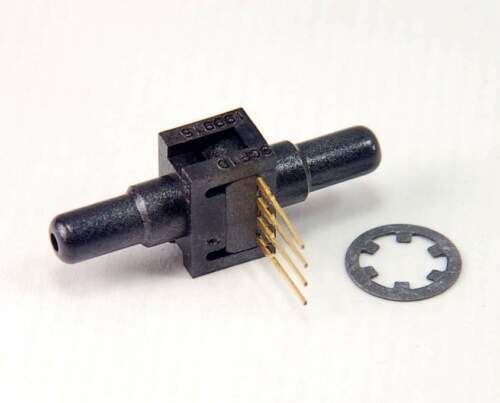
Honeywell 141PC15DL Differential Pressure Sensor Explained
The Honeywell 141PC15DL pressure sensor is a differential pressure sensing device built for applications that require stable measurement, compact integration, and amplified analog output. For engineers working with air flow, pneumatic monitoring, medical devices, instrumentation, or industrial control systems, the Honeywell 141PC15DL differential pressure sensor offers a practical combination of sensitivity, board-mount convenience, and compensation features.
Core Technical Features of Honeywell 141PC15DL
The Honeywell 141PC15DL sensor is publicly listed as a 15 psi differential pressure sensor, equivalent to approximately 103.42 kPa. It provides an analog voltage output from 1 V to 6 V and operates from a 7 V to 16 V supply. Distributor technical data also identifies ±0.6% accuracy, temperature compensation, and an amplified output, which makes the device especially useful when stable signal conditioning is important. The sensor uses dual 0.2 inch male pressure ports and a 3-SIP through-hole package for board mounting.
Why Engineers Use Differential Pressure Sensors
A Honeywell 141PC15DL pressure sensor product type is especially useful when the goal is to compare pressure between two points rather than measure absolute pressure against a vacuum reference. This matters in systems such as airflow monitoring, filter condition tracking, pneumatic diagnostics, and equipment control loops. Differential pressure sensing helps detect restriction, leakage, imbalance, and process variation with a clean and measurable voltage signal.
Operating Environment and Reliability
The published operating temperature range of the Honeywell 141PC15DL differential pressure sensor is -40°C to 85°C, and public listings also show a maximum pressure of 45 psi. Those values make it relevant for demanding embedded designs that need dependable pressure measurement across varying conditions. Because the output is already amplified, integration can be simpler for designers who want to reduce external signal-conditioning complexity.
For teams evaluating board-mount pressure transducers, this model stands out for its combination of compact packaging, compensated performance, and familiar analog output behavior. For more information about Honeywell, it is useful to compare this sensor with adjacent pressure ranges and port styles in the same family.
FAQ
What does Honeywell 141PC15DL measure?
Honeywell 141PC15DL measures differential pressure, meaning it compares pressure between two separate points rather than measuring pressure relative to atmosphere or vacuum.
What is the pressure range of Honeywell 141PC15DL?
The standard published operating pressure is 15 psi differential, which is approximately 103.42 kPa.
What output does Honeywell 141PC15DL provide?
This sensor provides an amplified analog voltage output in the 1 V to 6 V range, making it convenient for electronics and control interfaces that work with analog input signals.
What makes 141PC15DL useful for embedded applications?
Its through-hole 3-SIP package, compact board-mount format, amplified output, and temperature compensation help simplify integration and improve measurement stability.
What should be checked before selecting 141PC15DL?
Design teams should confirm pressure type, full-scale range, port compatibility, supply voltage, analog input requirements, environmental conditions, and the acceptable maximum pressure margin in the final system.