
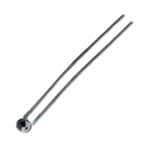
Honeywell 140-502LAG-RB1 Temperature Sensor Thermistor Guide
The Honeywell 140-502LAG-RB1 temperature sensor thermistor is an NTC disc thermistor developed for applications that need stable thermal feedback in a compact, leaded component format. It belongs to Honeywell’s 140 Series, a thermistor family widely recognized for supporting temperature sensing, compensation, and control functions across industrial and commercial electronics.
What Is the Honeywell 140-502LAG-RB1?
The Honeywell 140-502LAG-RB1 temperature sensor is a passive sensing component that changes resistance as surrounding temperature changes. Since it is an NTC thermistor, its resistance drops when temperature rises. This behavior makes it especially useful in designs where a circuit needs a clear thermal response without requiring more complex sensing hardware.
The Honeywell 140-502LAG-RB1 thermistor can support applications in HVAC controls, refrigeration-related electronics, general thermal monitoring, industrial equipment, and analog sensing circuits. In many of these environments, reliability and repeatability are more important than unnecessary feature depth.
Technical Highlights
This Honeywell temperature sensor thermistor is commonly listed with a nominal resistance of 5 kOhm at 25°C. Available product summaries also note an operating temperature range reaching from -60°C to 125°C, making it relevant for systems exposed to both low and elevated thermal conditions. Some listings additionally associate it with a resistance tolerance of ±10% and a B value tolerance around ±1.3%.
Those characteristics matter because they shape how the component performs inside a measurement network. A known 5 kOhm reference value can be important in voltage divider circuits, compensation networks, control boards, and thermal decision-making logic.
Why Engineers Specify the Full Product Name
The full phrase Honeywell 140-502LAG-RB1 temperature sensor thermistor should be used in documentation and sourcing because thermistor families often include similar part numbers with different electrical characteristics. Even a small variation in resistance or thermal curve can change how a circuit behaves in the field.
That is why accurate product identification matters not only during design, but also during maintenance, repair, and procurement. The exact code helps avoid mismatches and supports more dependable long-term system performance.
For more information about Honeywell, comparing related temperature sensor and control product families can help streamline engineering and replacement decisions.
FAQ
What is the resistance of the Honeywell 140-502LAG-RB1?
It is commonly listed as 5 kOhm at 25°C, which is the standard nominal reference used in thermistor selection and circuit design.
What does NTC mean in this Honeywell temperature sensor?
NTC stands for Negative Temperature Coefficient. It means resistance decreases as temperature increases, which is useful for measuring and reacting to heat changes.
What applications can use the Honeywell 140-502LAG-RB1 thermistor?
It can be suitable for HVAC controls, thermal monitoring circuits, industrial electronics, appliance systems, and general-purpose temperature compensation networks.
Why is the operating temperature range important?
The temperature range helps determine whether the thermistor can function reliably in the intended environment. Components used in exposed or variable conditions must be checked carefully against expected thermal loads.
Should buyers match the exact Honeywell part number?
Yes. Matching the exact code is essential because related thermistors can look similar while having different resistance values, tolerances, or response characteristics.