
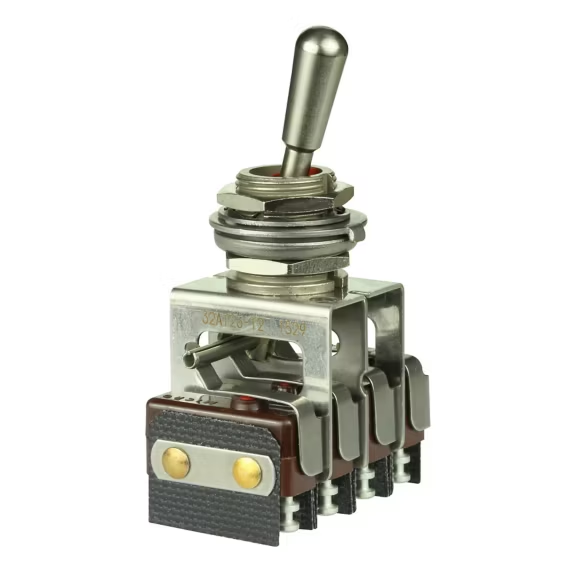
Honeywell 13AT26 Toggle Switch Technical Guide
The Honeywell 13AT26 toggle switch belongs to the MICRO SWITCH AT Series and is a well-known option for engineers who need a reliable manual operator control in industrial or equipment-level applications. Interest in the Honeywell 13AT26 toggle switch often comes from projects that require a three-position control device with solid mechanical feel and stable electrical behavior.
According to available references, the 13AT26 switch is a 2-pole, 3-position toggle switch with solder terminals and a standard lever. Within the AT Series order structure, this model is associated with a momentary-maintained-momentary action pattern and gold-contact configuration. That combination makes the Honeywell 13AT26 operator control switch especially relevant in circuits where dependable signal switching and clean contact behavior are important.
Why the 13AT26 Toggle Switch Stands Out
The Honeywell 13AT26 operator control is not just another panel switch. It sits within a long-established Honeywell toggle switch family developed for applications that value durability, repeatable actuation, and controlled manual input. Engineers often prefer this type of product when they want a physical selector that gives clear operator feedback and integrates well into maintenance-heavy environments.
Because the Honeywell 13AT26 toggle switch offers three positions, it can support more flexible control logic than a basic two-position model. This can be useful in directional commands, temporary overrides, reset functions, or mode-selection applications where the center position plays a practical role. In the right design, a three-position Honeywell 13AT26 industrial toggle switch can reduce interface complexity while improving operator understanding.
Best Use Cases for the 13AT26 Operator Control
The Honeywell 13AT26 toggle switch can be a strong fit for instrumentation panels, industrial electronics, vehicle control interfaces, and compact machine controls. Gold-contact versions are often considered when designers want better performance in lower-level switching conditions, signal circuits, or applications where contact integrity is especially important over time.
Another benefit is design familiarity. Maintenance teams already understand how a toggle operator works, which reduces training friction and supports faster service. In industries where downtime matters, that small usability advantage becomes a meaningful operational benefit.
For more information about Honeywell, it helps to review the wider AT Series and related operator control technologies.
FAQ About the Honeywell 13AT26 Toggle Switch
What kind of switch is the Honeywell 13AT26?
The Honeywell 13AT26 is a 2-pole, 3-position toggle switch in the Honeywell MICRO SWITCH AT Series. Product references identify it with solder terminals and a standard lever format.
What is the advantage of a 3-position Honeywell 13AT26 toggle switch?
A 3-position switch gives designers greater control flexibility. It can support functions such as center-off style logic, temporary commands, mode changes, or directional control depending on the circuit design.
Why are gold contacts important on the 13AT26?
Gold-contact switching options are often preferred in lower-level electrical applications because they are commonly chosen for signal integrity and dependable low-current performance.
Is the 13AT26 a good fit for operator panels?
Yes. Its manual lever action, compact panel-mount style, and durable AT Series construction make it suitable for operator panels, control interfaces, and serviceable equipment designs.
What makes the 13AT26 different from a standard commercial toggle switch?
The Honeywell 13AT26 benefits from the engineering background of the AT Series, which is known for robust materials, industrial use history, and configuration depth that supports specialized control requirements.