
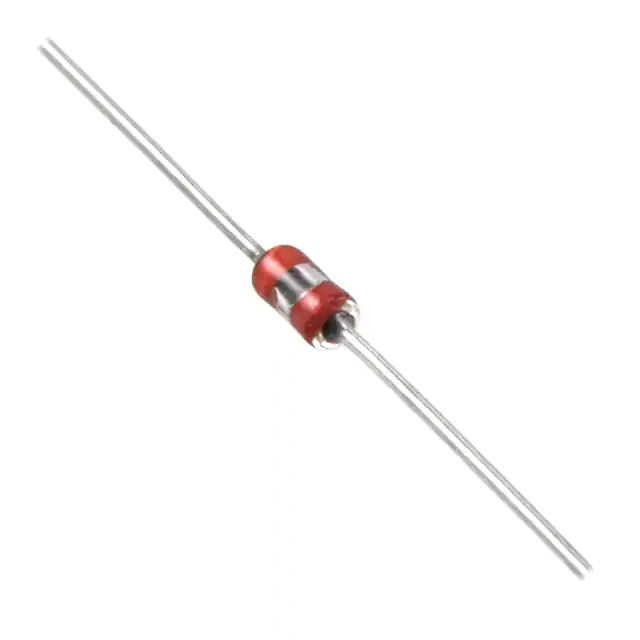
Honeywell 135-103FBD-J02 Temperature Sensor Overview
The Honeywell 135-103FBD-J02 temperature sensor is an NTC thermistor developed for accurate temperature sensing in compact electronic assemblies. Within the Honeywell 135 Series, this model stands out for its 10 kOhm nominal resistance and tighter ±2% resistance tolerance, which makes it especially relevant for applications where measurement consistency is important.
Understanding the Honeywell 135-103FBD-J02
The Honeywell 135-103FBD-J02 NTC thermistor is built in a DO-35 axial package and designed for through-hole mounting. This familiar construction supports dependable integration into control boards, monitoring modules, sensing circuits, and industrial control hardware. For designers who prefer proven discrete temperature sensing components, this Honeywell temperature sensor offers a practical balance between compact size and stable electrical behavior.
Main Technical Characteristics
This Honeywell 135-103FBD-J02 temperature sensor features 10 kOhm resistance at 25°C, ±2% resistance tolerance, through-hole mounting, and an operating temperature range from -60°C to 300°C. The wide thermal range helps it remain useful across diverse applications, from low-temperature monitoring to systems that encounter elevated heat during normal operation.
The relatively tight tolerance is one of the key reasons this part attracts attention. In temperature measurement circuits, tighter tolerance often supports more predictable calibration behavior, which is helpful in sensing, compensation, and reference designs.
Typical Application Areas
The Honeywell 135-103FBD-J02 thermistor can be relevant in industrial electronics, building automation, HVAC control, instrumentation, and thermal management circuits. It may also be used in designs where engineers want a discrete Honeywell temperature sensor instead of a larger packaged probe. Its axial geometry is easy to work with in traditional PCB layouts and maintenance-oriented electronic assemblies.
Another benefit is design familiarity. Many engineers still prefer axial NTC thermistors for analog sensing networks, voltage divider circuits, and over-temperature monitoring because these parts integrate cleanly into long-established board architectures.
For more information about Honeywell sensing products, reviewing the wider portfolio can help identify related components for similar temperature measurement requirements.
Frequently Asked Questions
What makes the Honeywell 135-103FBD-J02 different from other 10 kOhm thermistors?
A major difference is its ±2% resistance tolerance. In many designs, that tighter tolerance can support better consistency from one component to another, which is useful in applications where thermal accuracy and repeatability matter.
Is the Honeywell 135-103FBD-J02 a good fit for PCB-based systems?
Yes. It is a through-hole axial component, so it fits well into many conventional PCB designs, especially industrial and serviceable electronics where through-hole parts are still preferred.
Can this Honeywell temperature sensor handle extreme temperatures?
Yes. It is listed for operation from -60°C to 300°C, which is a wide range compared with many standard thermistors used in lighter-duty environments.
Why is a 10 kOhm NTC thermistor so common?
10 kOhm thermistors are widely used because they are easy to interface with analog circuits, microcontroller input stages, and resistor-divider networks. They are also well supported in existing design libraries and thermal calculation methods.
In which sectors might this part be used?
It can be considered in automation, HVAC, instrumentation, industrial controls, thermal monitoring, and other electronic systems that require reliable temperature feedback without using a large sensor assembly.