
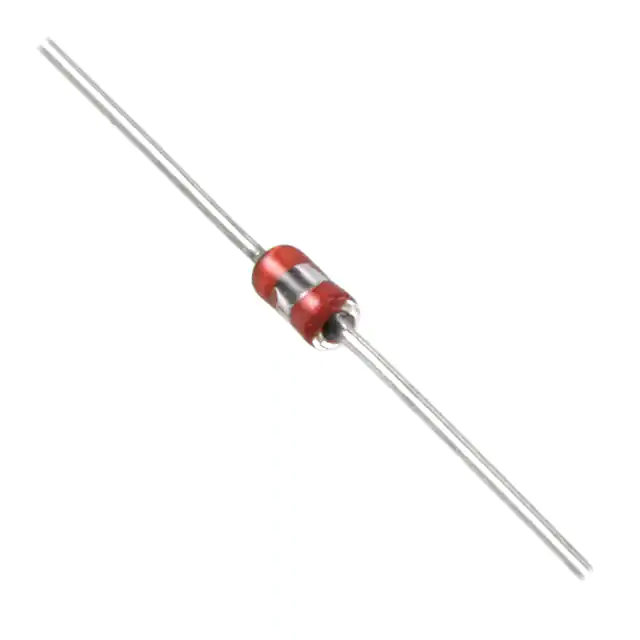
Honeywell 135-102DAG-J01 NTC Thermistor Technical Guide
The Honeywell 135-102DAG-J01 NTC thermistor is a discrete temperature sensing component from the Honeywell 135 Series. This product family is known for a glass encapsulated chip design in a DO-35 style package, making it a strong fit for compact assemblies that require dependable thermal response. Within the 135 Series, the 135-102DAG-J01 belongs to the nominal 1 kOhm class at 25°C, which makes it relevant for circuits designed around low-resistance NTC temperature sensing.
What Makes the Honeywell 135-102DAG-J01 Distinct
The Honeywell 135-102DAG-J01 is not just a generic temperature sensor. It is part of a rugged thermistor series engineered for broad thermal capability. Honeywell identifies the 135 Series as a glass encapsulated, hermetically sealed thermistor line with an operating range from -60°C to 300°C. That range immediately makes the series attractive for engineers who need a small sensor body with reliable performance in elevated temperature environments.
Technical Characteristics of the Honeywell 135-102DAG-J01
For the Honeywell 135-102DAG-J01, the nominal resistance is 1,000 ohms at 25°C. The 135 Series platform also brings several useful physical and thermal characteristics: a DO-35 type glass package, a maximum body diameter of about 2.0 mm, tinned copper-clad steel leads, a typical dissipation constant of 2.5 mW/°C in still air, and a typical time constant of 4 seconds in air. Those attributes matter because they influence response behavior, installation flexibility, and durability in compact electronics and industrial assemblies.
As an NTC thermistor, the Honeywell 135-102DAG-J01 decreases in resistance as temperature rises. That behavior allows designers to use it for temperature measurement, compensation, control, and protective monitoring. In practice, it may be incorporated into sensing circuits where thermal drift needs to be tracked accurately without adding unnecessary size or mechanical complexity.
Application Considerations
The Honeywell 135-102DAG-J01 NTC thermistor can be considered for industrial electronics, instrumentation, embedded controls, and thermal monitoring applications that benefit from a compact axial thermistor. The glass encapsulation is valuable where environmental durability and repeatable thermal characteristics are important. Engineers also appreciate this format because it supports straightforward integration into through-hole designs and custom assemblies.
Searches for terms such as Honeywell 135-102DAG-J01 thermistor, Honeywell 135-102DAG-J01 NTC thermistor, and Honeywell 1 kOhm temperature sensor often come from design teams trying to match a known resistance curve or preserve circuit behavior during a replacement cycle.
For more information about Honeywell, reviewing related thermistor families can help clarify fit, curve selection, and thermal integration strategy.
FAQ
What is the Honeywell 135-102DAG-J01?
The Honeywell 135-102DAG-J01 is an NTC thermistor from Honeywell’s 135 Series. It is a glass encapsulated chip thermistor designed for temperature sensing in compact electronic and industrial applications.
What is the nominal resistance of the Honeywell 135-102DAG-J01?
The nominal resistance is 1,000 ohms at 25°C, which places it in the 1 kOhm class commonly used in specific temperature measurement and compensation circuits.
What package style does the Honeywell 135-102DAG-J01 use?
It belongs to the 135 Series glass encapsulated DO-35 type format. That package supports compact installation and helps protect the sensing element in demanding environments.
Why is the 135-102DAG-J01 useful in temperature sensing?
Because it is an NTC thermistor, its resistance changes predictably with temperature. That makes it useful for sensing, compensation, control, and protective monitoring functions across many designs.
Is the 135-102DAG-J01 suitable for high temperature environments?
It is part of a series rated from -60°C to 300°C, so it is often researched for applications where standard low-temperature thermistors may not be sufficient. Final suitability should always be verified against the exact circuit and assembly conditions.