
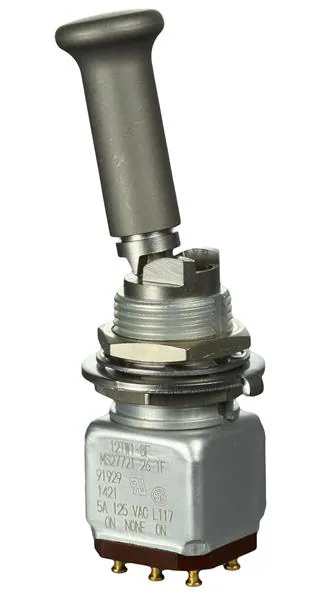
Honeywell 12TW1-8F Toggle Switch Details
The Honeywell 12TW1-8F toggle switch is a specialized TW Series component designed for panel applications that need compact DPDT switching with a locking lever. In control engineering terms, this type of switch becomes valuable when an operator should not move the actuator casually or accidentally. That makes the Honeywell 12TW1-8F toggle switch especially relevant in demanding interfaces where both space efficiency and deliberate actuation are part of the design requirement.
Key Technical Identity of the Honeywell 12TW1-8F Toggle Switch
The Honeywell 12TW1-8F toggle switch is commonly listed as a DPDT, two-position, solder terminal, panel-mount switch with a locking lever and 15/32 inch bushing format. This places it in the same rugged miniature family as other TW Series switches, but with a more controlled lever action than standard versions. For engineering teams, that distinction matters because actuator style can influence both user behavior and system safety logic.
As a Honeywell 12TW1-8F DPDT toggle switch, the part can manage two circuits together while maintaining a compact footprint. In practice, this supports functions such as paired control signals, direction selection, or linked switching steps in technical equipment.
Why a Locking Lever Can Be the Better Choice
There are many panels where a normal toggle switch is enough. There are also panels where a more intentional motion is the smarter option. The Honeywell 12TW1-8F locking lever toggle switch fits the second category. It is useful in mobile equipment, industrial controls, instrument consoles, and service platforms where unwanted actuation could interrupt a process or create an incorrect machine state.
The TW Series reputation also supports this positioning. The family is associated with military-grade miniature construction, availability for harsh environments, and dependable mechanical performance under vibration and temperature stress. That gives the Honeywell toggle switch 12TW1-8F relevance in both legacy replacement projects and new technical builds.
Selection Value for Technical Buyers
When a buyer searches for the Honeywell 12TW1-8F toggle switch, they are often trying to avoid interchange mistakes. A standard-lever version may fit the same panel opening, but it will not offer the same operational behavior. That is why locking lever variants like the 12TW1-8F continue to matter in documentation, maintenance records, and system upgrades.
For more information about Honeywell product families, it is useful to compare the 12TW1-8F against standard two-position TW switches when balancing operator convenience against accidental-actuation risk.
FAQ
What type of switch is the Honeywell 12TW1-8F?
The Honeywell 12TW1-8F is generally identified as a DPDT, two-position toggle switch with solder terminals and a locking lever. It belongs to the MICRO SWITCH TW Series and is intended for rugged panel applications.
Why would someone choose the Honeywell 12TW1-8F instead of the 12TW1-8?
The main reason is actuator control. The 12TW1-8F uses a locking lever, which helps reduce unintended switching. That makes it better suited to applications where accidental actuation could disrupt a process or operating sequence.
Is the Honeywell 12TW1-8F meant only for military equipment?
No. While the TW Series is associated with military-style qualification and rugged environments, the 12TW1-8F is also relevant for industrial machinery, transport systems, service equipment, and specialized control panels that need dependable miniature switching hardware.
What should be checked before using the Honeywell 12TW1-8F in a replacement job?
It is important to verify the exact switch action, DPDT configuration, locking lever behavior, mounting thread, and terminal style. A switch that looks similar externally may still behave differently in the circuit.
Is the Honeywell 12TW1-8F a good fit for compact panels?
Yes. One reason the TW Series is widely referenced is its miniature format. That makes the 12TW1-8F a practical option for control systems where behind-the-panel space is restricted but rugged mechanical performance is still required.