
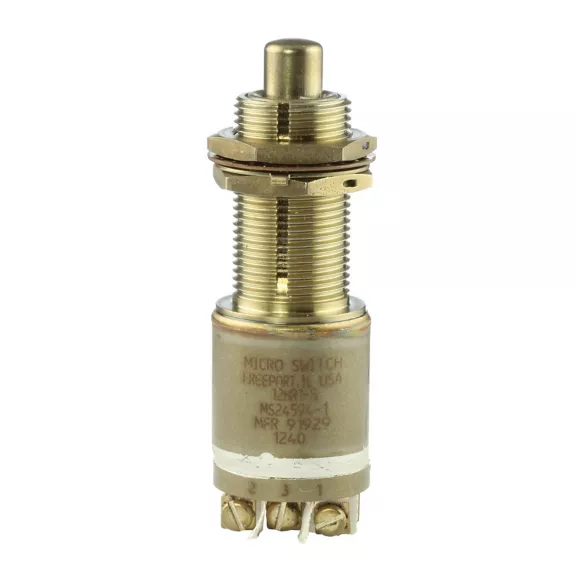
Honeywell 12HR61-10B Sealed Switch Specification Guide
The Honeywell 12HR61-10B sealed switch is a purpose-built electromechanical switch designed for controlled operation in environments where switch integrity and dependable performance are essential. As a Honeywell 12HR61-10B sealed switch, this model is most often reviewed by engineers, technical buyers, and maintenance teams who need a sealed plunger-type switch for specialized systems.
What Is the Honeywell 12HR61-10B Sealed Switch?
The Honeywell 12HR61-10B sealed switch is identified as a normally open SPST switch with a top plunger actuator. In practice, this means the switch remains open until a mechanical input actuates the plunger. This style is useful for control systems where switching should occur only when a component reaches a defined position or when a mechanical condition is intentionally triggered.
Technical Details Behind the Part
The Honeywell 12HR61-10B sealed switch is associated with a 5 A rating and 28 VDC operation. Technical references also show that it belongs to the enclosed or sealed switch category and uses a plunger-based mechanical design. Supporting documentation for the 12HR61-10B family also indicates corrosion-resistant exposed parts, sealed switch chamber construction, and wire lead style details in the product drawing. These points help explain why the part is evaluated for higher-demand applications rather than routine light-duty use.
Why Engineers Search for the Honeywell 12HR61-10B Sealed Switch
Searches for Honeywell 12HR61-10B sealed switch, Honeywell SPST sealed switch, top plunger limit switch, and sealed industrial switch often come from users trying to identify an exact technical fit. In many cases, the interest is not only about electrical rating, but also about sealed construction, actuator geometry, and compatibility with legacy or regulated equipment.
Application Perspective
The Honeywell 12HR61-10B sealed switch is relevant for installations where mechanical precision and environmental resilience matter. It can be discussed in relation to industrial machinery, transport systems, harsh-duty enclosures, and equipment that requires controlled linear actuation. Because this is a specification-driven product, proper selection depends on the total system context rather than a single data point alone.
For more information about Honeywell, visit more information about Honeywell.
FAQ
What contact arrangement does the Honeywell 12HR61-10B sealed switch use?
It uses a normally open SPST arrangement. This means the circuit is open in its resting state and closes only when the plunger is actuated.
Why is the top plunger design important on the Honeywell 12HR61-10B?
The top plunger supports direct linear actuation, which is useful in systems where a moving part or mechanical position must trigger the switching event with a clear and repeatable motion path.
Is the Honeywell 12HR61-10B intended for harsh operating conditions?
It is commonly evaluated for demanding conditions because the product family is built around sealed construction and corrosion-resistant exposed parts. Those attributes support use in more technically challenging environments.
What should be checked before using the Honeywell 12HR61-10B in a replacement project?
Users should confirm the contact logic, mounting requirements, actuation profile, voltage and current limits, lead or termination requirements, and the environmental conditions of the target application.
Why do documentation teams and engineers still rely on this type of sealed switch?
Because sealed electromechanical switches remain valuable in systems that need proven, understandable, and mechanically definite switching behavior. They are especially relevant in legacy platforms and controlled industrial equipment.