
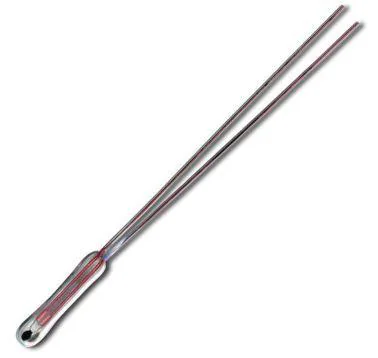
Honeywell 121-103FAD-S03 Temperature Sensor Overview
The Honeywell 121-103FAD-S03 temperature sensor is a glass probe NTC thermistor designed for accurate temperature monitoring across demanding environments. When engineers search for a reliable Honeywell 121-103FAD-S03 temperature sensor or a durable Honeywell 121-103FAD-S03 thermistor probe, they are usually looking for repeatable thermal response, stable long-term behavior, and a format that fits compact assemblies. This model belongs to Honeywell’s well-known 121 Series, which is recognized for rugged construction and consistent sensing performance.
Technical Characteristics of Honeywell 121-103FAD-S03
This Honeywell temperature sensor is built as an NTC thermistor with a nominal resistance of 10 kOhm at 25°C. It is configured as a cylindrical glass probe with free-hanging mounting and lead wires measuring approximately 50.8 mm. One of the main reasons professionals choose the Honeywell 121-103FAD-S03 temperature sensor is its tighter resistance tolerance, making it a practical option for applications where stable input values matter during calibration and temperature compensation. The wide operating range also makes it suitable for both low-temperature and high-temperature measurement tasks.
Where This Honeywell Thermistor Probe Fits Best
The Honeywell 121-103FAD-S03 NTC thermistor is often considered for industrial electronics, air sensing assemblies, laboratory thermal monitoring, and embedded control systems where compact glass probe construction is preferred. Because NTC sensing elements respond with decreasing resistance as temperature rises, this sensor type is commonly integrated into monitoring circuits, control boards, protective temperature feedback loops, and thermal management platforms.
Its glass-encapsulated structure supports dependable operation in environments where mechanical strength and sensing consistency are important. That makes the 121-103FAD-S03 temperature sensor relevant for designers who need a component that performs well beyond basic room-temperature applications.
Why Engineers Search for Honeywell 121-103FAD-S03 Temperature Sensor
High-interest searches around this part usually focus on terms such as 121-103FAD-S03 temperature sensor, Honeywell 121-103FAD-S03 NTC thermistor, and Honeywell 121-103FAD-S03 thermistor probe. These searches reflect a practical need: users want a component that is technically clear, physically compact, and suitable for dependable temperature measurement rather than a generic thermistor with limited documentation.
For more information about Honeywell, it is useful to review the broader product family and compare how this model fits different sensing requirements.
FAQ
What is the Honeywell 121-103FAD-S03 used for?
The Honeywell 121-103FAD-S03 is used for temperature sensing in electronic and industrial systems that require a compact NTC thermistor probe. It is commonly considered for thermal monitoring, compensation, and control functions where accurate resistance-based temperature feedback is needed.
Is the 121-103FAD-S03 a thermistor or an RTD?
This part is an NTC thermistor, not an RTD. That means its resistance decreases as temperature increases. This behavior makes it especially useful in responsive temperature sensing circuits and control designs.
What makes the 121-103FAD-S03 different from other 10 kOhm probes?
A key point is its glass probe construction and tighter tolerance profile compared with broader-tolerance variants. In many design contexts, that helps support more predictable measurement behavior and easier matching with circuit expectations.
Can the 121-103FAD-S03 work in high-temperature environments?
Yes. This Honeywell temperature sensor is designed for a wide operating temperature range, which makes it suitable for elevated-temperature environments where standard consumer-grade sensors may not be appropriate.
Why do engineers specifically search for the Honeywell 121-103FAD-S03 temperature sensor?
They usually need a clearly specified, rugged, glass-encapsulated temperature sensing component from a recognized manufacturer. Search interest is often tied to design validation, replacement sourcing, and application-specific thermal measurement requirements.