
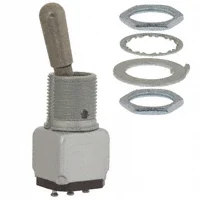
Honeywell 11TW1-7E Toggle Switch Technical Guide
What Is the Honeywell 11TW1-7E?
The Honeywell 11TW1-7E toggle switch is a compact control component designed for demanding panels, control assemblies, and rugged equipment interfaces. As part of the trusted TW Series, this model is widely associated with applications where environmental sealing, repeatable switching, and dependable mechanical feel are important. Engineers and maintenance teams often look for the Honeywell 11TW1-7E toggle switch when they need a locking lever design that helps reduce unintended actuation.
In practical terms, the Honeywell 11TW1-7E operator control toggle switch is known for combining a miniature format with a robust construction profile. That balance matters in aerospace-adjacent systems, industrial machinery, control boxes, and field equipment where panel space is limited but reliability standards remain high.
Technical Overview of Honeywell 11TW1-7E
The Honeywell 11TW1-7E toggle switch is commonly identified as a single-pole, three-position switch with solder terminal construction and a locking lever style. This makes it especially relevant where stable manual control is needed and where accidental movement of the lever could create an operational issue. In many specification references, this model is associated with a momentary-off-momentary switching profile, panel mounting, and an environment-sealed design approach.
Another reason the Honeywell 11TW1-7E locking lever toggle switch receives attention is its suitability for harsh operating conditions. Users regularly research this part for systems exposed to vibration, dust, mechanical shock, and temperature variation. That makes it a useful reference point not only for replacement searches, but also for engineering evaluations and control panel standardization.
Where the Honeywell 11TW1-7E Fits Best
The Honeywell 11TW1-7E toggle switch is not just about switching between positions. It is often selected because it supports disciplined manual input in environments where clarity and tactile confidence matter. In control cabinets, portable test systems, service vehicles, instrumentation panels, and specialized machinery, a locking lever format can help operators avoid unintended changes during routine use.
For teams reviewing component compatibility, it is also useful to compare mounting style, terminal type, circuit function, and lever behavior before replacement. That is especially true when a legacy assembly already depends on a specific panel cutout and wiring method.
Why This Model Stands Out
What makes the Honeywell 11TW1-7E toggle switch notable is its blend of compact dimensions, sealed construction philosophy, and control certainty. Many switch searches focus only on current rating or circuit type, but real-world performance often depends just as much on actuator design, environmental resistance, and long-term mechanical consistency.
For more information about Honeywell, it is worth reviewing broader TW Series references alongside individual product documentation.
FAQ
Is the Honeywell 11TW1-7E a locking lever switch?
Yes. One of the most recognized characteristics of the Honeywell 11TW1-7E toggle switch is its locking lever configuration. This feature is important in installations where accidental operation should be minimized.
What kind of applications use the Honeywell 11TW1-7E?
This model is commonly researched for aerospace-style panels, industrial control systems, rugged machinery, test equipment, and compact operator interfaces. It is particularly relevant where space is limited but dependable manual switching is still required.
Is the Honeywell 11TW1-7E suitable for harsh environments?
It is generally associated with the sealed, military-grade TW Series family, which is known for use in environments involving vibration, shock, dust, splashing, and temperature extremes. Final suitability should always be checked against the exact system requirements.
What should be checked before replacing a 11TW1-7E?
Before replacement, confirm the circuit function, number of positions, mounting format, lever style, sealing needs, and terminal style. Matching the part number exactly is usually the safest route in critical systems.
Why do engineers search specifically for 11TW1-7E instead of a generic toggle switch?
Because exact switch behavior matters. A generic alternative may look similar but still differ in lever action, sealing, mounting thread, operating feel, or switching logic. In technical environments, those differences can affect both safety and performance.