
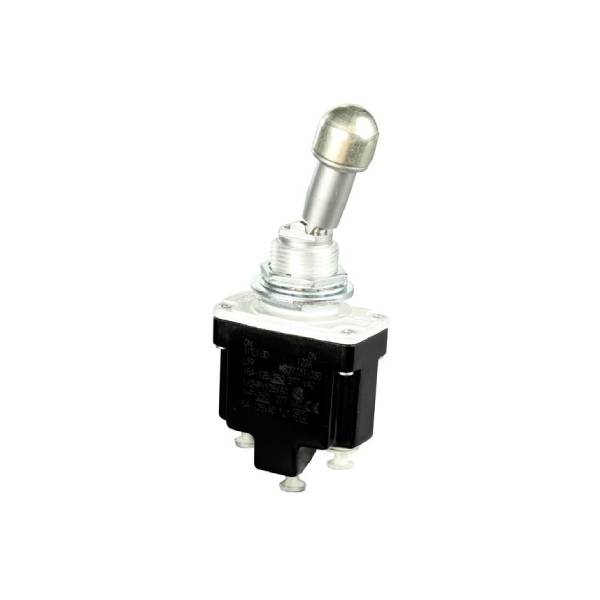
Honeywell 11TL1-3D Locking Toggle Switch: Technical Details and Use Cases
The Honeywell 11TL1-3D locking toggle switch is a specialized version of the TL Series designed for applications where accidental actuation must be reduced. In control panels, mobile machinery, aerospace support equipment, and rugged industrial systems, the Honeywell 11TL1-3D locking toggle switch gives operators the tactile confidence of a manual switch while adding an extra layer of actuation security.
What Is the Honeywell 11TL1-3D Locking Toggle Switch?
The Honeywell 11TL1-3D locking toggle switch is a single-pole, two-position SPDT toggle switch with solder turret terminals and a locking lever configuration. It is built on the Honeywell TL Series platform, which is known for sealed construction, military-grade design principles, and reliable performance in harsh conditions. For systems where switch movement should be deliberate rather than casual, the Honeywell 11TL1-3D locking toggle switch is a logical option.
Main Technical Features of the Honeywell 11TL1-3D Locking Toggle Switch
- Single-pole double-throw circuitry
- Two-position maintained ON-ON operation
- Locking lever actuator style
- Solder turret terminal construction
- Sealed design for challenging environments
- Panel mount installation format
- Wide operating temperature range
The defining advantage of the 11TL1-3D locking toggle switch is not just its electrical function. It is the combination of rugged sealing and a locking-style actuator that makes the part especially useful in mission-critical systems, safety-conscious interfaces, and high-vibration installations. In these environments, preventing unintended switching can be just as important as the switching action itself.
Where the 11TL1-3D Locking Toggle Switch Fits Best
The Honeywell 11TL1-3D locking toggle switch is well suited to operator stations, guarded functions, vehicle-mounted controls, aerospace ground systems, and industrial equipment that sees frequent movement or shock. It can also be a strong fit when designers want a manual override or selection switch that feels mechanically secure during use.
Many panel designers prefer a locking toggle switch for circuits tied to safety, power routing, mode selection, or configuration changes. That is where the Honeywell 11TL1-3D locking toggle switch offers practical value without adding unnecessary complexity.
Why This Toggle Switch Is Different
Standard toggle switches can be enough for light-duty controls, but the Honeywell 11TL1-3D locking toggle switch is built for more demanding expectations. The sealed TL Series platform already supports harsh-environment reliability. The locking lever format adds another functional benefit for installations where switch integrity matters over the long term.
For more information about Honeywell, exploring related switch families can help compare locking, standard, and momentary configurations.
FAQ About the 11TL1-3D Locking Toggle Switch
What makes the Honeywell 11TL1-3D locking toggle switch different from the 11TL1-3?
The main difference is the actuator style. The Honeywell 11TL1-3D locking toggle switch uses a locking lever design, while the standard 11TL1-3 is the regular lever version.
Is the 11TL1-3D locking toggle switch still an SPDT switch?
Yes. It retains the single-pole double-throw changeover function associated with the comparable non-locking version, while adding a locking actuator configuration.
Is the 11TL1-3D locking toggle switch good for harsh environments?
Yes. It is part of Honeywell’s sealed TL Series and is designed for demanding environments where shock, vibration, dust, and moisture exposure may be present.
Why would an engineer choose a locking toggle switch?
A locking toggle switch is useful when a control should not be changed accidentally. It can help improve operator confidence and reduce unintended switching in critical systems.
Can the Honeywell 11TL1-3D locking toggle switch be used in industrial panels?
Yes. It is a strong option for industrial control panels, transportation equipment, aerospace support systems, and any application where rugged manual control and switch security are both important.