
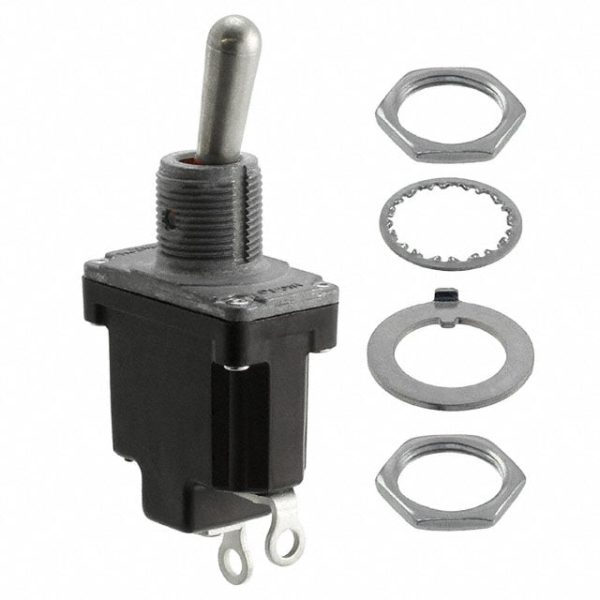
Honeywell 11NT1-2 Toggle Switch Overview
The Honeywell 11NT1-2 toggle switch is part of Honeywell’s NT Series, a commercial-grade toggle switch family developed for reliable manual control in demanding panel applications. Toggle switches remain widely used because they offer a direct, familiar, and dependable way to control power, functions, or operating states in equipment. In the case of the Honeywell 11NT1-2 toggle switch, that practical control logic is combined with sealing and durable construction, making it suitable for installations that need more than a basic panel switch.
What the Honeywell 11NT1-2 Toggle Switch Is
The Honeywell 11NT1-2 toggle switch is commonly listed as an SPST panel-mount toggle switch with an On-Off switching function. It is associated with a standard round actuator, solder lug termination, and a sealed housing concept designed for panel applications exposed to washdown, splashes, dust, or outdoor conditions. This gives the Honeywell 11NT1-2 toggle switch a practical role in operator control panels, commercial vehicles, industrial equipment, agricultural machinery, and systems where a clear maintained manual switch position is important.
Technical Characteristics of the Honeywell 11NT1-2 Toggle Switch
Current part data commonly identifies the Honeywell 11NT1-2 toggle switch with a 15 A AC rating at 125 V. Distributor references also show panel mounting, a 12.40 mm circular panel cutout, 15/32-32 bushing thread, and IP67/IP68 ingress protection. In addition, Honeywell’s NT Series product literature describes the family as having seals between the toggle lever and bushing, and between the case and cover. These construction details matter because they help maintain performance where conventional panel switches may be exposed to moisture, dirt, or routine cleaning conditions.
Why the Honeywell 11NT1-2 Toggle Switch Is Widely Useful
Because it is an SPST maintained On-Off switch, the Honeywell 11NT1-2 toggle switch is a strong fit for straightforward operator-controlled functions. Typical uses include machine enable and disable control, accessory power switching, lighting circuits, auxiliary equipment control, and simple system activation. The benefit of this design is not complexity. It is clarity. Operators know the switch position instantly, and maintenance teams can verify switch state without additional interface layers.
Built for Real Panel Conditions
Panel hardware often works in less-than-perfect environments. Equipment may face vibration, humidity, condensation, washdown routines, or outdoor exposure. That is where the Honeywell 11NT1-2 toggle switch stands apart from lighter-duty panel controls. The NT Series design is intended to support dependable service life while also preserving a clean, professional panel appearance.
For more information about Honeywell, it is useful to compare other NT Series configurations when a different circuit function or actuator style is required.
FAQ
What type of switch is the Honeywell 11NT1-2?
The Honeywell 11NT1-2 is a sealed panel-mount toggle switch in the NT Series. It is commonly listed as an SPST maintained On-Off switch with solder lug terminals.
What does SPST mean in the Honeywell 11NT1-2 toggle switch?
SPST stands for single-pole, single-throw. In practical use, it controls one circuit with a simple On-Off action, making it ideal for straightforward operator switching tasks.
Is the 11NT1-2 suitable for harsh environments?
Yes. The NT Series is known for sealed construction, and current product references commonly show IP67/IP68 protection. That makes the switch suitable for demanding panel environments where moisture and dust resistance are important.
Where is the 11NT1-2 toggle switch commonly used?
It is often used in industrial control panels, transportation systems, agricultural machinery, utility equipment, and outdoor installations where a rugged maintained toggle switch is preferred.
What should engineers verify before using the Honeywell 11NT1-2?
They should confirm the current and voltage load, required switch function, terminal style, panel cutout size, sealing needs, and operating environment. Those details ensure the selected toggle switch fits both mechanically and electrically.