
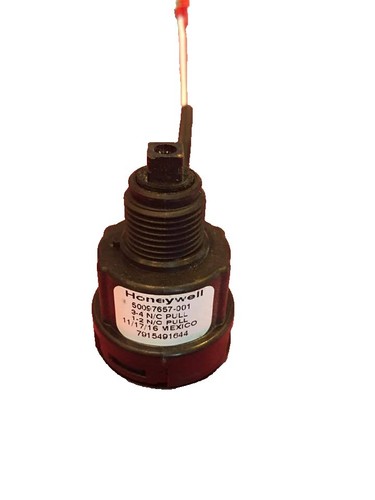
Honeywell 11CX12E Hazardous Location Switch Technical Guide
The Honeywell 11CX12E hazardous location switch is part of the MICRO SWITCH CX Series, a specialized line developed for severe-duty industrial environments. Public product listings identify the Honeywell 11CX12E as a hazardous location switch with dual SPDT basic switches, a 15 A rating, and environmental performance associated with IP66 sealing. This specification profile makes the component highly relevant for installations where a conventional limit switch may not deliver the required combination of durability, enclosure integrity, and switching reliability.
What Makes Honeywell 11CX12E Distinct
The Honeywell 11CX12E hazardous location limit switch stands out because public data associates it with (2) SPDT switching outputs in a chassis-mounted configuration. That is important in applications where redundancy, multiple signal paths, or more complex control logic is required. Rather than acting as a basic one-circuit switch, the 11CX12E can support more sophisticated industrial sensing and control strategies while still operating within a rugged enclosure designed for difficult environments.
Technical Characteristics of the 11CX12E
Available product information describes the Honeywell 11CX12E as a maintained side rotary hazardous location switch with (2) 3/4 in – 14 NPT conduit terminations, NEMA 1, 3, 4, 4X, 6, 6P, 13 and IP66 seal ratings, plus an operating temperature range of approximately -25 °C to 85 °C. Listings also reference suitability for NEMA 7 Class I, Div. 1 and 2, Groups C and D and NEMA 9 Class II classifications. These are not minor details. They define how the switch can be deployed in hazardous industrial environments where sealing, ingress protection, and approval scope are essential selection criteria.
Application Value in Real Industrial Systems
The Honeywell 11CX12E hazardous location switch can be relevant in petrochemical processing, outdoor machinery, bulk material systems, valves, conveyors, and equipment exposed to moisture, dust, and ignition-risk atmospheres. Search phrases like hazardous area limit switch, explosion-proof rotary limit switch, dual SPDT industrial switch, and 11CX12E reflect exactly the type of use case this model addresses.
Why Correct Specification Matching Matters
When replacing a part such as the Honeywell 11CX12E hazardous location limit switch, engineers must confirm enclosure style, actuation method, contact arrangement, conduit entry, and hazardous-location approval details. In regulated environments, an approximate replacement can create maintenance risk, inspection issues, or control-system inconsistency.
FAQ
What type of switch is Honeywell 11CX12E?
It is a Honeywell hazardous location limit switch from the CX Series, designed for severe-duty industrial environments.
Does Honeywell 11CX12E use SPDT contacts?
Yes. Public product listings identify it as using two SPDT basic switches, which supports more complex control logic than a single-output design.
What environmental protection is associated with Honeywell 11CX12E?
Available technical listings connect it with IP66 protection and multiple NEMA enclosure ratings, reflecting strong resistance to dust and water ingress.
What is the operating temperature range of Honeywell 11CX12E?
Published data associates the switch with an operating range of about -25 °C to 85 °C, which suits many industrial outdoor and process environments.
Why is 11CX12E useful in hazardous areas?
Because it combines rugged enclosure design, hazardous-location suitability, and dual switching capability in one industrial-grade assembly.
What should be confirmed before replacing Honeywell 11CX12E?
Check the actuation style, conduit entry, approval requirements, switching arrangement, and original installation details before selecting a replacement.
For more information about Honeywell, related CX Series products, and broader industrial sensing solutions, this page may help.