
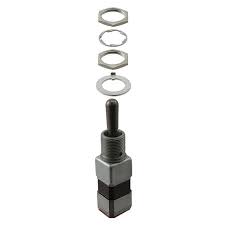
Honeywell 112TW1-70E Locking Lever Toggle Switch Guide
The Honeywell 112TW1-70E toggle switch is a highly specific TW Series operator control component for environments where both switching precision and mechanical lock behavior matter. This model combines a DPDT circuit, a Mom-On-Mom switch function, and a locking lever actuator. The E suffix indicates a locking configuration in which the lever is locked in the center position, making the switch especially relevant for applications where movement out of center should require intentional operator action.
Technical Specifications of the Honeywell 112TW1-70E Toggle Switch
The Honeywell 112TW1-70E locking lever toggle switch is a panel mount DPDT switch rated for 5 A, with voltage ratings up to 125 V AC and 28 V DC. It uses a locking lever actuator rather than the shorter standard round lever, and the actuator length is approximately 29.46 mm. The mounting system uses a 12.40 mm circular panel cutout and a 15/32-32 threaded bushing, consistent with the TW Series dimensional framework.
This model is also specified as environment sealed, an important consideration for industrial panels, field equipment, aerospace-adjacent systems, and mobile machinery. The operating temperature range of -65°C to 71°C strengthens its suitability in projects where ambient conditions can move well beyond ordinary indoor electronics use.
Why the Locking Lever Makes a Difference
The defining feature of the Honeywell 112TW1-70E toggle switch is not only its circuitry but also its operator behavior. A locking center position adds a deliberate action step to switching. In practical use, that reduces accidental state changes and supports more controlled user interaction. In technical environments, this can be valuable for command stability, process integrity, and operator confidence.
Because the switch uses a Mom-On-Mom electrical function, both outer positions are momentary while the center remains the stable ON state. Pairing that logic with a locking center lever creates a combination that is particularly useful in advanced control interfaces rather than general-purpose consumer switching.
Use Cases for the Honeywell 112TW1-70E Toggle Switch
The Honeywell 112TW1-70E DPDT locking lever toggle switch is often evaluated for industrial equipment, defense-oriented platforms, aviation support systems, instrumentation, agricultural machinery, and process control consoles. Search intent around this model often centers on terms such as locking toggle switch, Honeywell 112TW1-70E toggle switch, sealed DPDT toggle switch, and panel mount locking lever switch.
For more information about Honeywell, reviewing the broader TW Series and related operator control solutions can help clarify product family fit and specification strategy.
FAQ: Honeywell 112TW1-70E Toggle Switch
What type of switch is the Honeywell 112TW1-70E?
The Honeywell 112TW1-70E is a DPDT panel mount locking lever toggle switch from the TW Series. It combines a sealed design, a three-position switching layout, and a locking center mechanism.
What does the E suffix mean on the Honeywell 112TW1-70E?
The E suffix refers to a locking configuration in which the switch is locked in the center position. This helps ensure that movement away from center is deliberate rather than accidental.
Why is the Honeywell 112TW1-70E useful in industrial controls?
It is useful because it offers both electrical precision and mechanical control discipline. The locking center can support safer and more intentional operator input, while the sealed construction supports challenging installation environments.
Is the Honeywell 112TW1-70E different from the Honeywell 112TW1-70?
Yes. Both are based on the same special circuitry family, but the Honeywell 112TW1-70E toggle switch adds a locking lever arrangement and a longer actuator format, which changes how the operator interacts with the switch.
What should engineers check before specifying this model?
They should verify the switch function, the need for locking behavior, actuator clearance, panel dimensions, electrical ratings, and the surrounding environmental conditions. In many applications, the difference between a standard lever and a locking lever is operationally significant, not cosmetic.