
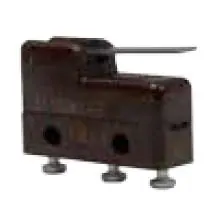
Honeywell 111SM115-H58 Basic Switches: Reliable Snap-Action Performance in a Compact Format
The Honeywell 111SM115-H58 Basic Switches model is a specialized SM Series subminiature basic switch designed for dependable switching in compact assemblies. This version is commonly described as an SPDT snap-action switch with a straight lever actuator, a 5 A electrical rating at 250 Vac, and quick connect termination. That specification mix gives the Honeywell 111SM115-H58 basic switches product clear relevance in industrial equipment, precision mechanisms, and service-friendly panel or chassis assemblies.
What Distinguishes Honeywell 111SM115-H58 Basic Switches?
In the SM Series family, model variations often come down to actuator geometry and terminal format. Those details matter more than many buyers first expect. The Honeywell 111SM115-H58 basic switches version stands out because it combines a compact subminiature body with a lever actuator and quick-connect style installation. In applications where assembly speed, field replacement, or consistent wiring practices are important, that combination can simplify maintenance planning.
Searches for terms such as Honeywell micro switch, SPDT snap action switch, quick connect basic switch, and industrial lever switch often point toward products in exactly this category.
Technical Characteristics That Matter in Real Use
The Honeywell 111SM115-H58 basic switches switch is associated with SPDT circuitry, 5 A AC/DC current class, 250 V AC, and a straight lever actuator. Distributor and product-family data also connect the SM platform to -55 °C to 125 °C operation, 10,000,000 mechanical cycles, and a compact design intended for simple or precision on/off applications. The H58 suffix is tied to a quick connect termination style, which is useful where clean, repeatable wiring is a priority.
Common Applications
The Honeywell 111SM115-H58 basic switches configuration fits machinery interlocks, door and position sensing, compact actuator systems, small appliance mechanisms, control modules, and equipment where repeated switching happens under limited installation space. Engineers often value this style because it offers a strong balance between footprint, tactile consistency, and electrical capacity.
For replacement and maintenance teams, the quick-connect structure can also make service workflows more efficient. That is especially useful when downtime matters and a switch change must be handled quickly without complex rewiring.
Engineering Perspective
When selecting a switch like the Honeywell 111SM115-H58 basic switches model, the best approach is to treat the switch as a motion-control interface, not just an electrical part. Lever reach, actuation force, mounting pattern, and wire management all shape long-term performance. A well-matched switch improves repeatability, while a poorly matched one can cause early wear, mis-triggering, or field service headaches.
For more information about Honeywell, reviewing related SM Series configurations can help clarify whether H58 termination is the most appropriate fit.
FAQ
What is the Honeywell 111SM115-H58 Basic Switches model designed for?
It is designed for compact snap-action switching tasks in industrial and electromechanical systems where repeatability and reliable actuation are important.
What does the H58 designation mean on Honeywell 111SM115-H58 Basic Switches?
It is associated with a quick connect terminal style, which can simplify assembly and replacement in applications that benefit from organized wiring.
Is Honeywell 111SM115-H58 Basic Switches a good fit for repetitive operation?
Yes. The SM Series is known for long mechanical life and precision switching behavior, making it suitable for applications with frequent actuation cycles.
Why is a straight lever useful on Honeywell 111SM115-H58 Basic Switches?
A straight lever can help designers align the switch with predictable mechanical motion paths, which is often useful in cams, doors, linkages, and moving assemblies.
What should engineers confirm before using Honeywell 111SM115-H58 Basic Switches?
They should verify the lever travel, load conditions, connector compatibility, mounting arrangement, and environment to ensure proper performance in the final assembly.