
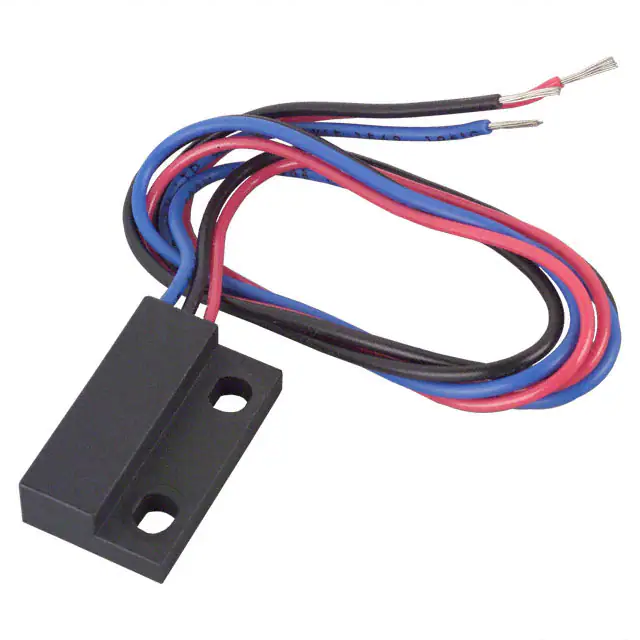
Honeywell 103SR17A-1 Hall-Effect Position Sensor
The Honeywell 103SR17A-1 hall-effect position sensor is built for applications where reliable non-contact sensing is more important than mechanical wear points. As part of the Honeywell 103SR Series, this model uses a latching hall-effect design, making it well suited for systems that need a stable switched output in the presence of alternating magnetic fields. That makes it a practical choice for motion detection, rotary systems, speed feedback, and position monitoring in demanding industrial environments.
What Makes the Honeywell 103SR17A-1 Different?
One of the key strengths of the Honeywell 103SR17A-1 magnetic position sensor is its sealed threaded housing. In real installations, that matters because dust, splashing liquids, vibration, and repeated movement can quickly reduce the life of exposed sensing components. This model is designed to avoid the contact wear and bounce associated with electromechanical switches, while still giving engineers a dependable digital signal.
The sensor operates on a 4.5 Vdc to 24 Vdc supply and uses a digital open-collector sinking output. Its latching magnetic behavior is especially useful when the application involves alternating north and south magnetic poles, such as ring magnets or rotating assemblies. In those cases, the sensor does not simply react moment to moment; it changes state in a controlled way that supports consistent monitoring logic.
Typical Use Cases
The Honeywell 103SR17A-1 hall-effect position sensor is commonly relevant for industrial automation, transportation equipment, motor feedback systems, tachometer-style sensing, and motion control tasks. It also fits designs where long service life is a priority, because there are no mechanical contacts to erode over time.
From a design standpoint, engineers often choose this Honeywell 103SR17A-1 hall-effect sensor when they want a rugged digital magnetic sensor that can be mounted in a threaded bracket and adjusted with precision. That threaded format helps simplify alignment during commissioning and maintenance.
Why This Sensor Matters in Modern Designs
Many legacy systems still rely on physical switch contact. The drawback is predictable: wear, contamination risk, and inconsistent switching after long use. The Honeywell 103SR17A-1 position sensor addresses those issues through solid-state sensing. For OEMs and maintenance teams, that usually means more stable performance, fewer false triggers, and better reliability over time.
For more information about Honeywell, it helps to review compatible sensing families and mounting options before final component selection.
FAQ
What type of sensor is the Honeywell 103SR17A-1?
It is a latching hall-effect position sensor with a digital output. It is intended for non-contact magnetic sensing in industrial and mobile equipment.
When is a latching sensor useful?
A latching sensor is useful when the system uses alternating north and south poles, especially in rotating assemblies. It helps maintain a defined switching behavior rather than acting like a simple presence detector.
Is the Honeywell 103SR17A-1 suitable for harsh environments?
Yes. Its sealed threaded housing is designed for applications where dust, moisture exposure, vibration, and physical stress are part of normal operation.
What is the benefit of a non-contact sensor here?
Non-contact sensing reduces wear, eliminates contact bounce, and supports longer service life compared with many mechanical switch alternatives.
Can the Honeywell 103SR17A-1 be used for speed or position sensing?
Yes. It is often used in position monitoring, rotational sensing, motion tracking, and related control systems where repeatable magnetic detection is required.