
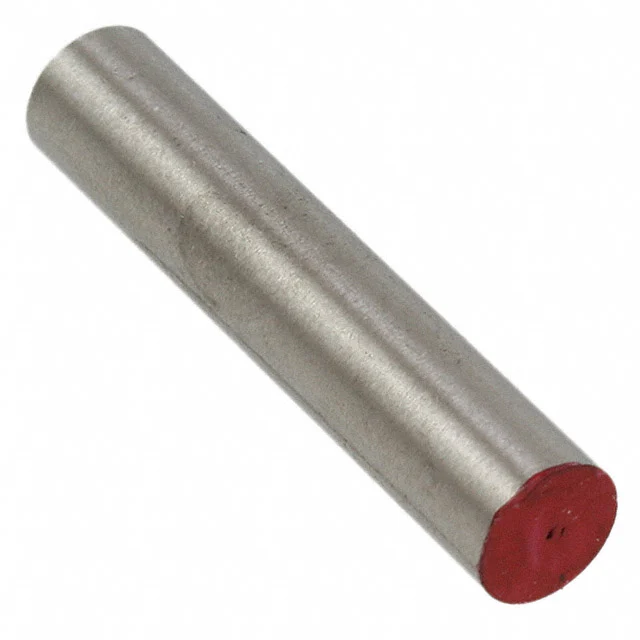
Honeywell 101MG3 HCS Magnetics Cylindrical Magnet Overview
The Honeywell 101MG3 HCS Magnetics cylindrical magnet is one of those parts that looks simple on paper but carries a major role in real sensing performance. In magnetic detection systems, the magnet determines how reliably a Hall-effect or magnetoresistive sensor sees movement, position, or state change. That makes the magnet a design variable, not an afterthought. The Honeywell 101MG3 cylindrical magnet is especially relevant for engineers who need strong magnetic output, a classic cylindrical form factor, and performance that remains stable in high-temperature environments.
Within Honeywell’s MG Series, the Honeywell 101MG3 HCS Magnetics part is listed as an Alnico V cast cylindrical magnet. Its dimensions are approximately 31.75 mm in length and 6.35 mm in diameter, with the north pole identified in red. That longer body immediately distinguishes it from compact actuator magnets used only in miniature assemblies. This is the kind of magnet that becomes attractive when a project needs greater field reach, a robust mechanical presence, or a straightforward cylindrical package for brackets and holders. For broader brand information, more information about Honeywell is available here.
Technical Characteristics of Honeywell 101MG3 HCS Magnetics
The published magnetic data gives a clear idea of where the Honeywell 101MG3 HCS Magnetics cylindrical magnet fits in the portfolio. Typical gauss levels are around 1460 G at 0.25 mm, 1320 G at 0.76 mm, 1170 G at 1.27 mm, 810 G at 2.54 mm, 575 G at 3.81 mm, and 420 G at 5.08 mm. Those values are significantly stronger than smaller compact magnets in the range, which is why the part is frequently evaluated in designs where sensing distance or field margin matters.
The model is also notable for its thermal profile. Honeywell lists the operating stability range at approximately -40°C to 300°C. For many industrial and engineered systems, that is a serious specification. It supports deployment in environments where heat exposure can be far above everyday commercial conditions, including machinery housings, high-load equipment, and specialized controls.
Why Engineers Search for Honeywell 101MG3 HCS Magnetics
Search demand around terms like Honeywell 101MG3 HCS Magnetics cylindrical magnet, Alnico V magnet for Hall effect sensor, industrial sensing magnet, and high temperature cylindrical actuator magnet reflects a practical industry need. Designers often need a magnet that delivers more than basic actuation. They want field strength that supports reliable triggering even when tolerances, vibration, or gap changes are part of the real assembly.
The longer cylindrical shape of the Honeywell 101MG3 HCS Magnetics part can be especially useful in fixtures where the magnet must sit inside a tube, sleeve, or drilled carrier. It also suits designs where directional alignment needs to be visually obvious and easy to repeat in production.
Use Cases in Industrial and Embedded Systems
This magnet can support a wide range of sensing tasks. In industrial enclosures, it may be used for door or guard state detection. In equipment monitoring, it can assist with travel limit sensing or home-position confirmation. In machine control layouts, it can work alongside sensor ICs to provide pulse generation or position awareness. In custom OEM builds, the part may also appear in prototypes where engineers need a stronger magnet before deciding whether to scale down or optimize package size later.
The key benefit is not only magnetic strength. It is the combination of strength, cylindrical geometry, and high operating temperature capability. That combination makes the Honeywell 101MG3 HCS Magnetics cylindrical magnet a sensible candidate for more demanding applications where low-cost commodity magnets may create inconsistent performance.
Design Considerations Before Final Selection
Even though the Honeywell 101MG3 HCS Magnetics part offers strong typical field values, magnet choice should still be validated at the full system level. Sensor threshold, target air gap, direction of movement, magnetic orientation, and nearby ferrous materials all affect real switching behavior. In some assemblies, the magnet may appear stronger or weaker than expected because the surrounding metal changes the magnetic path.
Another detail worth noting is that Honeywell describes the physical strength and shock resistance characteristics in its broader selection guide. That helps engineers choose between compactness, durability, and magnetic output rather than simply defaulting to the strongest field value on a chart.
FAQ About Honeywell 101MG3 HCS Magnetics
What is the Honeywell 101MG3 HCS Magnetics part used for?
The Honeywell 101MG3 HCS Magnetics part is used as a magnetic actuator for Hall-effect and magnetoresistive sensors. It helps create position, motion, or state detection in industrial, embedded, and equipment-control applications.
What material is used in Honeywell 101MG3?
This model is an Alnico V cast cylindrical magnet. That material choice supports strong magnetic output and excellent thermal stability compared with many general-purpose small magnets.
How large is the Honeywell 101MG3 cylindrical magnet?
The part measures approximately 31.75 mm in length and 6.35 mm in diameter. That makes it much longer than compact button-style or miniature actuator magnets and gives it a distinct place in magnetic sensing designs.
Is Honeywell 101MG3 suitable for high-temperature applications?
Yes. Honeywell lists a typical operating stability range from -40°C to 300°C, which makes the part appealing for hot industrial environments and equipment with elevated internal temperatures.
Why would an engineer select Honeywell 101MG3 over a smaller magnet?
The most common reasons are stronger field output, easier cylindrical mounting, and added design margin at longer sensing gaps. In applications where reliability is more important than the smallest possible package, the Honeywell 101MG3 HCS Magnetics cylindrical magnet can be a very logical option.