
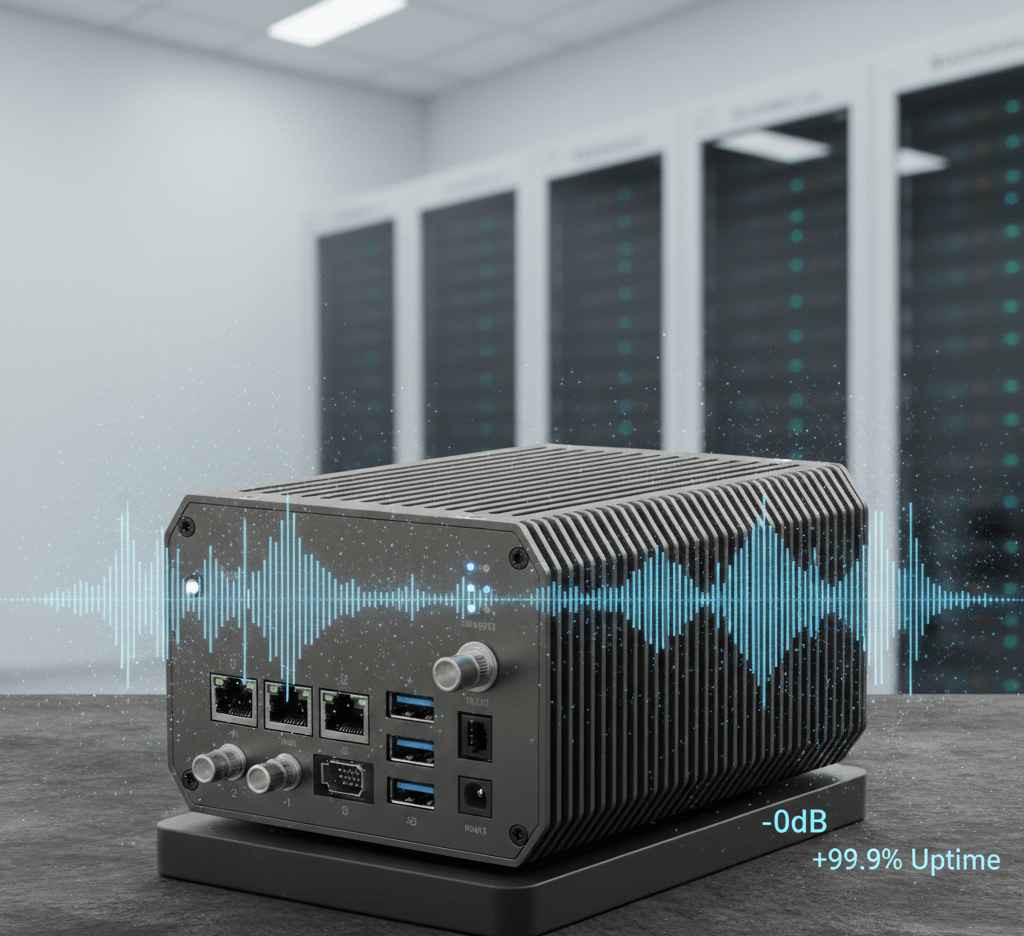
Fanless Box IPC: Silent and Reliable Industrial Computing
Traditional computers rely on mechanical fans forcing air through heat sinks to dissipate thermal energy generated by processors, memory, and power supplies. While effective in clean office environments, fan-based cooling proves problematic in industrial settings where airborne contaminants accumulate on cooling fins, reduce thermal efficiency, and ultimately destroy fan bearings. Advantech fanless box industrial PCs eliminate this vulnerability through passive thermal designs that conduct heat to external chassis surfaces, providing silent operation, extended reliability, and maintenance-free service in the harshest industrial environments.
Fanless thermal management represents sophisticated mechanical engineering balancing processor performance against heat dissipation constraints. High-conductivity aluminum alloy chassis function as large heat sinks with ribbed external surfaces maximizing surface area for convective cooling. Internal heat pipes efficiently transfer thermal energy from processors and chipsets to chassis walls. Thermal interface materials ensure intimate contact between heat-generating components and chassis heat spreaders, minimizing thermal resistance. This integrated thermal architecture enables sustained processor operation at rated speeds without throttling, even in ambient temperatures reaching 50-60°C common in outdoor equipment enclosures or factory environments.
Operational Advantages in Contaminated Environments
Manufacturing facilities generate various airborne particles depending on processes – metal machining produces fine metal dust and cutting fluid mist, food processing creates organic matter and flour dust, pharmaceutical production demands cleanroom-grade air quality, and outdoor installations face pollen, insects, and precipitation. Fan-cooled computers draw these contaminants directly into enclosures where they accumulate on circuit boards, short electrical connections, corrode components, and block cooling paths. Initial contamination appears harmless, but months of accumulation transforms computers into unreliable systems requiring frequent maintenance or replacement.
Fanless industrial PCs avoid contamination ingress entirely through sealed enclosures with no ventilation openings. The chassis itself dissipates all thermal energy without requiring air circulation through internal components. This protection proves especially valuable in corrosive environments where chemical vapors, salt spray, or hydrogen sulfide attack exposed electronics. Conformal coating on circuit boards provides additional protection when combined with fanless operation, creating truly maintenance-free industrial computers operating 24/7/365 without cleaning, filter replacement, or component degradation from environmental exposure.
Silent Operation for Noise-Sensitive Applications
Industrial environments don’t always involve heavy machinery and loud processes. Healthcare facilities, laboratories, recording studios, libraries, and office spaces demand quiet computing solutions. Even in factories, equipment operators appreciate reduced noise levels improving communication and reducing fatigue during long shifts. Fanless industrial PCs produce zero acoustic emissions – no fan whine, bearing noise, or air turbulence. The only sounds come from optional mechanical hard drives (if equipped) or external peripherals.
Noise reduction benefits extend beyond operator comfort to technical applications. Sensitive measurement equipment can detect electromagnetic interference and vibration from nearby cooling fans. Audio recording, vibration analysis, and precision metrology applications all benefit from eliminating mechanical noise sources. Medical imaging equipment, automated optical inspection systems, and scientific instruments often specify maximum acoustic emissions – fanless computers easily meet these requirements where fan-cooled systems would require sound-damping enclosures adding cost and size.
Extended MTBF and Reliability
Cooling fans represent the highest-failure-rate component in traditional computers. Fan bearings wear from continuous rotation, accumulating millions of revolutions annually. Ball bearing fans typically last 30,000-50,000 hours under ideal conditions, but industrial environments with vibration, temperature extremes, and contamination dramatically reduce bearing lifespan. When fans fail, computers quickly overheat, triggering thermal shutdowns or component damage. The resulting downtime costs far exceed fan replacement expenses, especially when failures occur during production runs or critical operations.
Eliminating fans removes this failure mode entirely. Fanless industrial PCs achieve Mean Time Between Failures (MTBF) exceeding 100,000 hours (11+ years) based on component reliability calculations. Solid-state storage (SSD/flash) eliminates the other major mechanical component – hard disk drives – creating completely solid-state systems with no moving parts susceptible to wear, vibration damage, or mechanical failure. This reliability transformation reduces maintenance costs, increases uptime, and enables deployment in remote or inaccessible locations where service visits prove expensive or impractical.
Thermal Performance Optimization
Fanless operation doesn’t mean accepting lower processing performance. Modern fanless industrial PCs utilize the latest Intel Core i3/i5/i7 processors delivering desktop-class computing power. Thermal design power (TDP) ratings typically range from 6W for ultra-low-power Atom processors to 35W for performance-oriented Core processors. Chassis dimensions scale with TDP requirements – compact models measuring 170 x 105 x 45mm suit low-power applications, while larger chassis reaching 260 x 210 x 60mm accommodate high-performance processors through increased surface area.
Intelligent thermal management software monitors processor temperatures, adjusting clock speeds dynamically to maintain safe operating ranges. Unlike fan-cooled systems that maintain constant processor speeds until overheating triggers emergency shutdowns, fanless systems gracefully reduce performance during sustained high loads, preventing thermal emergencies while maintaining operation. For most industrial applications involving cyclical processing loads rather than sustained maximum utilization, thermal throttling rarely activates. Applications requiring guaranteed sustained performance can select lower TDP processors or larger chassis ensuring adequate passive cooling capacity.
Mounting Flexibility and Installation Options
Fanless box PCs accommodate diverse installation requirements through multiple mounting configurations. VESA mounts (75x75mm, 100x100mm) enable attachment to monitor backs, creating integrated all-in-one workstations without separate computer enclosures. Wall mounting via bracket kits suits space-constrained installations where floor or desk space is unavailable. Desktop operation with optional stands provides traditional computer placement for development, testing, or office environments. Some models include DIN-rail clips for control cabinet installation alongside automation equipment.
Mounting orientation flexibility allows installation in any position – horizontal, vertical, or inverted – without affecting thermal performance or reliability. This orientation independence simplifies installation in tight spaces where equipment orientation is dictated by available room rather than manufacturer restrictions. Vibration-resistant mounting hardware secures computers to machinery, vehicles, or equipment experiencing continuous vibration that would damage conventional computers with loosened internal connections or component damage.
I/O Connectivity and Expansion Capabilities
Despite compact dimensions, fanless box PCs provide comprehensive connectivity matching full-size computers. Standard interfaces include multiple USB 3.0/3.1 ports for peripherals and storage, dual or quad Gigabit Ethernet ports for network redundancy, serial ports (RS-232/422/485) for industrial equipment communication, and video outputs (HDMI, DisplayPort, VGA) for monitors or HMI panels. Audio jacks, PS/2 ports, and GPIO pins accommodate specialized requirements.
Internal expansion via mini-PCIe or M.2 slots adds wireless connectivity (WiFi 6, Bluetooth 5, 4G LTE, 5G), additional storage, or specialized interface cards. Some models feature PCIe/PCI expansion slots accepting full-size cards for motion control, machine vision, data acquisition, or other specialized functions impossible through external interfaces. This expandability enables customization for specific applications without requiring larger equipment or external expansion chassis.
Operating System Support and Software Ecosystem
Fanless industrial PCs support mainstream operating systems including Windows 10/11 IoT Enterprise, various Linux distributions (Ubuntu, Debian, CentOS), and real-time operating systems (VxWorks, QNX). Windows compatibility ensures support for thousands of industrial software applications including SCADA systems, HMI platforms, machine vision software, motion control suites, and data acquisition tools. Linux suits embedded applications, containerized workloads, or organizations preferring open-source ecosystems. Dual-boot configurations allow switching between operating systems based on application requirements.
Hypervisor support (Hyper-V, VMware, KVM) enables virtual machine hosting where multiple operating systems run simultaneously on single hardware. One VM might run Windows SCADA software while another handles Linux-based analytics, maximizing hardware utilization while maintaining application isolation. Container support through Docker or Kubernetes enables modern DevOps workflows, allowing application deployment, updates, and rollbacks without operating system reinstallation.
Real-World Application Examples
A semiconductor manufacturing facility deployed fanless industrial PCs in cleanroom production equipment where particle contamination directly impacts yield. Traditional fan-cooled computers generated airborne particles from bearing wear and disturbed settled dust during operation – both unacceptable in Class 10,000 cleanrooms. Fanless PCs eliminated these contamination sources while providing processing power for real-time process monitoring, recipe management, and statistical process control. The installation reduced particle counts near computers by 95% while improving equipment uptime from 92% to 99.7% by eliminating fan-related failures.
A railway transit authority uses fanless box PCs in subway station platform safety systems running computer vision analytics on camera feeds to detect platform edge incidents, suspicious packages, and crowd density. The computers operate in underground environments experiencing temperature swings, brake dust, humidity, and vibration from passing trains. After six years of 24/7 operation, the fanless PCs maintain 100% operational status with zero maintenance interventions, while earlier fan-cooled systems required quarterly cleaning and component replacement averaging once annually.
Frequently Asked Questions
How do fanless PCs stay cool without fans?
Fanless designs use aluminum chassis as large passive heat sinks. Heat pipes transfer thermal energy from processors to chassis walls where ribbed surfaces maximize convective heat dissipation to surrounding air. Thermal interface materials ensure efficient heat conduction from chips to chassis. This passive cooling handles processor TDPs up to 35-45W depending on chassis size.
What temperature ranges can fanless PCs operate in?
Operating temperature ranges typically span -20°C to 60°C for standard models, with extended-temperature variants operating from -40°C to 70°C. These ratings assume free air circulation around the chassis. Enclosed installations may require derating or forced air circulation around (not through) the computer for adequate thermal performance.
Are fanless PCs less powerful than fan-cooled models?
Not necessarily. Fanless PCs use the same Intel Core i3/i5/i7 processors as fan-cooled systems, just with appropriate thermal designs. Lower TDP processor variants (15-35W) suit fanless operation while higher TDP versions (65-95W) require active cooling. For most industrial applications, lower TDP processors provide adequate performance while enabling fanless benefits.
Can fanless PCs handle continuous 24/7 operation?
Yes, fanless industrial PCs are specifically designed for continuous operation. Industrial-grade components rated for extended lifecycles, solid-state storage, and passive cooling create extremely reliable systems exceeding 100,000 hours MTBF. Many deployments run 24/7/365 for years without maintenance or failures.
What happens if fanless PCs overheat?
Processor thermal management monitors temperatures continuously. If approaching thermal limits, clock speeds reduce automatically, decreasing heat generation while maintaining operation. Emergency thermal thresholds trigger system shutdown preventing component damage. Properly sized fanless systems with adequate ventilation rarely encounter thermal issues during normal operation.
Do fanless PCs cost more than fan-cooled models?
Initial purchase costs are often slightly higher due to more sophisticated thermal engineering and chassis design. However, total cost of ownership typically favors fanless systems through reduced maintenance, longer operational lifespans, and higher reliability reducing downtime costs. Applications requiring cleanroom operation or silent computers find fanless designs essential regardless of cost.
Can I install fanless PCs in enclosed cabinets?
Enclosed installation is possible but requires adequate ventilation around the chassis for convective cooling. Cabinet fans moving air around (not through) the computer help thermal dissipation. Temperature monitoring ensures safe operation. Some applications use forced air circulation in cabinets to maintain temperatures within acceptable ranges.
What storage options are available for fanless PCs?
Most fanless PCs use industrial-grade SSDs or flash storage ranging from 32GB to 512GB+. SSDs provide faster performance, lower power consumption, vibration resistance, and wider temperature operation than mechanical hard drives. Some models support RAID configurations for redundancy or dual storage for operating system separation from data.