
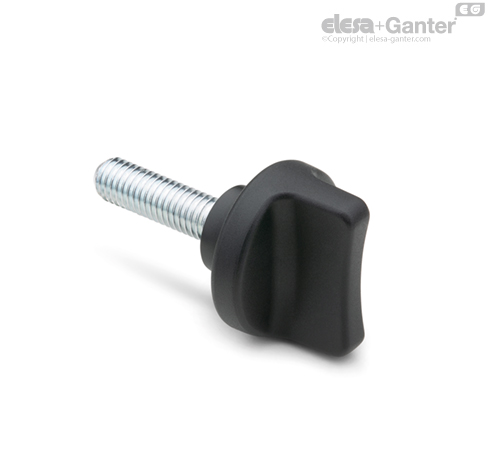
Elesa+Ganter CT-FG.30-SST-P-M8X16 Wing Knob Details
The Elesa+Ganter CT-FG.30-SST-P-M8X16 wing knob is a compact manual clamping solution for applications that require an M8 thread with a shorter stud length. It is especially relevant in industrial assemblies where space is controlled, but stronger thread sizing is still preferred for stability and repeatable fastening.
Choosing the right wing knob is not only about thread diameter. It also involves grip comfort, corrosion resistance, dimensional suitability, and how often the component will be adjusted during operation or maintenance. That is why this CT-FG variant is appealing in systems that need practical hand tightening without sacrificing durability.
What Defines the Elesa+Ganter CT-FG.30-SST-P-M8X16 Wing Knob?
The Elesa+Ganter CT-FG.30-SST-P-M8X16 wing knob features a flanged technopolymer body and a stainless steel M8 threaded stud with a 16 mm length. This configuration is useful when an assembly requires the strength of M8 threading but does not need an extended stud.
Key Product Highlights
- M8 stainless steel threaded stud for robust fastening
- 16 mm stud length for compact assembly layouts
- 30 mm knob diameter for comfortable hand operation
- Glass-fibre reinforced technopolymer body
- Wing design with flange for enhanced grip
Why M8x16 Is a Practical Choice
In many industrial applications, M8 is selected for improved holding strength and compatibility with heavier-duty fastening points. However, not every installation benefits from a long stud. The M8x16 version supports more compact layouts, reducing the chance of unnecessary protrusion while still offering strong thread engagement where the receiving component is properly designed.
This makes the Elesa+Ganter CT-FG.30-SST-P-M8X16 wing knob a sensible option for compact housings, machine frames, positioning fixtures, protective guards, and modular assemblies where controlled dimensions are important.
Materials That Support Long-Term Use
The technopolymer body is reinforced for strength and durability, while the stainless steel stud supports use in settings where corrosion resistance is expected. Together, these materials suit industrial sectors such as packaging, process equipment, general manufacturing, and technical installations that involve regular human interaction with fastening points.
For more information about Elesa+Ganter, it is helpful to compare companion components within the same design family for a more standardized machine build.
Where This Wing Knob Is Often Used
- Compact industrial enclosures
- Machine guards and removable covers
- Jigs, fixtures, and support arms
- Technical equipment requiring quick manual adjustment
- Assemblies using M8 threaded interfaces
FAQ
Why would someone choose M8x16 instead of M6?
M8 is often selected when the application needs a larger thread size for stronger fastening or compatibility with existing machine design standards. Even with a shorter stud, it can be the better match when the receiving thread and load expectations call for M8 hardware.
Is the shorter 16 mm stud a limitation?
Not necessarily. In compact assemblies, a shorter stud can actually be an advantage because it avoids excess projection, keeps layouts cleaner, and reduces interference with nearby components. The best choice depends on the required engagement depth.
Does the flange really improve usability?
Yes, it can. The flange contributes to a steadier grip and more confident handling, especially when repeated tightening is part of routine machine use. Small ergonomic details often make a meaningful difference in real working environments.
Can the Elesa+Ganter CT-FG.30-SST-P-M8X16 wing knob be used for maintenance replacement?
Absolutely. It is suitable not only for original machine construction but also for maintenance and retrofit work, provided the thread size and stud length match the existing installation requirements.
What kind of industries may use this wing knob?
It can be relevant across manufacturing, machinery, automation, packaging, and other technical sectors where manual clamping points must remain durable, easy to use, and resistant to everyday industrial conditions.