
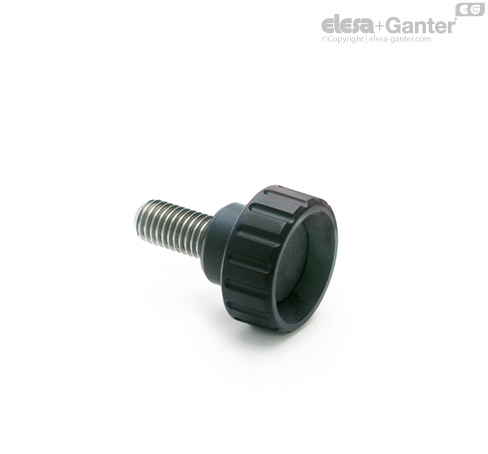
Elesa+Ganter BT.20-SST-P-M6X20 Fluted Knob Guide
The Elesa+Ganter BT.20-SST-P-M6X20 fluted knob is a compact clamping component designed for accurate manual tightening in industrial assemblies, machine frames, fixtures, and equipment covers. It combines a polyamide-based technopolymer body with an AISI 303 stainless steel threaded stud, making it a practical option wherever corrosion resistance, repeatable grip, and dependable handling matter in daily operation.
What the BT.20-SST-P-M6X20 Actually Is
This model belongs to the BT fluted grip knob family. In the official BT series data, the BT-SST-p execution uses a black matte PA technopolymer knob body and an AISI 303 stainless steel threaded stud with a chamfered flat end according to UNI 947 / ISO 4753. For this exact version, the main dimensions are a 20 mm knob diameter, M6 thread, 15 mm overall knob height, 11.5 mm upper diameter, 11 mm lower diameter, 20 mm stud length, and 6 mm shoulder reference with 7 mm final dimensional value in the table.
Key Technical Characteristics
- Product family: BT fluted grip knobs
- Brand: Elesa+Ganter
- Code: BT.20-SST-P-M6X20
- Body material: Polyamide-based technopolymer
- Stud material: AISI 303 stainless steel
- Thread: M6
- Stud length: 20 mm
- Knob diameter: 20 mm
- Operating temperature reference for the BT family: -30°C to +130°C
- Surface finish: Black, matte
Why This Size Is Common in Machine Design
A 20 mm fluted knob with an M6 stainless stud sits in a useful middle ground. It is small enough for compact assemblies, yet large enough to provide reliable fingertip control during repetitive adjustment. This matters in guards, positioning brackets, inspection panels, sensor mounts, and light clamping points where technicians need quick manual engagement without switching to a tool.
The stainless stud also makes this version relevant for environments where humidity, washdown risk, or mild chemical exposure could shorten the service life of standard plated hardware. In practical engineering terms, the material pairing helps balance user comfort, weight efficiency, and corrosion resistance.
Typical Application Areas
The Elesa+Ganter BT.20-SST-P-M6X20 fluted knob is commonly considered for packaging equipment, food-adjacent machinery, laboratory devices, light automation frames, access panels, and OEM assemblies that require frequent opening or repositioning. Its compact stud length is especially useful when designers want secure engagement without excessive protrusion behind the mounting surface.
Elesa+Ganter BT.20-SST-P-M6X20 For more information about Elesa+Ganter, it helps to review the wider product family and matching machine element options.
Elesa+Ganter BT.20-SST-P-M6X20 FAQ
Is the BT.20-SST-P-M6X20 suitable for corrosive environments?
It is better suited than standard zinc-plated alternatives because the stud is made of AISI 303 stainless steel. That makes it a sensible choice for humid production zones, general industrial exposure, and applications where resistance to rust is an important specification factor.
What makes a fluted knob different from a plain round knob?
The fluted outer profile improves finger grip and makes tightening easier during repetitive use. This can reduce handling effort, especially when operators need controlled manual clamping several times per shift.
Why would an engineer choose the 20 mm stud length?
A 20 mm threaded stud often works well where the mounting thickness and engagement depth are moderate. It gives enough thread reach for many standard brackets and machine panels without adding unnecessary length behind the assembly.
Can this knob be used in equipment that is cleaned regularly?
In many cases, yes. The technopolymer body and stainless steel stud make it more suitable for routine cleaning environments than many basic steel alternatives. Final compatibility still depends on the cleaning agents, exposure duration, and exact machine design.
Is this model mainly for heavy-duty clamping?
No. It is more commonly used for controlled manual tightening, quick access points, and medium-duty adjustment tasks rather than extremely high-torque locking. It performs best where ergonomics, repeatability, and corrosion resistance are more important than maximum tightening force.