
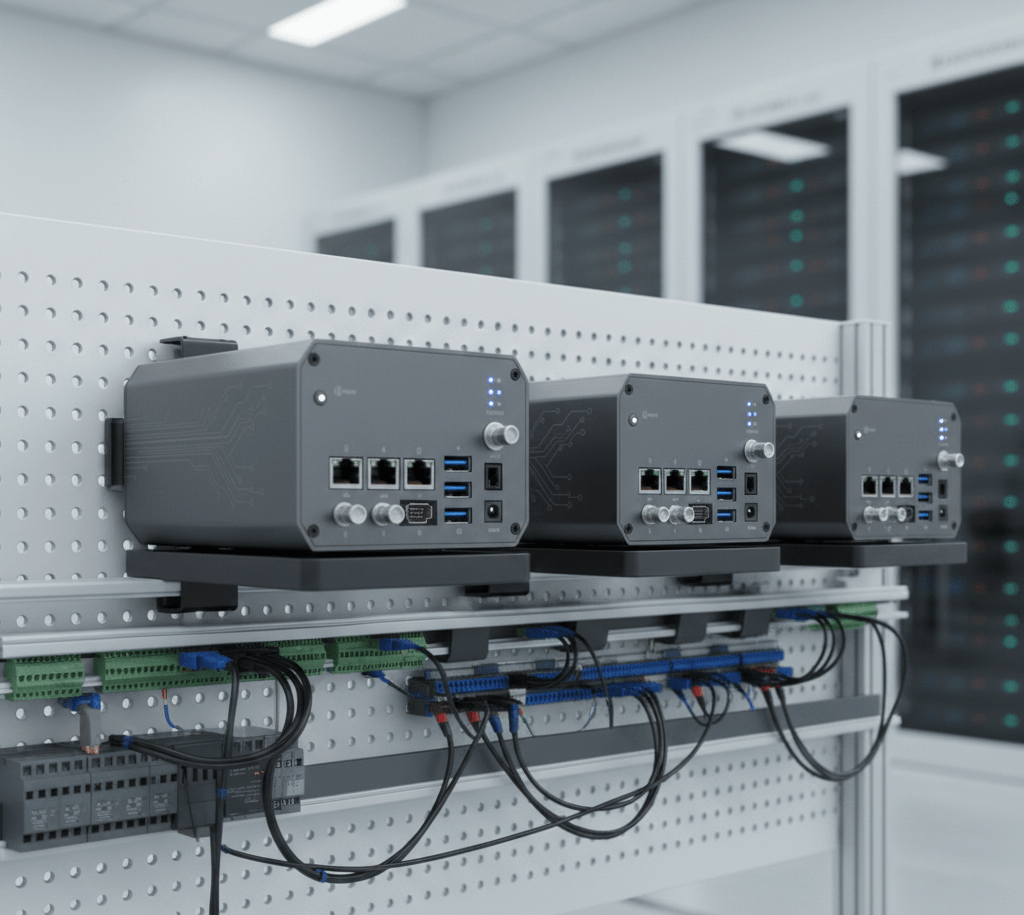
DIN Rail Mounted Compact Industrial PC Models
Space constraints in industrial control cabinets demand computing solutions that deliver robust processing power within minimal footprints. Traditional rack-mount servers and tower PCs consume precious panel space while requiring specialized mounting hardware and extensive cabling. Advantech DIN-rail mountable compact industrial PCs combine the processing capabilities of full computers with the space efficiency and installation simplicity required for control cabinet deployment, enabling advanced automation, edge computing, and machine vision applications without panel redesign or space expansion.
DIN-rail mounting revolutionized industrial control systems by standardizing component attachment on 35mm rails conforming to EN 50022 specifications. This universal mounting system allows components from different manufacturers to coexist in the same panel, with spring-loaded clips enabling tool-free installation and removal. Modern industrial PCs leverage this proven mounting methodology, reducing installation time from hours to minutes while providing secure mechanical attachment that withstands vibration and shock common in factory environments. The compact form factor typically measures 40-120mm wide, occupying far less DIN-rail space than equivalent rack-mount systems would consume in vertical orientation.
Processing Power in Constrained Spaces
Early industrial PCs sacrificed processing capability for size, using low-power embedded processors adequate for simple HMI displays but inadequate for demanding applications like real-time video analytics or complex motion control algorithms. Modern DIN-rail industrial PCs utilize the latest Intel Atom, Celeron, and Core processor families, delivering performance comparable to desktop computers within compact enclosures. Multi-core processors execute multiple tasks simultaneously – one core handles HMI display updates, another processes PLC communications, a third runs data logging, and a fourth executes custom analytics algorithms, all without performance degradation.
Memory capacity scaled proportionally with processor improvements. Contemporary DIN-rail PCs support 4GB to 32GB of DDR4 RAM, sufficient for running Windows 10 IoT Enterprise with multiple applications, virtual machines, or containerized workloads. Storage options include industrial-grade SSDs ranging from 32GB to 512GB, providing both operating system storage and local data buffering for applications requiring historical data retention during network outages. The combination of powerful processors, ample memory, and solid-state storage enables deployment of sophisticated applications previously requiring dedicated server infrastructure.
Fanless Thermal Management
Traditional computer cooling relies on fans forcing air through heat sinks, removing thermal energy generated by processors and power supplies. This approach fails in industrial environments where airborne dust, oil mist, metal shavings, and other contaminants clog cooling fins and destroy fan bearings. DIN-rail industrial PCs employ fanless designs where aluminum chassis function as passive heat sinks, conducting thermal energy from internal components to the DIN rail and mounting panel. Carefully engineered thermal paths using heat pipes, thermal interface materials, and optimized component placement ensure safe operating temperatures without mechanical cooling.
Wide temperature operation from -20°C to 60°C enables deployment in unheated warehouses, outdoor equipment cabinets, and tropical environments without air conditioning. Some ruggedized models extend this range to -40°C for arctic applications or +70°C for installations near high-temperature processes. Thermal cycling tests verify components withstand repeated temperature swings without solder joint failures or material fatigue. This environmental resilience eliminates the need for climate-controlled equipment rooms, reducing facility costs while enabling computing resources closer to data sources and control points.
I/O Connectivity and Expansion
Industrial applications require diverse connectivity beyond standard computer peripherals. DIN-rail PCs provide multiple serial ports (RS-232/422/485) for legacy equipment communication, Ethernet ports for network connectivity, USB ports for peripherals and mass storage, and digital I/O for direct sensor and actuator interfacing. Some models include isolated I/O protecting computer electronics from industrial voltage spikes and ground potential differences. CAN bus interfaces suit automotive and mobile equipment applications, while fieldbus options like Profinet, EtherCAT, or Modbus TCP integrate directly with automation networks without external adapters.
Expansion capabilities accommodate specialized requirements. Mini-PCIe or M.2 sockets accept wireless cards (WiFi, Bluetooth, 4G LTE), additional serial ports, or specialized communication modules. GPIO pins provide flexibility for custom interface boards developed for specific applications. Despite compact dimensions, these expansion options enable customization matching diverse industrial requirements without requiring larger equipment or external interface boxes that would negate space-saving benefits.
Operating System and Software Compatibility
Industrial PCs must support both specialized automation software and standard Windows or Linux applications. DIN-rail models typically ship with Windows 10 IoT Enterprise providing long-term support, security updates, and compatibility with thousands of industrial software packages for SCADA, HMI, data acquisition, and equipment diagnostics. Linux distributions like Ubuntu or Debian suit open-source automation stacks, containerized applications, or custom software development. Real-time operating systems (RTOS) enable deterministic control applications requiring microsecond timing precision.
Software licensing for industrial deployments differs from consumer editions. Windows 10 IoT Enterprise licenses remain valid for the PC’s operational lifetime, typically 7-10 years, without forced feature updates disrupting production environments. Lockdown features prevent unauthorized software installation, USB device usage, or system configuration changes, maintaining operational stability and security. Remote management tools enable centralized monitoring, updates, and troubleshooting across distributed PC fleets without requiring site visits to each installation.
Power Supply Integration
Control panels standardize on 24V DC power distribution for automation components including PLCs, relays, and field devices. DIN-rail industrial PCs accept 12-24V DC or 9-36V DC inputs, eliminating separate power supplies and simplifying installation. Wide input voltage tolerance handles voltage fluctuations common on industrial power buses where inductive loads cause transients. Reverse polarity protection prevents damage from incorrect wiring during installation, while surge protection guards against voltage spikes from nearby equipment switching or lightning-induced transients.
Power consumption typically ranges from 10-30 watts depending on processor selection and peripheral loading. This efficiency enables operation from limited power budgets in remote installations, solar-powered systems, or battery backup applications. Automatic power failure recovery allows configured behavior when power restores – immediate restart, delayed startup to prevent simultaneous boot of multiple devices overloading power supplies, or remaining off until manual intervention. These features suit unattended remote installations where power cycling occurs frequently.
Industrial Certifications and Standards
Compliance with industrial standards verifies equipment meets requirements for safety, electromagnetic compatibility, and environmental performance. CE marking indicates compliance with European directives for industrial equipment. UL/cUL listings satisfy North American safety requirements for commercial and industrial use. FCC Part 15 Class A certification addresses electromagnetic emissions limits for industrial environments, more lenient than Class B residential requirements while still ensuring adjacent equipment protection.
Specialized certifications address unique deployment scenarios. EN 50121 railway certification verifies performance in rolling stock applications with severe vibration, electromagnetic interference, and environmental extremes. ATEX or IECEx certification allows installation in potentially explosive atmospheres like chemical plants or grain elevators where hydrocarbon vapors or combustible dust require explosion-proof or intrinsically safe equipment. Marine certifications (DNV, Lloyd’s Register) address salt spray, shock, and vibration requirements for shipboard installations.
Application Examples and Use Cases
A pharmaceutical manufacturer deployed DIN-rail industrial PCs in cleanroom production equipment controlling tablet presses, coating machines, and packaging lines. The compact PCs fit existing control panels without modifications, running recipe management software, quality data collection, and equipment monitoring. 21 CFR Part 11 compliance features including audit trails, electronic signatures, and data integrity controls met FDA regulatory requirements. The installation replaced aging panel-mount PCs three times larger, freeing panel space for additional I/O modules while improving processing performance 400%.
A water treatment facility uses DIN-rail PCs in remote lift stations and booster pumping facilities spread across 200 square kilometers. Each PC runs local SCADA software displaying process status on operator panels while logging historical data locally. Cellular modems provide connectivity to central SCADA servers for remote monitoring. The compact form factor allowed installation in existing outdoor enclosures without requiring larger weatherproof cabinets. Wide temperature operation handles seasonal temperature swings from -25°C winter nights to +50°C summer afternoons inside solar-heated enclosures.
Comparison with Alternative Solutions
Panel-mount touchscreen PCs combine display and computer in single units, conserving panel space but limiting display size to available panel real estate. DIN-rail PCs separate computing from display, allowing optimal placement of each component – computers mount near I/O connections minimizing cable runs while displays position for operator visibility. This separation enables display upgrades without computer replacement or vice versa. Rack-mount industrial PCs provide extensive expansion but require 19-inch equipment racks consuming vertical panel height. DIN-rail mounting utilizes horizontal space more efficiently in typical control panels where vertical space accommodates terminal blocks, circuit breakers, and power distribution.
Embedded controllers or PLCs with computing capabilities blur lines between control and computing functions. These devices excel at deterministic control loops and I/O interfacing but often provide limited processing power for complex applications, restrictive operating systems incompatible with standard software, or proprietary programming environments. DIN-rail industrial PCs complement these controllers by handling computationally intensive tasks while controllers maintain real-time control responsibilities. This distributed architecture leverages strengths of each component type.
Frequently Asked Questions
What processors are available in DIN-rail industrial PCs?
Current models offer Intel Atom (quad-core, 1.6-2.0 GHz), Celeron (dual/quad-core, 1.8-2.5 GHz), and Core i3/i5/i7 (up to 6 cores, 3.0+ GHz). ARM-based options provide lower power consumption for less demanding applications. Processor selection balances performance requirements against thermal constraints and power budgets.
How much memory and storage do these PCs support?
Memory ranges from 2GB to 32GB DDR4 RAM depending on model. Storage typically uses industrial-grade SSDs from 32GB to 512GB, though some models support larger capacities or dual storage for redundancy. Adequate memory prevents paging, while SSD storage provides vibration resistance and extended temperature operation impossible with mechanical hard drives.
Can DIN-rail PCs run standard Windows software?
Yes, models running Windows 10 IoT Enterprise support standard Windows applications including SCADA software (Wonderware, Ignition, iFIX), databases (SQL Server, MySQL), development tools (Visual Studio), and office applications. Linux models support equivalent open-source software. Some industrial applications may require specific hardware drivers or real-time operating systems.
What display options work with DIN-rail industrial PCs?
Standard options include HDMI, DisplayPort, or VGA video outputs supporting industrial monitors, touchscreen panels, or projectors. Some models provide dual video outputs for multi-monitor setups. Remote desktop protocols (RDP, VNC) enable operation from office workstations without displays in control cabinets. Panel-mount touchscreens connect via video cables for operator interfaces.
How reliable are fanless industrial PCs?
Fanless designs eliminate the most common mechanical failure point in computers. Industrial-grade components rated for extended temperature ranges and conformal coating protecting circuit boards significantly improve reliability over commercial PCs. Typical MTBF (Mean Time Between Failures) exceeds 100,000 hours (11+ years). Solid-state storage with no moving parts further enhances reliability.
What network connectivity is available?
Most models include dual Gigabit Ethernet ports supporting network redundancy protocols (RSTP, MRP). Expansion slots accommodate WiFi, Bluetooth, or cellular modems (4G LTE, 5G). Serial-to-Ethernet converters enable legacy serial devices to communicate over networks. Managed switches often integrate directly for distributed I/O or multiple device connectivity.
Can I remotely manage DIN-rail industrial PCs?
Yes, remote management capabilities include remote desktop access (RDP, VNC, TeamViewer), remote BIOS configuration, remote power cycling, and automated software updates. Management platforms can monitor health, disk usage, and application status across distributed PC fleets. Out-of-band management via dedicated network interfaces allows access even when primary OS fails.
What happens during power failures?
Configurable power failure recovery allows automatic restart when power returns, delayed startup to prevent simultaneous device boot, or manual restart requirement for critical safety applications. Battery backup systems (UPS) provide brief runtime for graceful shutdown or maintain operation through momentary outages. Supercapacitor-based instant power-off protection ensures file system integrity during unexpected power loss.