
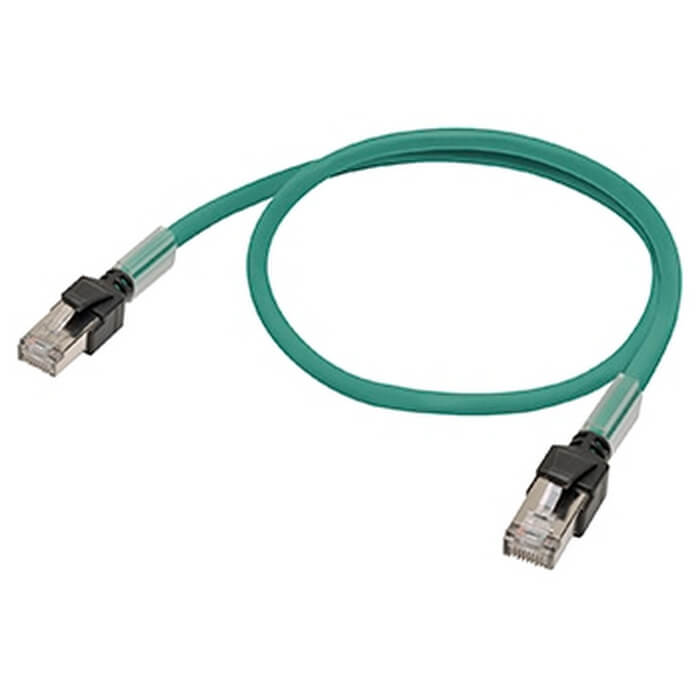
Omron XS6W-6LSZH8SS50CM-G Industrial Ethernet Patch Cable
| Feature | Value |
|---|---|
| Manufacturer | Omron |
| Model | XS6W-6LSZH8SS50CM-G |
| Product Type | Industrial Ethernet Patch Cable |
| Ethernet Category | Cat.6A (IEC) |
| Cable Construction | F/UTP Shielded |
| Connector Type | RJ45 Straight Plug to RJ45 Straight Plug |
| Cable Length | 0.5 m |
| Outer Jacket | LSZH (Low Smoke Zero Halogen) |
| Outer Jacket Color | Green |
| Cable Diameter | 6.3 mm |
| Suitable for Robotics | No |
Industrial communication systems require dependable physical connections to maintain stable data exchange between automation devices. The Omron XS6W-6LSZH8SS50CM-G Industrial Ethernet Patch Cable is designed for fixed industrial Ethernet installations where compact cable routing, electromagnetic noise resistance, and Cat.6A communication performance are required. Its short 0.5-meter length is particularly suitable for cabinet-level wiring between nearby network components.
The cable combines shielded F/UTP construction with a Low Smoke Zero Halogen (LSZH) outer sheath, providing reliable network performance while supporting installations where reduced smoke emission and halogen-free materials are preferred. Factory-installed RJ45 connectors simplify installation and eliminate the need for field termination.
Technical Description
The Omron XS6W-6LSZH8SS50CM-G Industrial Ethernet Patch Cable complies with Cat.6A transmission requirements and is equipped with straight RJ45 connectors on both ends. The cable is intended for industrial Ethernet communication networks used throughout factory automation, machine control, and industrial networking applications.
Its F/UTP shielding helps reduce electromagnetic interference generated by servo amplifiers, variable frequency drives, switching power supplies, and other electrical equipment commonly installed inside control panels.
The green LSZH sheath improves cable identification while providing a jacket material designed to generate minimal smoke and no halogen gases during fire exposure.
Operating Principle
Ethernet communication is transmitted through balanced twisted copper conductor pairs engineered for Cat.6A performance. The foil shield surrounding the conductor pairs minimizes the influence of external electromagnetic fields, allowing network devices to exchange data with improved signal stability.
Since both connectors are factory assembled, installation requires only connecting each RJ45 plug to compatible Ethernet ports without additional wiring or crimping operations.
Typical Applications
- Industrial Ethernet communication networks
- PLC to industrial switch connections
- Industrial computer networking
- Operator interface communication
- Machine control cabinets
- Remote I/O communication
- EtherCAT compatible network installations
- Production monitoring equipment
Industrial Applications
Automation equipment manufacturers frequently install short Ethernet patch cables between PLC CPUs, managed switches, and industrial gateways inside compact electrical enclosures where organized cable management improves maintenance accessibility.
Packaging systems utilize high-speed industrial Ethernet communication to synchronize conveyors, labeling equipment, barcode readers, and inspection devices. Short Cat.6A patch cables provide clean internal cabinet wiring between network components.
Electronics manufacturing lines use shielded Ethernet infrastructure to connect production monitoring equipment with industrial controllers while reducing communication disturbances caused by nearby electrical equipment.
Water treatment facilities employ industrial Ethernet networks for communication between programmable controllers, operator stations, and distributed monitoring systems located within centralized control cabinets.
Advantages
- Cat.6A industrial Ethernet performance
- Factory-assembled RJ45 connectors
- Shielded F/UTP construction for improved EMC performance
- Compact 0.5-meter cable length
- LSZH cable jacket
- Suitable for structured cabinet wiring
- Simplified installation without field termination
Omron XS6W-6LSZH8SS50CM-G Selection Considerations
Choosing an industrial Ethernet cable requires evaluating several technical parameters, including Ethernet category, shielding method, cable length, connector type, and installation environment. Short patch cables are generally preferred for cabinet wiring because they minimize cable congestion while maintaining organized layouts.
The Omron XS6W-6LSZH8SS50CM-G Industrial Ethernet Patch Cable is intended for stationary industrial installations rather than continuously moving cable carrier systems. Engineers should verify application requirements before selecting cables for dynamic motion.
More information about Omron sensor products and industrial automation solutions is available for designing integrated factory automation systems.
System Integration
The cable can be installed between industrial switches, PLCs, HMIs, industrial PCs, network gateways, remote I/O stations, and other Ethernet-enabled automation equipment that uses standard RJ45 interfaces. Its Cat.6A specification supports high-bandwidth industrial communication networks used in modern manufacturing environments.
Omron XS6W-6LSZH8SS50CM-G Frequently Asked Questions
Which Ethernet category does this cable support?
It complies with Cat.6A specifications according to IEC standards.
How long is the cable?
The cable has a factory length of 0.5 meter.
Does it provide shielding?
Yes. The cable uses F/UTP shielding to help reduce electromagnetic interference.
Which connectors are fitted?
Both ends are equipped with straight RJ45 connectors.
Is this cable intended for robotic motion?
No. The manufacturer specifies that this model is designed for fixed installations.
Why is an LSZH jacket used?
An LSZH jacket reduces smoke generation and avoids halogen emissions during fire conditions.
Which automation devices can be connected?
Typical applications include PLCs, industrial switches, HMIs, IPCs, remote I/O systems, and Ethernet gateways.
Where is this cable commonly installed?
It is typically used inside electrical control panels, automation cabinets, industrial machines, and fixed Ethernet infrastructure.