
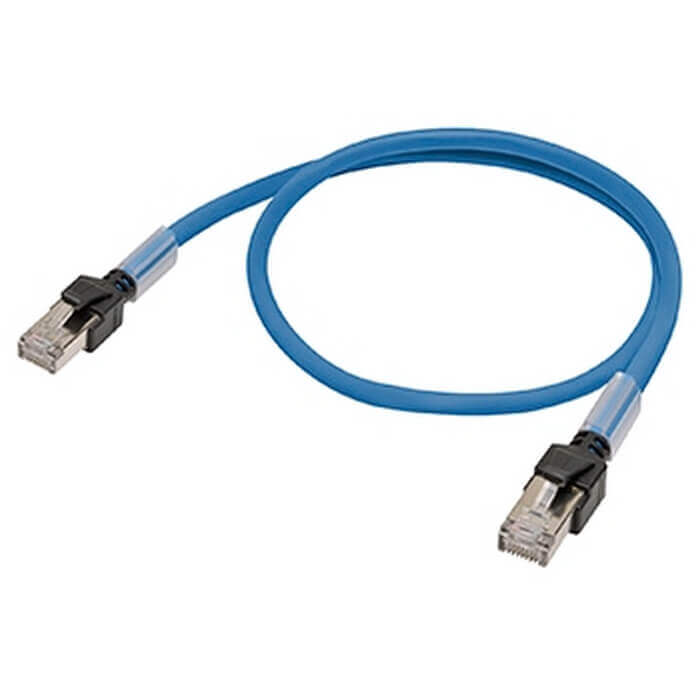
Omron XS6W-6LSZH8SS1500CM-B Ethernet Patch Cable
| Specification | Value |
|---|---|
| Manufacturer | Omron |
| Product Type | Industrial Ethernet Patch Cable |
| Model Number | XS6W-6LSZH8SS1500CM-B |
| Ethernet Category | Cat.6A (IEC) |
| Cable Construction | F/UTP Shielded |
| Connector Type | RJ45 Straight Plug × RJ45 Straight Plug |
| Cable Length | 15 m |
| Outer Jacket Material | LSZH (Low Smoke Zero Halogen) |
| Jacket Color | Blue |
| Cable Diameter | 6.3 mm |
| Suitable for Robotic Motion | No |
Modern industrial facilities often require Ethernet connections that extend beyond local control cabinets while maintaining stable communication quality. The Omron XS6W-6LSZH8SS1500CM-B Ethernet Patch Cable is intended for these installations by combining Category 6A transmission performance with industrial shielding and a 15-meter cable length. This configuration provides greater installation flexibility where controllers, switches, operator interfaces, and network devices are distributed across larger equipment layouts.
The Omron XS6W-6LSZH8SS1500CM-B Ethernet Patch Cable belongs to Omron’s industrial Ethernet connectivity range developed for factory automation systems utilizing Ethernet-based communication protocols. Its factory-terminated RJ45 connectors help simplify installation while ensuring consistent connection quality.
Technical Description
The cable is manufactured using an F/UTP construction in which the twisted conductor pairs are enclosed within an overall foil shield. This design helps reduce electromagnetic interference generated by nearby industrial equipment such as variable frequency drives, servo amplifiers, contactors, and switching power supplies.
Its LSZH outer sheath offers low smoke and halogen-free characteristics, making the cable suitable for industrial facilities where these material properties are specified by engineering standards. The blue jacket also supports organized cable identification within automation systems.
Working Principle
Ethernet communication relies on balanced twisted-pair transmission to carry digital data between compatible network devices. Each conductor pair is designed to minimize signal degradation and internal crosstalk while supporting high-speed communication.
The foil shield surrounding the cable provides additional protection against external electrical noise. When installed correctly, the cable helps maintain reliable communication between industrial controllers, managed switches, industrial computers, vision systems, and remote I/O devices.
Typical Applications
- PLC to industrial switch connections
- Machine-to-machine Ethernet communication
- Distributed control systems
- Industrial HMI networking
- Factory communication backbones
- Remote I/O networks
- Industrial PC communication
- Automation panel interconnections
Industrial Application Examples
Production Lines
Large manufacturing cells frequently require Ethernet links between centralized control panels and distributed machine sections. A 15-meter cable provides flexibility without requiring intermediate patch points.
Process Automation
Industrial Ethernet networks are commonly used to connect operator stations, PLC racks, communication gateways, and field control equipment throughout processing facilities.
Automated Warehousing
Conveyor controllers, industrial barcode readers, and monitoring stations often communicate through shielded Ethernet infrastructure installed across extended equipment layouts.
Machine Integration Projects
System integrators can use longer Ethernet patch cables when connecting automation equipment installed across separate machine frames while maintaining organized routing.
Advantages
- Category 6A industrial Ethernet performance
- 15-meter factory-manufactured cable length
- F/UTP shielding for improved electromagnetic compatibility
- RJ45 straight connectors on both ends
- LSZH outer jacket for low smoke and halogen-free installations
- Blue jacket simplifies cable identification
- Suitable for industrial networking applications
- Supports structured Ethernet infrastructure within automation systems
Selection Considerations
When selecting an industrial Ethernet patch cable, engineers should consider the required communication distance, network topology, electromagnetic environment, and available installation space. Longer cable assemblies should be routed carefully to avoid unnecessary mechanical stress and excessive bending.
Connector compatibility, shielding requirements, and Ethernet category should also be verified before installation. Although the cable is designed for industrial automation, this model is not specified for applications involving continuous robotic movement or cable-chain operation.
Omron XS6W-6LSZH8SS1500CM-B For additional industrial networking components and related automation products, visit Omron sensor series.
Omron XS6W-6LSZH8SS1500CM-B Frequently Asked Questions
1. What is the cable length of the Omron XS6W-6LSZH8SS1500CM-B Ethernet Patch Cable?
The cable has a factory-assembled length of 15 meters.
2. Which Ethernet category does this model support?
It complies with IEC Category 6A specifications.
3. What type of shielding is used?
The cable uses an F/UTP shielded construction with an overall foil shield.
4. Which connector type is installed?
Both ends are equipped with straight RJ45 connectors.
5. Why is an LSZH jacket used?
The LSZH sheath reduces smoke generation and eliminates halogen emissions during fire conditions compared with conventional jacket materials.
6. Where can this cable typically be installed?
It is suitable for industrial control panels, automation equipment, communication cabinets, production machinery, and Ethernet network infrastructure.
7. Is the cable compatible with industrial Ethernet protocols?
Yes. It is designed for Ethernet-based industrial communication systems that utilize RJ45 interfaces.
8. Is the Omron XS6W-6LSZH8SS1500CM-B Ethernet Patch Cable intended for robotic applications?
No. According to the manufacturer’s specifications, this model is intended for stationary installations rather than continuous robotic motion.