
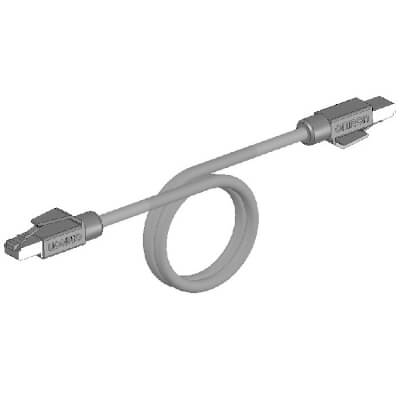
Omron XS5W-T421-BMD-KR Industrial Ethernet Cable
| Specification | Value |
|---|---|
| Product Type | Industrial Ethernet Cable |
| Connector A | M12 Smartclick Straight Plug |
| Connector B | M12 Smartclick Straight Plug |
| Ethernet Category | Category 5e |
| Cable Construction | SF/UTP Shielded |
| Cable Length | 0.5 m |
| Outer Sheath Material | PVC |
| Outer Sheath Color | Black |
| Cable Diameter | 6.5 mm |
| Suitable for Robotics | Yes |
Industrial robotic systems require communication components capable of maintaining stable Ethernet connectivity while being exposed to repetitive mechanical movement. The Omron XS5W-T421-BMD-KR Industrial Ethernet Cable has been developed to connect industrial devices equipped with M12 Smartclick Ethernet interfaces in applications where continuous machine motion is part of normal operation. This model belongs to Omron’s Industrial Ethernet cable portfolio and is intended for Cat5e communication networks used in modern automation systems.
The Omron XS5W-T421-BMD-KR Industrial Ethernet Cable combines two M12 Smartclick straight connectors with a shielded cable construction, making it suitable for machine-level communication without requiring RJ45 interfaces. According to the manufacturer’s specifications, this version is designed for robotic applications where cable flexibility and communication reliability are both important.
Omron XS5W-T421-BMD-KR Technical Description
This cable incorporates M12 Smartclick straight connectors at both ends and utilizes an SF/UTP Category 5e shielded cable construction. The PVC outer jacket provides mechanical protection while the compact 0.5-meter length is appropriate for short communication links inside robotic equipment, machine modules, and industrial control systems.
The Smartclick connector mechanism enables quick installation while providing secure mechanical locking for industrial Ethernet devices operating under vibration or repetitive movement.
Operating Principle
The cable serves as a passive Ethernet transmission medium between two compatible M12 Industrial Ethernet interfaces. Ethernet frames are transmitted through shielded twisted-pair conductors that satisfy Category 5e communication requirements. The SF/UTP shielding helps reduce the influence of electromagnetic interference generated by servo amplifiers, motors, frequency converters, and industrial power equipment.
Because this model is specified for robotic applications, its construction is intended to accommodate repeated cable movement while maintaining reliable data communication between automation devices.
Omron XS5W-T421-BMD-KR Typical Areas of Use
- Industrial robots
- Motion control systems
- Machine automation
- Distributed I/O communication
- Industrial Ethernet networks
- Assembly cells
- Automated handling systems
- Machine control cabinets
Industrial Applications
Robotic Assembly Systems
Industrial robots continuously exchange motion commands, diagnostic information, and process data with controllers through Industrial Ethernet networks. Compact robotic-rated communication cables support these high-cycle operating environments.
Automated Material Handling
Pick-and-place equipment, transfer systems, and robotic conveyors often require Ethernet connections between moving equipment and stationary control systems using rugged M12 connectivity.
Flexible Manufacturing Cells
Production cells that incorporate multiple robotic stations rely on dependable network communication for synchronized machine operation, controller coordination, and real-time monitoring.
Advantages
- Dual M12 Smartclick connectors
- Category 5e Industrial Ethernet performance
- SF/UTP shielded construction
- Designed for robotic applications
- Compact 0.5 m cable length
- PVC industrial outer sheath
- Suitable for continuous automation environments
- Supports reliable machine-level Ethernet communication
Industry Examples
This cable is suitable for automotive body assembly robots, electronics manufacturing equipment, automated packaging systems, robotic palletizers, pharmaceutical production machinery, precision assembly stations, and intelligent manufacturing cells where M12 Industrial Ethernet connectivity is required between moving machine components.
Factors to Consider When Selecting the Product
- Verify that both connected devices use compatible M12 Ethernet connectors.
- Select a cable length appropriate for the installation.
- Confirm that the application involves robotic or continuous motion if this version is being selected.
- Evaluate environmental conditions such as vibration and electromagnetic interference.
- Ensure compatibility with the Industrial Ethernet protocol implemented by the connected equipment.
- Follow the manufacturer’s recommendations regarding cable routing and minimum bending radius.
Omron XS5W-T421-BMD-KR Additional Industrial Ethernet connectivity products can be found within the Omron sensor series.
Omron XS5W-T421-BMD-KR Frequently Asked Questions
1. What type of connectors are used on this cable?
The cable features straight M12 Smartclick connectors on both ends for direct Industrial Ethernet device connections.
2. Is this cable intended for robotic applications?
Yes. The manufacturer specifies this model for robotic applications involving repetitive mechanical movement.
3. Which Ethernet category is supported?
The cable is manufactured according to Category 5e Industrial Ethernet requirements.
4. What shielding configuration is provided?
An SF/UTP shielded construction is used to help reduce electromagnetic interference in industrial environments.
5. What is the cable length?
The standard cable length is 0.5 meter.
6. Which industries commonly use this cable?
Typical sectors include automotive manufacturing, robotics, electronics production, machine building, logistics automation, and industrial assembly.
7. Why are M12 Smartclick connectors preferred in industrial automation?
They provide secure mechanical locking, simplified installation, and reliable connectivity in environments exposed to vibration and continuous operation.
8. What should be verified before installation?
Users should confirm connector compatibility, cable routing requirements, required cable length, network protocol compatibility, and installation conditions before integrating the cable into an automation system.