
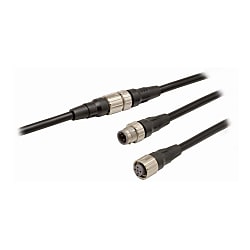
Omron XS5W-T421-CM1-KR Industrial Ethernet Cable
| Specification | Value |
|---|---|
| Manufacturer | Omron |
| Model | XS5W-T421-CM1-KR |
| Product Type | Industrial Ethernet Cable |
| Ethernet Category | Cat5e |
| Connector 1 | M12 Straight Plug |
| Connector 2 | M12 Straight Socket |
| Cable Type | SF/UTP Shielded Robotic Cable |
| Cable Length | 1 m |
| Outer Sheath Material | PVC |
| Outer Sheath Color | Yellow |
| Cable Diameter | 6.5 mm |
| Application | Continuous Flex / Robotic Installation |
The Omron XS5W-T421-CM1-KR Industrial Ethernet Cable is engineered for Industrial Ethernet installations where network communication must remain reliable while the cable is exposed to continuous movement. Unlike standard fixed-installation cables, this robotic version is intended for dynamic applications such as robotic arms, automated handling equipment, and moving machine assemblies. According to the manufacturer, the cable combines Cat5e communication performance with M12 industrial connectors and a robotic-grade cable construction.
The Omron XS5W-T421-CM1-KR Industrial Ethernet Cable provides secure Ethernet connectivity between automation components equipped with M12 interfaces. Its shielded construction assists in maintaining communication quality in environments where electrical noise, vibration, and repeated flexing are common operating conditions.
Technical Description
This model belongs to Omron’s XS5 Industrial Ethernet cable family. It features an M12 straight plug and an M12 straight socket connected through a 1-meter SF/UTP shielded Cat5e cable. The yellow PVC jacket allows rapid identification inside production equipment while protecting the cable against mechanical wear associated with industrial installations.
The robotic cable structure is intended for repeated bending cycles encountered in moving equipment. This construction differs from conventional Ethernet cables developed primarily for stationary routing.
Working Principle
Ethernet data is transmitted through balanced twisted conductor pairs designed for Cat5e communication. Differential signaling minimizes susceptibility to external electrical disturbances, while the SF/UTP shielding helps reduce electromagnetic interference generated by nearby motors, servo amplifiers, and switching equipment.
The M12 connector system provides a secure locking mechanism that maintains stable electrical contact even when machinery is subjected to continuous vibration or movement. This characteristic makes the cable suitable for dynamic automation systems where reliable communication is essential.
Typical Applications
- Industrial robotic systems
- Robot arm Ethernet connections
- Automated assembly equipment
- Moving machine axes
- Industrial Ethernet communication networks
- Servo-controlled machinery
- Machine vision systems
- Flexible cable carrier installations
Industrial Applications
Robotic Welding Cells
Robotic welding equipment continuously exchanges communication data between controllers, robots, and peripheral devices. A robotic Ethernet cable helps support dependable network communication while accommodating repetitive motion.
Automated Material Handling
Transfer units, gantry systems, and pick-and-place machines often require Ethernet communication across moving assemblies where continuous cable flexing occurs during normal operation.
Flexible Manufacturing Systems
Modern production lines frequently include programmable motion systems that integrate distributed controllers, sensors, and industrial networking devices through shielded Ethernet infrastructure.
Advantages
- Cat5e Industrial Ethernet communication
- Designed for robotic and continuous-flex applications
- SF/UTP shielded construction
- M12 straight plug to M12 straight socket configuration
- Yellow industrial cable jacket
- 1-meter factory cable length
- Secure industrial connector locking
- Suitable for dynamic automation equipment
Omron XS5W-T421-CM1-KR Industry Examples
- Automotive body assembly
- Industrial robotics
- Electronics manufacturing
- Battery production lines
- Automated packaging equipment
- Warehouse robotics
- Machine tool automation
- Flexible conveyor systems
Omron XS5W-T421-CM1-KR Selection Considerations
Engineers selecting a robotic Ethernet cable should evaluate cable movement, connector compatibility, communication category, shielding performance, and installation routing. Continuous-flex applications require cable constructions specifically developed for repetitive motion rather than standard fixed-installation cables.
It is also advisable to verify compatibility with the Industrial Ethernet architecture, including field devices using M12 interfaces and Cat5e communication infrastructure.
Additional industrial connectivity solutions are available within the Omron sensor products portfolio.
Omron XS5W-T421-CM1-KR Frequently Asked Questions
1. What is the Omron XS5W-T421-CM1-KR Industrial Ethernet Cable designed for?
It is designed for Cat5e Industrial Ethernet communication in robotic and continuous-flex automation applications.
2. Which connectors are fitted to the cable?
The cable is equipped with one M12 straight plug and one M12 straight socket.
3. Is this cable suitable for moving equipment?
Yes. The manufacturer specifies this model for robotic applications involving repeated cable movement.
4. What shielding does the cable use?
It features an SF/UTP shielded construction to help reduce electromagnetic interference.
5. What is the cable length?
The factory cable length is 1 meter.
6. Why are M12 connectors commonly used in industrial automation?
M12 connectors provide secure mechanical locking, helping maintain reliable Ethernet communication under vibration and demanding operating conditions.
7. Which industries commonly use this cable?
Typical applications include automotive manufacturing, robotics, packaging machinery, electronics production, logistics automation, and machine building.
8. What should be considered before installing the Omron XS5W-T421-CM1-KR Industrial Ethernet Cable?
Confirm connector compatibility, cable routing, required flex performance, shielding requirements, cable length, and compatibility with the Industrial Ethernet network used by the machine.