
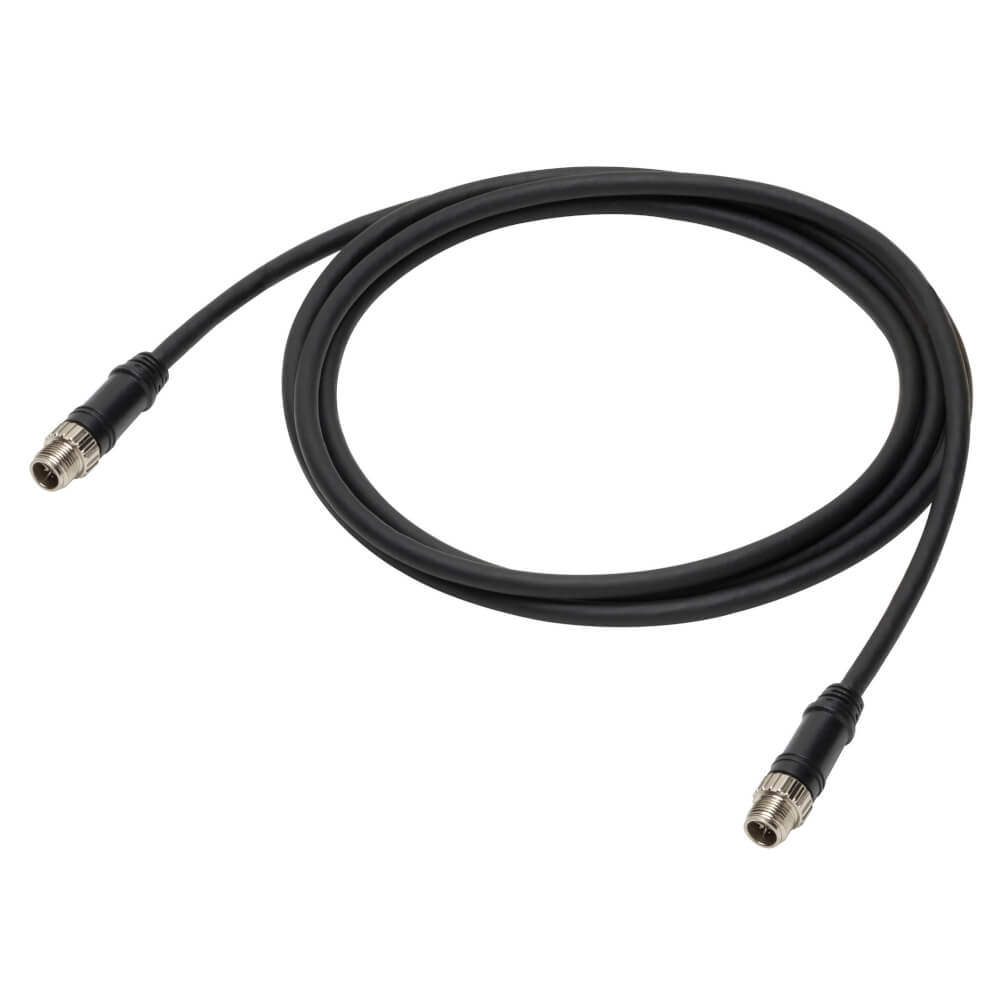
Omron XS2W-T421-JM2-SS Industrial Ethernet Cable
| Specification | Value |
|---|---|
| Manufacturer | Omron |
| Model | XS2W-T421-JM2-SS |
| Product Type | Industrial Ethernet Cable |
| Connector 1 | M12 Straight Plug (Male), D-Coded, 4-Pole |
| Connector 2 | M12 Straight Plug (Male), D-Coded, 4-Pole |
| Ethernet Category | Cat5e |
| Cable Construction | SF/UTP Shielded |
| Cable Length | 10 m |
| Cable Diameter | 6.5 mm |
| Outer Jacket | PVC, Black |
| Protection Rating | IP67 (Both M12 Connectors) |
The Omron XS2W-T421-JM2-SS Industrial Ethernet Cable is developed for Industrial Ethernet installations requiring secure M12 D-coded connectivity at both ends of the cable assembly. Manufactured with factory-terminated connectors and Cat5e transmission characteristics, this cable supports reliable communication between industrial automation devices while helping maintain network stability in electrically demanding environments. The standard configuration includes a 10-meter shielded cable with straight M12 male connectors and a durable PVC outer sheath.
The Omron XS2W-T421-JM2-SS Industrial Ethernet Cable is intended for communication between PLCs, remote I/O stations, industrial switches, servo controllers, machine modules, and distributed automation equipment using Industrial Ethernet protocols.
Omron XS2W-T421-JM2-SS Technical Description
This model belongs to Omron’s XS2W Industrial Ethernet cable family, designed specifically for Ethernet communication within industrial automation systems. The D-coded M12 connectors provide a secure locking mechanism suitable for applications exposed to vibration, repetitive machine movement, and challenging environmental conditions.
The cable incorporates an SF/UTP shielding structure that reduces the influence of electromagnetic interference generated by nearby electrical equipment. Its 10-meter length provides additional flexibility when connecting devices separated by greater installation distances inside production facilities.
Operating Principle
The cable transfers Ethernet communication signals between compatible Industrial Ethernet devices without modifying network data. Both factory-installed M12 connectors provide consistent electrical performance while reducing installation variability associated with field-assembled connectors.
Shield continuity throughout the cable assembly helps preserve communication quality in environments where motors, inverters, welding equipment, or high-current electrical systems may generate electromagnetic noise.
Omron XS2W-T421-JM2-SS Typical Applications
- Industrial Ethernet backbone connections
- Machine-to-machine communication
- Distributed I/O systems
- PLC networking
- Servo drive communication
- Industrial control systems
- Assembly automation
- Production line communication
Industrial Applications
The cable is widely applicable in automated production environments where industrial communication reliability directly supports machine operation. Typical installations include automotive production equipment, semiconductor manufacturing systems, robotics, conveyor automation, warehouse logistics, food processing machinery, and industrial packaging systems.
The extended 10-meter cable length enables greater installation flexibility by allowing communication between equipment located farther apart while maintaining a single factory-manufactured cable assembly.
Omron XS2W-T421-JM2-SS Advantages
- Dual M12 D-coded connectors for Industrial Ethernet.
- Cat5e communication performance.
- SF/UTP shield improves EMC characteristics.
- IP67 connector protection when properly connected.
- Factory-assembled cable minimizes installation errors.
- 10-meter cable length supports larger machine layouts.
- Durable PVC outer jacket.
- Suitable for continuous industrial operation.
Sector Examples
Robotics
Industrial robots communicate with distributed control equipment through secure Ethernet connections designed for continuous machine movement and vibration.
Automated Warehousing
Network communication between conveyor controllers, scanners, and decentralized control stations supports coordinated material flow throughout logistics facilities.
Process Manufacturing
Industrial Ethernet infrastructure enables communication between field devices and supervisory automation systems across large production areas.
Machine Construction
Machine builders use standardized M12 Ethernet cabling to simplify equipment integration and maintenance throughout the machine lifecycle.
Selection Considerations
Before selecting an Industrial Ethernet cable, engineers should verify connector coding, cable routing distance, shielding requirements, installation environment, and compatibility with connected devices. The Omron XS2W-T421-JM2-SS Industrial Ethernet Cable is appropriate for applications requiring M12 D-coded Ethernet interfaces at both cable ends and an extended cable length.
Additional compatible products are available within the Omron sensor product series.
Frequently Asked Questions
What connectors are installed on this cable?
Both cable ends are equipped with straight M12 D-coded male connectors.
How long is the cable?
The cable assembly has a standard length of 10 meters.
Does it support Cat5e Industrial Ethernet?
Yes. The cable is manufactured according to Cat5e Industrial Ethernet specifications.
Is the cable shielded?
Yes. It incorporates an SF/UTP shielded cable design for improved electromagnetic compatibility.
Which industrial systems commonly use this cable?
It is suitable for PLCs, distributed I/O, industrial switches, servo systems, machine automation, and Ethernet-based industrial communication networks.
What protection rating do the connectors provide?
When correctly connected, both M12 connectors provide IP67 environmental protection.
Can the cable be installed in electrically noisy environments?
Yes. Its shielded construction helps reduce the effects of electromagnetic interference commonly present in industrial facilities.
What factors should be evaluated before installation?
Connector compatibility, required cable length, installation routing, environmental conditions, and network architecture should all be confirmed before deployment.