
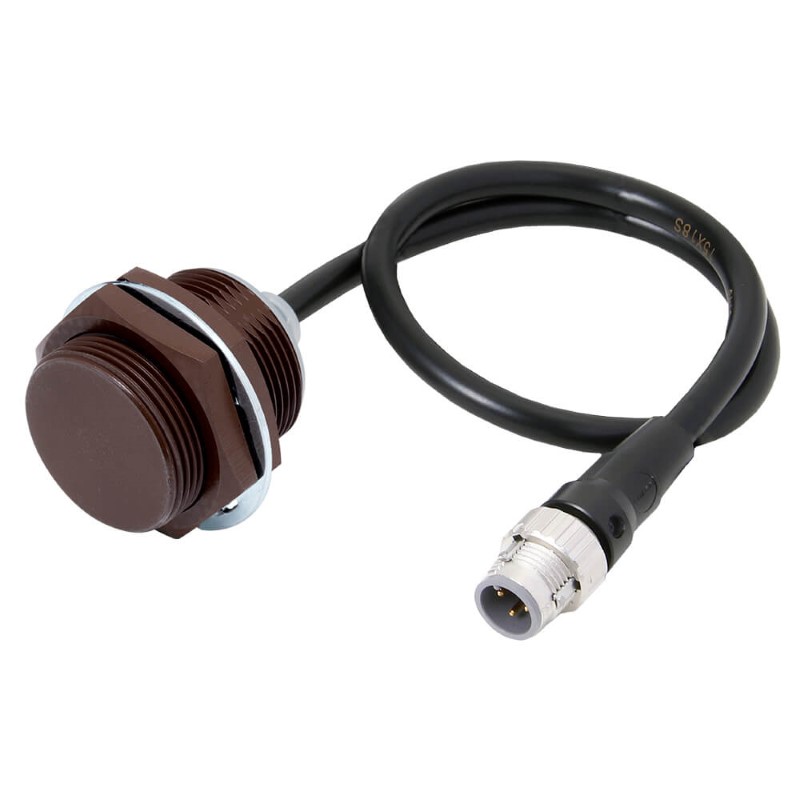
Omron E2EW-QX10C230-M1TJ 0.3M Inductive Proximity Sensor
| Feature | Value |
|---|---|
| Sensor Type | Inductive Proximity Sensor |
| Series | E2EW-Q |
| Housing Size | M30 |
| Mounting Type | Flush |
| Sensing Distance | 10 mm |
| Output Type | NPN |
| Operation Mode | Normally Closed (NC) |
| Supply | DC 3-wire |
| Connection | M12 Smartclick Pigtail Connector |
| Cable Length | 0.3 m |
| Housing Material | Stainless Steel (SUS303) with Fluororesin Coating |
| Sensing Face | Metal |
| Protection Rating | IP67 |
| Overall Length | 41.9 mm |
| Thread Length | 30.3 mm |
Technical Description
Reliable non-contact metal detection is essential for automated manufacturing systems operating in environments exposed to vibration, welding spatter, metallic particles, and continuous production cycles. The Omron E2EW-QX10C230-M1TJ Inductive Proximity Sensor belongs to Omron’s E2EW-Q series, which is designed for demanding industrial applications requiring robust mechanical construction and stable sensing characteristics. According to the manufacturer’s specifications, this model features a 10 mm sensing distance, M30 threaded flush-mount housing, NPN normally closed output, DC three-wire configuration, stainless-steel housing with fluororesin coating, a metal sensing face, and an M12 Smartclick pigtail connector with a 0.3 m cable. :contentReference[oaicite:0]{index=0}
The Omron E2EW-QX10C230-M1TJ Inductive Proximity Sensor is intended for applications where reliable metal object detection and simplified installation are equally important. The Smartclick connector supports quick replacement during maintenance while minimizing machine downtime.
Working Principle
The sensor generates a high-frequency electromagnetic field through its active sensing surface. When a conductive metallic object enters the sensing area, eddy currents are induced inside the target material. These currents reduce the oscillation amplitude within the sensing circuit. Once the predefined threshold is reached, the internal electronics switch the NPN normally closed output, allowing the connected PLC or controller to identify the target accurately.
The flush mounting design enables installation inside metallic machine structures while maintaining consistent sensing performance when installation clearances follow the manufacturer’s recommendations.
Technical Features
- 10 mm rated sensing distance.
- M30 threaded cylindrical housing.
- Flush mounting configuration.
- NPN Normally Closed switching output.
- DC three-wire electrical design.
- M12 Smartclick pigtail connector.
- 0.3 m PVC cable.
- Fluororesin-coated stainless-steel housing.
- Metal sensing face for enhanced durability.
- IP67 ingress protection.
Application Areas
This sensor is suitable for production equipment requiring repeatable metallic target detection without mechanical contact. It is commonly integrated into positioning systems, indexing mechanisms, robotic fixtures, transfer units, conveyor equipment, and machine tools.
- Automated assembly systems
- Machine tool positioning
- Robotic welding stations
- Transfer mechanisms
- Metal fabrication equipment
- Industrial conveyors
- Automated inspection systems
- Production line monitoring
Industrial Applications
Automotive manufacturing facilities use this sensor to verify fixture positions before robotic welding operations begin. In metal processing plants, it detects steel components before machining, bending, or stamping processes. Automated conveyor systems utilize it for workpiece positioning and sequencing, while robotic handling systems rely on stable sensing to confirm part presence before pick-and-place movements.
The fluororesin-coated housing helps reduce adhesion of welding spatter, making the sensor suitable for production cells where conventional proximity sensors may require more frequent maintenance.
Advantages
- Reliable non-contact detection of metallic objects.
- Quick installation using the M12 Smartclick connector.
- Durable stainless-steel housing.
- Fluororesin coating improves resistance to welding spatter.
- Compact flush mounting.
- IP67 protection for demanding industrial environments.
- Suitable for continuous automation processes.
Selection Considerations
When selecting an inductive proximity sensor, engineers should verify the required sensing distance, mounting configuration, output type, cable routing, controller compatibility, connector preference, and environmental conditions. Proper installation spacing and wiring practices are also important for maintaining stable sensing performance throughout the service life of the equipment.
Additional information about compatible sensing technologies is available in the Omron sensor product series.
Omron E2EW-QX10C230-M1TJ Frequently Asked Questions
1. What is the sensing distance of this sensor?
The rated sensing distance is 10 mm.
2. Which output configuration does this model provide?
It features an NPN Normally Closed output.
3. What connection method is used?
The sensor is equipped with an M12 Smartclick pigtail connector and a 0.3 m PVC cable.
4. Is it suitable for flush mounting?
Yes. The sensor is designed for flush installation in accordance with the manufacturer’s specifications.
5. What environmental protection does it offer?
The enclosure is rated IP67.
6. Why is the fluororesin coating beneficial?
It helps reduce welding spatter adhesion and improves durability in harsh manufacturing environments.
7. Which industries typically use this sensor?
Automotive manufacturing, robotics, machine building, metal processing, material handling, and industrial automation commonly employ this model.
8. Where is the Omron E2EW-QX10C230-M1TJ Inductive Proximity Sensor commonly installed?
The Omron E2EW-QX10C230-M1TJ Inductive Proximity Sensor is typically installed on robotic welding fixtures, transfer systems, automated conveyors, machine tools, and production equipment requiring dependable non-contact detection of metal components.