
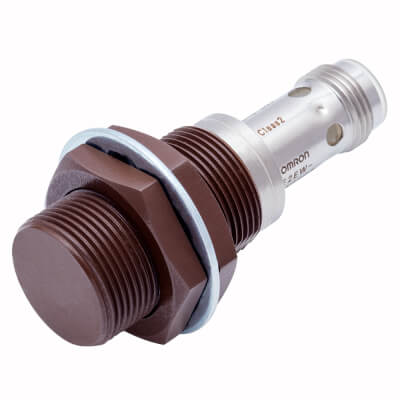
Omron E2EW-QX10B218-M1 Inductive Proximity Sensor
| Feature | Value |
|---|---|
| Manufacturer | Omron |
| Series | E2EW |
| Sensor Type | Inductive Proximity Sensor |
| Housing Size | M18 |
| Mounting Type | Flush (Shielded) |
| Sensing Distance | 10 mm |
| Output Type | PNP NC |
| Connection Method | M12 Connector |
| Supply Voltage | 10 to 30 VDC |
| Housing Material | SUS303 Stainless Steel with Fluororesin Coating |
| Protection Rating | IP67 |
| Overall Length | 54.4 mm |
| Thread Length | 28 mm |
The Omron E2EW-QX10B218-M1 Inductive Proximity Sensor is designed for reliable metal target detection in industrial automation environments where mechanical contact is undesirable. As part of the E2EW series, this sensor combines a stainless-steel housing with a fluororesin-coated sensing face, making it suitable for demanding production areas exposed to coolant, oil mist, or metal particles.
Technical Description
The Omron E2EW-QX10B218-M1 Inductive Proximity Sensor features a flush-mounted M18 cylindrical body and provides a sensing distance of 10 mm. The sensor utilizes a PNP normally closed output configuration and connects through an M12 connector, allowing straightforward integration into control cabinets, machine panels, and sensor distribution systems.
The sensor belongs to Omron’s E2EW family, which incorporates Factor 1 sensing technology. This design helps maintain stable detection characteristics across different metal materials, including ferrous and non-ferrous targets. The robust construction also supports operation in industrial environments where durability and stable sensing performance are required.
Working Principle
Inductive proximity sensors operate by generating a high-frequency electromagnetic field at the sensing surface. When a conductive metal object enters this field, eddy currents are induced within the target material.
These eddy currents affect the oscillator circuit inside the sensor. Once the detected change reaches a predefined threshold, the output state changes accordingly. In the PNP NC configuration of the Omron E2EW-QX10B218-M1 Inductive Proximity Sensor, the output remains active under normal conditions and changes state when a target is detected.
This non-contact detection method minimizes wear and eliminates the need for mechanical switching components.
Key Advantages
- 10 mm sensing distance in a compact M18 housing
- Flush mounting capability for flexible installation
- PNP NC output suitable for various PLC architectures
- IP67 protection against dust and water ingress
- Fluororesin-coated sensing face for improved environmental resistance
- Stainless steel housing for mechanical durability
- M12 connector simplifies replacement and maintenance
- Stable metal detection characteristics across different target materials
Typical Areas of Use
The Omron E2EW-QX10B218-M1 Inductive Proximity Sensor can be implemented in numerous automation systems where reliable metal detection is required.
- Machine tool position monitoring
- Automated assembly lines
- Conveyor transfer systems
- Packaging equipment
- Metal processing machinery
- Automated storage systems
- Material handling equipment
- Industrial robotics installations
For additional sensor options and related products, explore Omron sensor product ranges.
Industrial Applications
Automotive Manufacturing
Production facilities frequently use inductive sensors to verify metal component presence, detect fixture positions, and monitor transfer mechanisms. The sensor’s durable housing supports continuous operation near machining and assembly equipment.
Metalworking Operations
In metal fabrication processes, proximity sensors monitor workpiece positioning, machine states, and tool movements. The fluororesin-coated sensing face contributes to long-term operation in environments where metal chips and coolant are present.
Packaging and Logistics
Automated packaging lines often rely on inductive sensors for detecting metallic carriers, pallets, and machine actuators. The M12 connector configuration simplifies maintenance activities during scheduled downtime.
Robotics and Material Handling
Industrial robots use proximity sensors for end-position confirmation, gripper verification, and part presence detection. Consistent switching behavior helps maintain process repeatability in automated cells.
Selection Considerations
When selecting an inductive proximity sensor, engineers should evaluate several technical parameters beyond sensing distance alone.
- Required mounting style and available installation space
- Target material characteristics
- Output type compatibility with the control system
- Environmental exposure to liquids or contaminants
- Connection requirements for maintenance accessibility
- Mechanical durability requirements
- Protection rating specifications
- Supply voltage compatibility
The Omron E2EW-QX10B218-M1 Inductive Proximity Sensor is particularly suitable for applications requiring a flush-mounted M18 sensor with a PNP NC output and robust environmental protection.
Maintenance and Operational Considerations
Routine inspection should include checking cable integrity, connector condition, mounting security, and sensing surface cleanliness. Although inductive sensors have no moving parts, contamination buildup around the sensing face may affect performance in some environments.
Periodic verification of switching operation and alignment can help maintain reliable machine performance throughout the equipment lifecycle.
Frequently Asked Questions
1. What type of sensor is the Omron E2EW-QX10B218-M1?
It is an inductive proximity sensor designed for non-contact detection of metal objects.
2. What is the sensing distance of this model?
The sensor provides a nominal sensing distance of 10 mm.
3. Which output configuration does it use?
The sensor features a PNP normally closed (NC) output.
4. Is the sensor suitable for flush mounting?
Yes. It is a shielded design intended for flush installation.
5. What connection method is provided?
The Omron E2EW-QX10B218-M1 Inductive Proximity Sensor uses an M12 connector connection.
6. What protection rating does the sensor offer?
The sensor is rated IP67, providing protection against dust and temporary water immersion.
7. Which industries commonly use this sensor?
Automotive manufacturing, packaging, metal processing, robotics, logistics, and machine building industries commonly utilize this sensor.
8. What housing material is used?
The sensor incorporates a SUS303 stainless-steel body with a fluororesin-coated sensing face.
9. What supply voltage range is supported?
The sensor operates from 10 to 30 VDC.
10. Why choose the Omron E2EW-QX10B218-M1 Inductive Proximity Sensor for automation systems?
It combines non-contact metal detection, a durable stainless-steel construction, IP67 protection, and a standardized M12 connection suitable for industrial automation environments.