
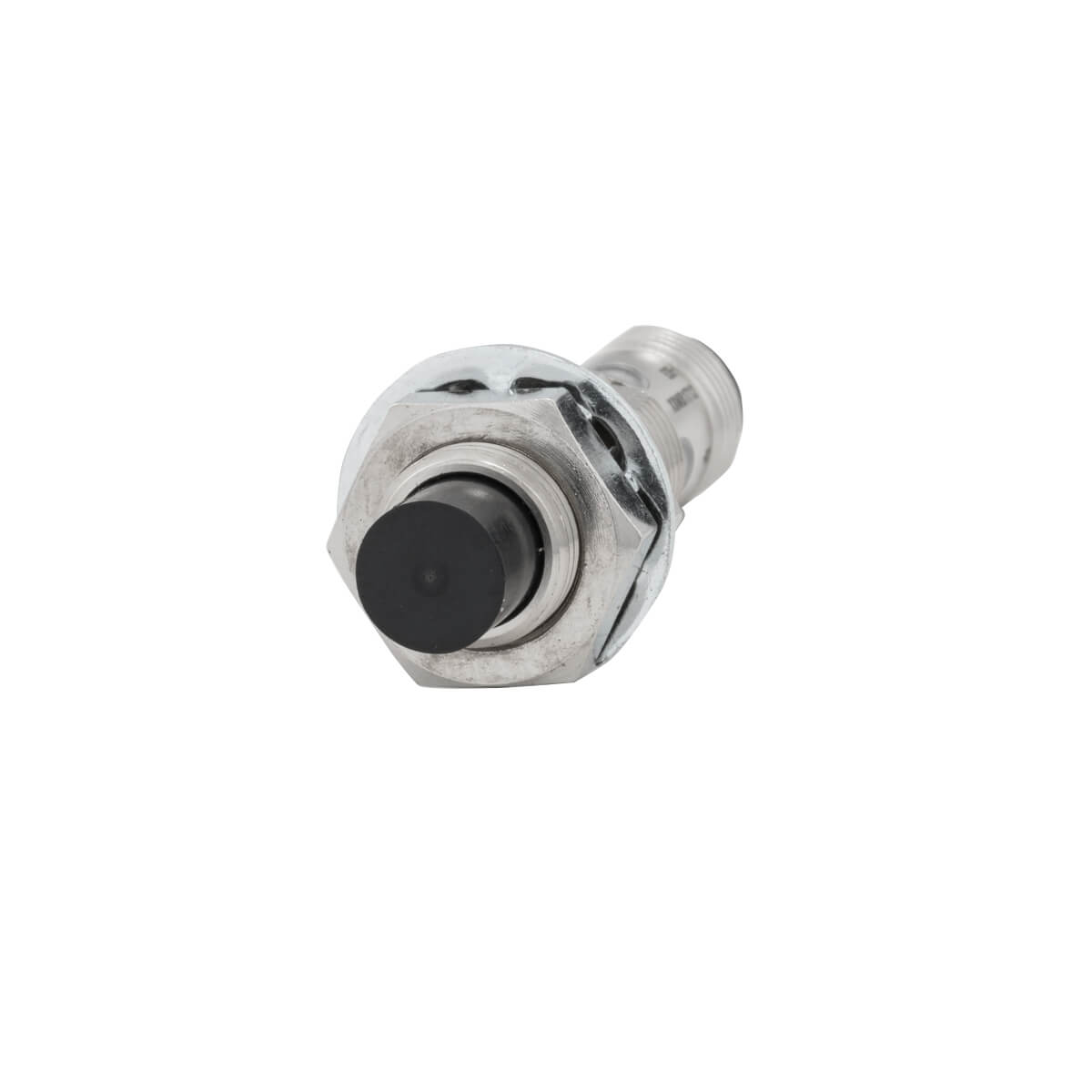
Omron E2E-X8MC112-M1 Inductive Proximity Sensor
| Feature | Value |
|---|---|
| Sensor Type | Inductive Proximity Sensor |
| Series | E2E NEXT |
| Housing Size | M12 |
| Mounting Type | Non-flush |
| Sensing Distance | 8 mm |
| Output Type | NPN |
| Operation Mode | Normally Open |
| Connection Method | M12 Connector |
| Housing Material | Nickel-Plated Brass |
| Overall Length | 48 mm |
| Thread Length | 26 mm |
| IO-Link Function | Not Applicable |
| Protection Rating | IP67 / IP69K |
Technical Description
The Omron E2E-X8MC112-M1 Inductive Proximity Sensor is a cylindrical M12 sensor designed for non-contact detection of metallic targets in industrial automation systems. It belongs to the Omron E2E NEXT series and uses an unshielded, non-flush sensing structure with an 8 mm rated sensing distance. This configuration is suitable for applications where the target may not always pass extremely close to the sensing face.
The Omron E2E-X8MC112-M1 Inductive Proximity Sensor uses an NPN normally open output and an M12 connector interface. Unlike fixed-cable versions, the connector type allows the sensor cable to be selected separately according to panel distance, routing path, maintenance concept, or machine design standard.
Working Principle
Inductive proximity sensors operate by creating an electromagnetic field at the sensing face. When a conductive metal object enters this field, eddy currents are generated in the target. These eddy currents change the sensor oscillator condition, and the internal circuit converts that change into a switching signal.
This contactless detection method is widely used in automation because it avoids mechanical wear. In moving machine assemblies, linear transfer systems, rotary indexing units, or fixture monitoring stations, the sensor can detect metal parts without requiring a lever, roller, or mechanical actuator.
Use Areas
- Metal part presence detection
- Machine position confirmation
- Fixture and clamp position monitoring
- Automated conveyor indexing
- Robot cell tooling verification
- Packaging machine position feedback
- Assembly line component detection
- Industrial handling equipment
Industrial Applications
Assembly Automation
In automated assembly equipment, the sensor can be used to verify whether a metal component has reached the correct location before the next operation begins. This helps prevent incorrect sequencing in pneumatic, electric, or servo-driven mechanisms.
Machine Tool Systems
Machine tools can use the Omron E2E-X8MC112-M1 Inductive Proximity Sensor to detect slide positions, turret positions, guards, or workpiece holders. The contactless principle is useful where coolant, vibration, and repeated movement are present.
Conveyor and Transfer Lines
In transfer applications, the M12 connector structure supports modular replacement. When a sensor is installed in a conveyor section or transfer station, maintenance teams can disconnect the cordset without removing the complete cable route.
Robotic Workstations
Robot cells often require confirmation that grippers, fixtures, or metal nests are in the correct position. An M12 inductive sensor can provide a discrete signal to the PLC before robot movement continues.
Advantages
- Non-contact detection reduces mechanical wear
- 8 mm sensing distance supports practical installation tolerance
- M12 connector simplifies replacement and cable management
- Nickel-plated brass body provides mechanical durability
- IP67 and IP69K protection ratings support demanding environments
- NPN normally open output suits many industrial input systems
- Short body construction helps in compact machine layouts
For related models and compatible sensing families, review Omron sensor products used in industrial automation and machine control applications.
Sector-Based Usage Examples
Automotive Component Assembly
A fixture station may use the sensor to confirm that a stamped metal bracket is seated before a press or fastening cycle starts. This prevents process errors caused by missing or misaligned parts.
Packaging Machinery
In a cartoning or filling machine, the sensor may detect metal cam positions or confirm mechanical end positions. The M12 connector layout supports faster replacement during scheduled maintenance.
Logistics Automation
Automated material handling systems can use inductive sensing to detect metal carriers, shuttle positions, or mechanical stops. The sensor output can be connected to a PLC input module for system sequencing.
Industrial Equipment Manufacturing
Machine builders may specify the Omron E2E-X8MC112-M1 Inductive Proximity Sensor when they need a connector-based M12 sensor with non-flush mounting and 8 mm metal detection capability.
Selection Considerations
Before selecting this sensor, the application should be checked for target material, mounting conditions, available installation space, electrical input compatibility, and environmental exposure. Since this model is non-flush, enough free space around the sensing face should be provided according to the installation requirements.
- Confirm that the control system accepts NPN output signals
- Check whether normally open logic is suitable for the machine sequence
- Verify that the 8 mm sensing distance is adequate for the target position
- Use a compatible M12 cordset for the installation environment
- Review ingress protection needs for washdown or dusty areas
- Consider mechanical clearance around non-flush mounting zones
- Ensure cable routing does not expose the connector to unnecessary mechanical stress
Frequently Asked Questions
1. What is the sensing distance of this model?
The rated sensing distance of the Omron E2E-X8MC112-M1 Inductive Proximity Sensor is 8 mm.
2. Is this sensor flush mountable?
No. It is a non-flush sensor, so it requires appropriate clearance around the sensing face during installation.
3. What type of output does it provide?
It provides an NPN normally open output.
4. What connection method does the sensor use?
This model uses an M12 connector instead of an integrated cable.
5. What housing material is used?
The housing is made from nickel-plated brass.
6. Does this model support IO-Link?
No. The IO-Link function is listed as not applicable for this model.
7. Where is this sensor commonly used?
It is used in machine tools, conveyors, transfer systems, robotic cells, packaging equipment, and assembly automation.
8. Why choose a connector type instead of a fixed cable type?
A connector type can simplify sensor replacement, reduce downtime during maintenance, and allow different cable lengths or cable materials to be selected separately.
9. Can it be used in environments with water exposure?
The sensor has IP67 and IP69K protection ratings, so it is suitable for many industrial environments where moisture or cleaning processes may occur.
10. What should be checked before installation?
Engineers should check target distance, NPN input compatibility, mounting clearance, connector orientation, cable routing, and environmental protection requirements.