
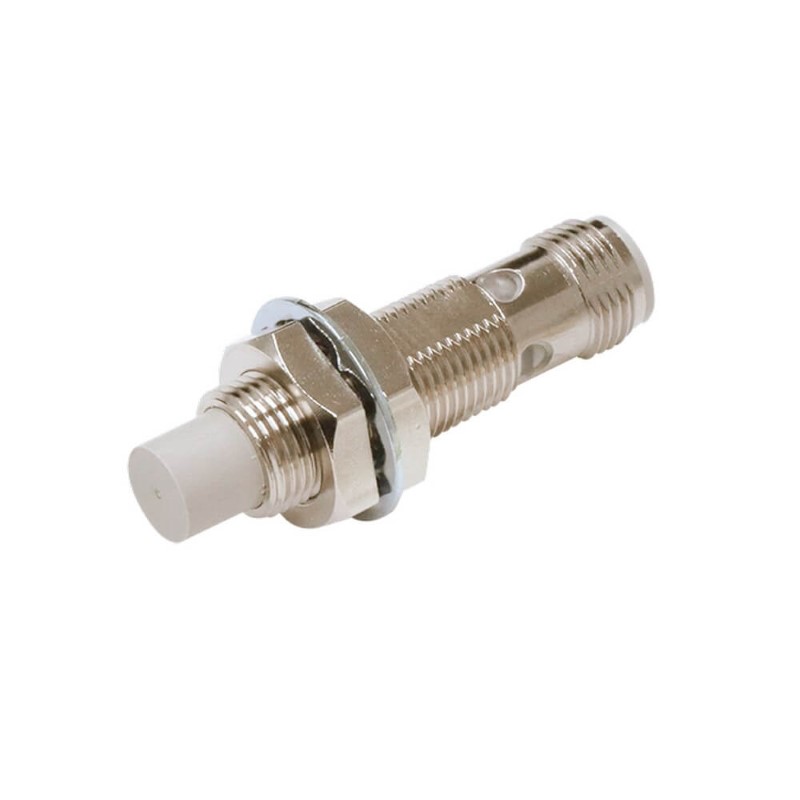
Omron E2E-X8MB212-M1 Inductive Proximity Sensor
| Feature | Value |
|---|---|
| Sensor Type | Inductive Proximity Sensor |
| Series | E2E NEXT |
| Housing Size | M12 Cylindrical Threaded |
| Sensing Distance | 8 mm |
| Mounting Type | Non-Flush (Unshielded) |
| Output Type | PNP Normally Closed (NC) |
| Supply Voltage | 10 to 30 VDC |
| Connection Method | M12 Connector |
| Response Frequency | 800 Hz |
| Current Consumption | 16 mA max. |
| Load Current | 200 mA max. |
| Operating Temperature | -40°C to +85°C |
| Protection Rating | IP67 / IP69K |
| Housing Material | Nickel-Plated Brass |
| Overall Length | 48 mm |
The Omron E2E-X8MB212-M1 Inductive Proximity Sensor is designed for non-contact detection of metallic objects in industrial automation systems. As part of the E2E NEXT series, this sensor combines a compact M12 cylindrical body with an extended sensing distance of 8 mm, allowing installation flexibility in machinery, material handling equipment, and production lines. Its non-flush design enables a wider sensing field while maintaining stable operation in demanding industrial environments.
The Omron E2E-X8MB212-M1 Inductive Proximity Sensor features a PNP normally closed output configuration and supports operation from 10 to 30 VDC. The sensor is equipped with an M12 connector interface, simplifying integration into modern control systems and reducing installation time. Its IP67 and IP69K protection ratings support use in environments exposed to dust, moisture, washdown procedures, and temperature fluctuations. :contentReference[oaicite:0]{index=0}
Technical Description
This sensor utilizes electromagnetic induction technology to detect metallic targets without physical contact. The sensing face generates a high-frequency electromagnetic field. When a conductive metal object enters this field, eddy currents are induced within the target material. These currents alter the oscillator characteristics inside the sensor, allowing the detection circuit to switch the output state.
The Omron E2E-X8MB212-M1 Inductive Proximity Sensor is optimized for ferrous metal detection and provides reliable operation in automated equipment where consistent target recognition is required. The nickel-plated brass housing offers mechanical durability and corrosion resistance suitable for industrial installations. :contentReference[oaicite:1]{index=1}
Operating Principle
Inductive proximity sensors operate by generating an oscillating magnetic field at the sensing face. Under normal conditions, the oscillator remains stable. As a metal target approaches the sensing zone, energy is absorbed from the field through induced eddy currents.
The internal circuitry continuously monitors oscillator amplitude. Once the predefined threshold is reached, the sensor changes its output state. Because the process is entirely electronic and contactless, there is no mechanical wear associated with detection.
The 800 Hz response frequency enables the sensor to monitor rapidly moving machine components, making it suitable for high-speed automation tasks. :contentReference[oaicite:2]{index=2}
Typical Areas of Use
- Automated assembly equipment
- Packaging machinery
- Conveyor systems
- Material transfer stations
- Machine tool positioning systems
- Automated storage and retrieval systems
- Robotic end-of-arm tooling verification
- Metal part presence detection
Its 8 mm sensing range provides additional mounting flexibility compared with shorter-range sensors, allowing installation further from moving targets and reducing the risk of accidental mechanical impact. :contentReference[oaicite:3]{index=3}
Industrial Applications
Automotive Manufacturing
In automotive production facilities, the sensor can be used to verify the presence of metal brackets, stamped components, and fixture positioning elements during assembly operations.
Packaging and Logistics
Packaging lines frequently use inductive sensors to monitor machine positions, detect metallic carriers, and verify actuator movement during production cycles.
Machine Building
Equipment manufacturers integrate sensors such as the Omron E2E-X8MB212-M1 Inductive Proximity Sensor into safety interlocks, position monitoring systems, and automated handling equipment.
Food and Beverage Processing
Its IP69K protection rating supports installation in washdown environments where regular cleaning procedures are required. :contentReference[oaicite:4]{index=4}
Advantages
- Extended 8 mm sensing distance
- Compact M12 housing
- Reliable non-contact detection
- High response frequency of 800 Hz
- Wide operating temperature range
- IP67 and IP69K environmental protection
- Durable nickel-plated brass construction
- Connector-based installation for easier maintenance
Industry-Specific Examples
In warehouse automation systems, the sensor may be used to confirm shuttle positioning before automated pallet transfer begins.
In metal fabrication facilities, it can monitor workpiece movement between machining stages and provide feedback to PLC-controlled production cells.
In robotics applications, the sensor can verify fixture engagement before robotic motion is initiated, helping maintain process consistency.
Factors to Consider During Product Selection
- Required sensing distance and target size
- Available installation space
- Output type compatibility with the control system
- Connector versus cable connection requirements
- Environmental protection requirements
- Operating temperature conditions
- Target material characteristics
- Machine cycle speed and response frequency requirements
Engineers evaluating inductive sensing solutions may also review additional Omron sensor products when designing new automation systems.
The Omron E2E-X8MB212-M1 Inductive Proximity Sensor is frequently selected in applications requiring reliable metal detection, high environmental resistance, and compact installation dimensions. Its combination of extended sensing range, rugged housing construction, and industrial protection ratings makes it suitable for a broad range of automation tasks. :contentReference[oaicite:5]{index=5}
Frequently Asked Questions
1. What type of sensor is the E2E-X8MB212-M1?
It is an inductive proximity sensor designed to detect metallic objects without physical contact.
2. What is the sensing distance?
The nominal sensing distance is 8 mm.
3. What output configuration does it use?
The sensor provides a PNP normally closed (NC) output.
4. What supply voltage is required?
It operates from 10 to 30 VDC.
5. Can it operate in washdown environments?
Yes. The IP67 and IP69K ratings support operation in environments exposed to water and cleaning processes.
6. What connection method is provided?
The sensor uses an M12 connector for electrical connection.
7. What materials can it detect?
It is primarily designed for detecting ferrous metallic targets. Detection distance may vary with different metal types.
8. What is the maximum operating temperature?
The sensor supports operation up to +85°C.
9. Is the sensor suitable for high-speed machinery?
Yes. Its 800 Hz response frequency supports fast detection cycles in automated equipment.
10. Where is the Omron E2E-X8MB212-M1 Inductive Proximity Sensor commonly used?
Common applications include conveyors, assembly systems, packaging equipment, machine tools, robotics, and material handling systems.