
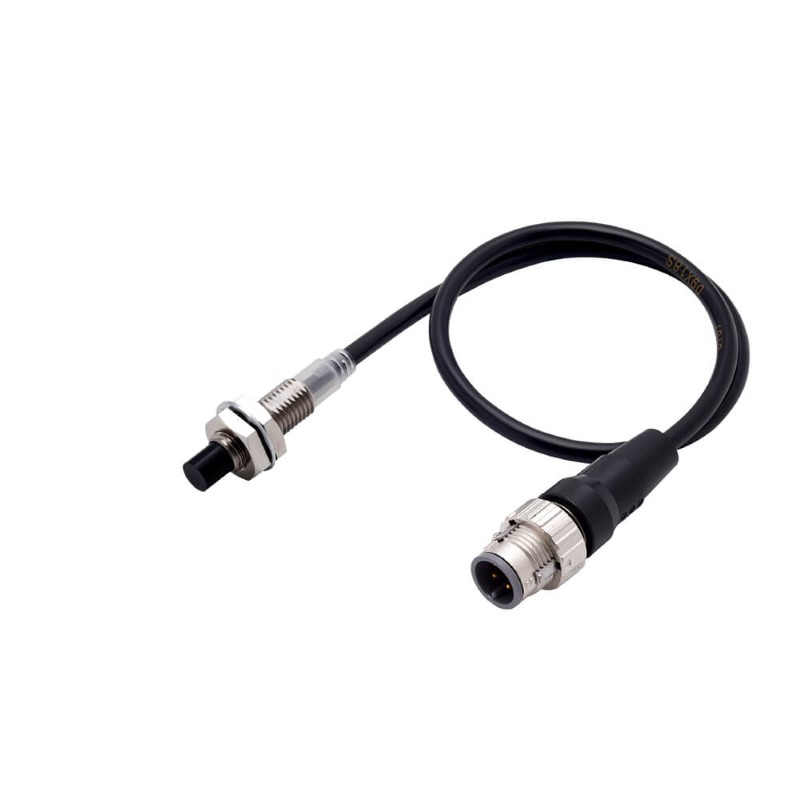
Omron E2E-X8MB1T8-M1TJ 0.3M Inductive Proximity Sensor
| Feature | Value |
|---|---|
| Sensor Type | Inductive Proximity Sensor |
| Series | E2E NEXT |
| Housing Size | M12 |
| Mounting Type | Non-Flush |
| Sensing Distance | 8 mm |
| Output Type | PNP Normally Open |
| Supply Voltage | 10 to 30 VDC |
| Connection | M12 Connector with 0.3 m Pigtail Cable |
| Response Frequency | 800 Hz |
| Housing Material | Nickel-Plated Brass |
| Protection Rating | IP67 / IP67G / IP69K |
| Operating Temperature | -40°C to +85°C |
| Short-Circuit Protection | Yes |
| Reverse Polarity Protection | Yes |
The Omron E2E-X8MB1T8-M1TJ 0.3M Inductive Proximity Sensor is designed for industrial automation systems that require reliable metal object detection and quick sensor replacement. Its pigtail cable with M12 connector configuration simplifies maintenance procedures while supporting efficient integration into modern control architectures.
Technical Description
The Omron E2E-X8MB1T8-M1TJ 0.3M Inductive Proximity Sensor belongs to the E2E NEXT series of cylindrical inductive sensors. It provides an 8 mm sensing distance in a compact M12 housing and utilizes a PNP normally open output configuration suitable for PLC-based automation systems.
The combination of a short pigtail cable and standard M12 connector enables easier field wiring and faster replacement during maintenance activities.
Operating Principle
The sensor generates a high-frequency electromagnetic field at its sensing surface. When a metallic object enters this field, eddy currents are generated within the target material.
The resulting change in oscillation characteristics is detected by the internal circuitry, causing the output state to switch. This contactless detection method minimizes mechanical wear and supports long operational life.
Typical Applications
- Automated assembly stations
- Machine tool position monitoring
- Automotive production equipment
- Packaging machinery
- Material transfer systems
- Industrial robotics
- Automated storage systems
- Metal processing equipment
Industrial Applications
Robotic Work Cells
The Omron E2E-X8MB1T8-M1TJ 0.3M Inductive Proximity Sensor can monitor fixture positions, end-stop locations, and metallic workpiece presence within robotic production cells.
Automated Assembly Equipment
Manufacturers often use inductive sensors to verify the presence of metal components before assembly operations proceed.
Machining Centers
CNC machines employ proximity sensors for position confirmation, tooling verification, and automated safety monitoring functions.
Advantages
- Compact M12 housing
- Fast sensor replacement using M12 connectivity
- Reliable metal detection without contact
- High environmental protection ratings
- Wide operating temperature range
- Integrated electrical protection functions
- Suitable for modern PLC systems
The Omron E2E-X8MB1T8-M1TJ 0.3M Inductive Proximity Sensor supports maintenance-friendly machine designs where rapid replacement and reduced downtime are important considerations.
Engineers seeking additional sensing technologies can review Omron sensor products.
Sector-Specific Examples
- Metal fixture detection in automotive plants
- Position verification on robotic grippers
- Detection of steel carriers in assembly systems
- Monitoring indexing mechanisms in packaging lines
- Workpiece presence confirmation in machining centers
- Transfer shuttle position detection
Selection Considerations
- Required sensing distance
- Connector compatibility
- Available installation space
- Environmental exposure conditions
- Control system requirements
- Target material dimensions
Frequently Asked Questions
What is the sensing distance?
The rated sensing distance is 8 mm.
What type of output is provided?
A PNP normally open output is used.
Does it use a connector?
Yes, it includes a 0.3 m pigtail cable with an M12 connector configuration.
Can it detect aluminum?
Yes, inductive sensors can detect conductive metallic materials, although sensing characteristics may vary.
What is the operating voltage?
10 to 30 VDC.
Is it suitable for washdown environments?
Its IP69K protection rating supports demanding industrial cleaning procedures.
What industries commonly use this sensor?
Automotive, packaging, robotics, logistics, and machine manufacturing industries.
What protection functions are included?
Reverse polarity and short-circuit protection are integrated.