
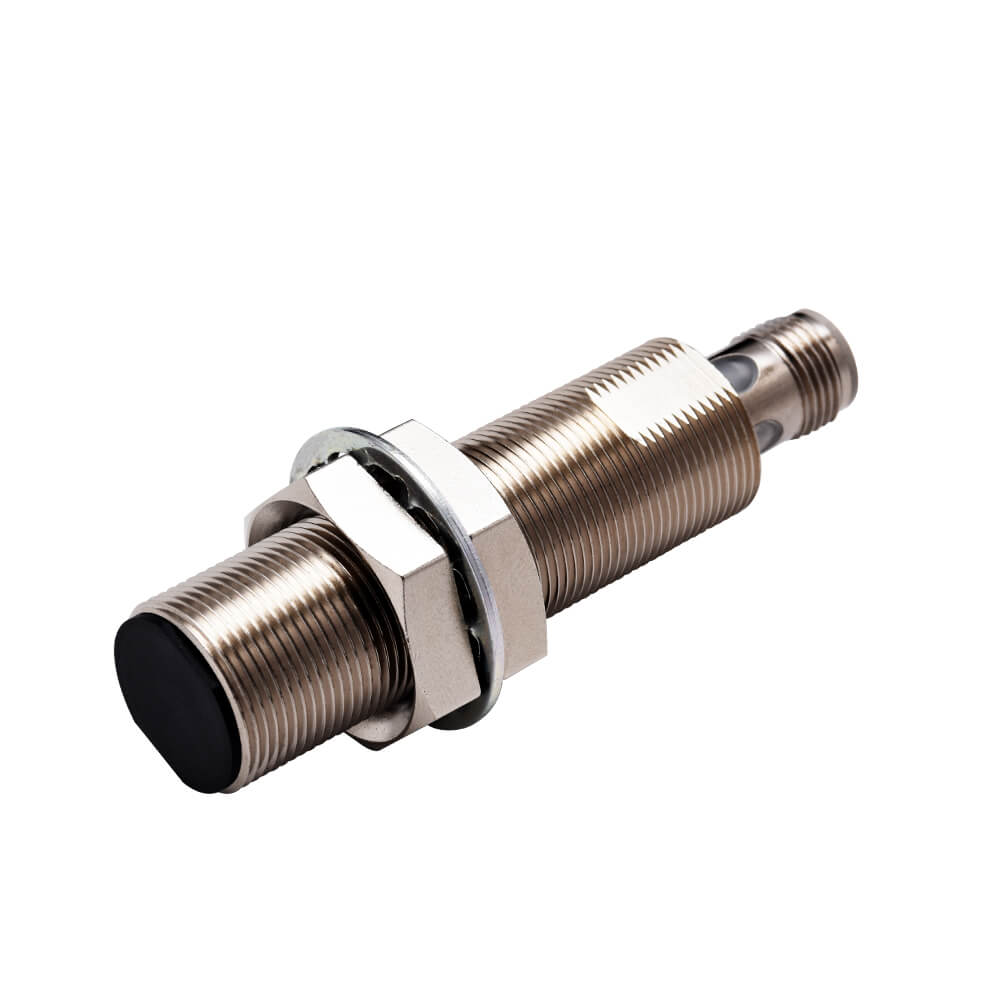
Omron E2E-X8C3L18-M1 Inductive Proximity Sensor
| Feature | Value |
|---|---|
| Product Type | Inductive Proximity Sensor |
| Series | E2E NEXT |
| Sensing Distance | 8 mm |
| Housing Size | M18 |
| Mounting Type | Shielded (Quasi-flush) |
| Output Type | NPN |
| Output Configuration | NO + NC |
| Connection Method | M12 Connector |
| Supply Voltage | 10 to 30 VDC |
| Housing Material | Nickel-Plated Brass |
| Overall Length | 75 mm |
| Thread Length | 60 mm |
| Protection Rating | IP67 / IP69K |
The Omron E2E-X8C3L18-M1 Inductive Proximity Sensor is designed for reliable non-contact detection of metallic targets in industrial automation systems. As part of the E2E NEXT sensor family, this model combines a robust nickel-plated brass housing with a shielded sensing structure and dual-output configuration. The sensor is commonly integrated into machinery where accurate position verification, object presence monitoring, and process control are required.
The Omron E2E-X8C3L18-M1 Inductive Proximity Sensor is suitable for applications exposed to dust, moisture, washdown procedures, and mechanical vibration. Its M18 threaded housing simplifies installation in equipment frames, conveyors, and manufacturing stations.
Technical Overview
This sensor operates with an 8 mm sensing distance and utilizes inductive detection technology for metallic object recognition. The shielded sensing design allows installation close to surrounding metal structures while maintaining stable performance.
The device incorporates both Normally Open (NO) and Normally Closed (NC) NPN outputs, enabling flexible integration into PLC-based control systems, machine controllers, and industrial monitoring equipment.
The nickel-plated brass body provides resistance to mechanical stress and industrial contaminants. IP67 and IP69K protection ratings support deployment in demanding environments where water ingress protection is essential.
Operating Principle
The Omron E2E-X8C3L18-M1 Inductive Proximity Sensor generates a high-frequency electromagnetic field from its sensing face. When a metallic object enters the sensing zone, eddy currents are induced within the target material.
These eddy currents absorb energy from the oscillating field, causing a measurable change within the sensor circuitry. The internal electronics detect this variation and switch the output state accordingly.
Because the sensing process does not require physical contact, the sensor experiences minimal mechanical wear and can operate consistently in high-cycle automation systems.
Applications and Installation Areas
The Omron E2E-X8C3L18-M1 Inductive Proximity Sensor is used in a wide range of automation environments where metallic object detection is required.
- Conveyor positioning systems
- Packaging machinery
- Automated assembly equipment
- Material transfer stations
- Machine tool positioning
- Part counting systems
- Industrial robotics
- Safety interlock monitoring
Its shielded sensing design is particularly useful in installations where mounting space is limited and surrounding metallic structures are present.
Industrial Applications
Automotive Manufacturing
The sensor can monitor fixture positioning, metal component transfer, and automated welding line operations where repeatable target detection is required.
Packaging Industry
Production lines frequently use inductive sensors to verify machine positions, detect metallic tooling components, and synchronize conveyor movements.
Metalworking Facilities
Machine tools and fabrication equipment rely on proximity sensing for position feedback, end-of-travel detection, and process automation.
Material Handling Systems
Automated warehouses and transfer stations utilize sensors for actuator position confirmation and pallet movement monitoring.
Advantages
- Non-contact sensing operation
- Dual NO and NC output configuration
- 8 mm sensing distance
- IP67 and IP69K environmental protection
- Durable nickel-plated brass housing
- Reliable performance near metallic mounting structures
- M12 connector for simplified installation
- Suitable for demanding industrial environments
Engineers often select the Omron E2E-X8C3L18-M1 Inductive Proximity Sensor when a combination of flexible output options and environmental durability is required.
Additional information about related sensing technologies can be found through Omron sensor products.
Industry-Specific Use Cases
- Monitoring metal carrier positions on assembly lines
- Detecting actuator end positions in pneumatic systems
- Verifying workpiece placement before machining cycles
- Position feedback for industrial lifting mechanisms
- Detection of metallic fixtures in robotic cells
- Tracking movement of tooling components in production equipment
Factors to Consider When Selecting This Sensor
Before implementing the Omron E2E-X8C3L18-M1 Inductive Proximity Sensor, engineers should evaluate the target material, available mounting space, environmental conditions, and control system requirements.
The NPN output configuration must be compatible with the receiving PLC or controller inputs. The shielded sensing structure should also be considered when determining installation distances and mounting arrangements.
Environmental requirements such as washdown exposure, vibration levels, and contamination risks should be reviewed to ensure optimal long-term operation.
Frequently Asked Questions
What type of sensor is the Omron E2E-X8C3L18-M1?
It is an inductive proximity sensor designed for non-contact detection of metallic objects.
What is the sensing distance?
The sensor provides an 8 mm sensing distance under specified operating conditions.
Does it support both NO and NC outputs?
Yes. The sensor includes both Normally Open and Normally Closed NPN outputs.
What supply voltage is required?
The sensor operates within a 10 to 30 VDC supply range.
Is the sensor suitable for washdown environments?
Yes. IP67 and IP69K protection ratings support operation in demanding industrial environments.
What connection type does it use?
The device uses an M12 connector interface.
Can it detect non-metallic materials?
No. Inductive proximity sensors are intended for metallic target detection.
Where is this sensor commonly installed?
It is frequently installed on conveyors, machine tools, assembly equipment, packaging machinery, and robotic systems.
What housing material is used?
The sensor body is manufactured from nickel-plated brass.
Why choose a shielded sensor design?
Shielded sensors can be mounted closer to surrounding metal structures while maintaining stable sensing performance.