
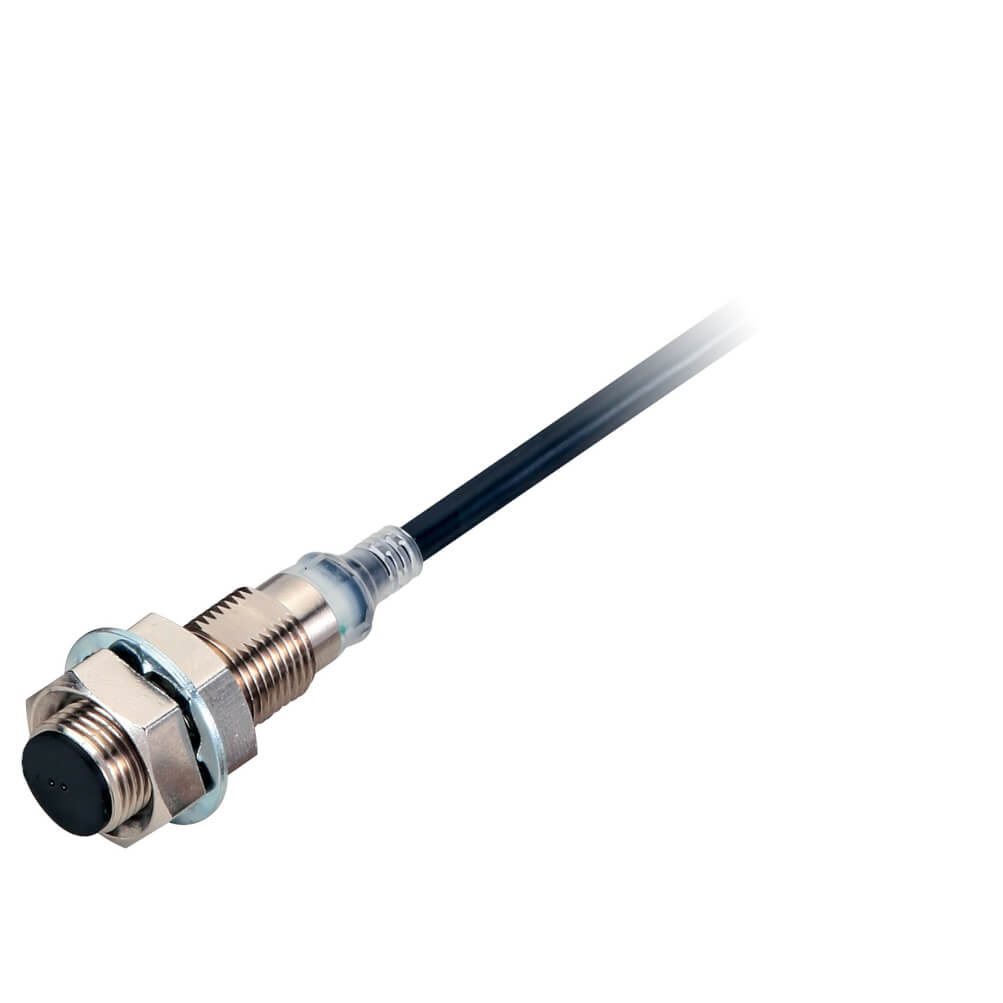
Omron E2E-X7D212-T 2M Inductive Proximity Sensor
| Feature | Value |
|---|---|
| Manufacturer | Omron |
| Model | E2E-X7D212-T 2M |
| Sensor Type | Inductive Proximity Sensor |
| Housing Diameter | M12 |
| Sensing Distance | 7 mm |
| Mounting Method | Shielded (Quasi-flush) |
| Output Configuration | 2-wire |
| Output Logic | Normally Closed (NC) |
| Connection Type | Pre-wired Cable |
| Cable Length | 2 m |
| Housing Material | Nickel-Plated Brass |
| Protection Rating | IP67 / IP67G / IP69K |
| Overall Length | 47.1 mm |
| Series | E2E NEXT |
Technical Description
The Omron E2E-X7D212-T Inductive Proximity Sensor is designed for non-contact detection of metallic objects in industrial automation systems. Built within the E2E NEXT product family, this sensor combines enhanced environmental protection with stable sensing performance and compact installation dimensions. Its M12 cylindrical housing allows straightforward integration into machinery where installation space is limited.
This model features a 7 mm sensing distance and a normally closed two-wire output configuration. The normally closed operating mode is frequently selected in machine control applications where monitoring of sensor circuit continuity is important for operational safety and fault detection.
The Omron E2E-X7D212-T Inductive Proximity Sensor is widely applied in manufacturing environments where accurate metal detection and long-term reliability are essential requirements.
Working Principle
The sensor operates by generating an electromagnetic field from the sensing surface. When a metallic object enters the detection zone, eddy currents are induced in the target material. These currents affect the oscillation characteristics of the sensor’s internal circuitry.
The electronic control circuit continuously evaluates these changes and switches the output once the predefined sensing threshold is reached. Because the detection process does not involve physical contact, wear is minimized and operational consistency is maintained over extended periods.
The Omron E2E-X7D212-T Inductive Proximity Sensor is specifically intended for metallic target detection and can be integrated into a wide variety of automated systems.
Common Areas of Use
This sensor is suitable for industrial applications requiring dependable presence detection of conductive metal components.
- Production machinery
- Automated assembly systems
- Industrial conveyors
- Packaging equipment
- Machine tool installations
- Automated transfer systems
- Robotic production cells
- Metal fabrication machinery
Industrial Application Examples
Manufacturing Lines
The sensor can verify the presence of metallic workpieces before automated assembly operations begin, helping maintain process consistency.
Conveyor Automation
Metal pallets, carriers, and fixtures moving through conveyor systems can be monitored accurately using inductive sensing technology.
Machining Equipment
CNC machinery and automated production equipment often use proximity sensors to confirm fixture positions and machine component status.
Robotic Handling Systems
Robotic workstations may utilize the sensor to verify gripper positions, tooling status, and part presence before initiating movement sequences.
Advantages of the Sensor
- Reliable detection of metallic objects
- Compact M12 housing design
- Normally closed output configuration
- Non-contact sensing technology
- High resistance to industrial contaminants
- Durable nickel-plated brass construction
- Suitable for demanding industrial environments
- IP67, IP67G, and IP69K protection ratings
These features allow the Omron E2E-X7D212-T Inductive Proximity Sensor to perform effectively in applications where environmental durability and reliable detection are required.
Sector-Specific Usage Examples
- Position monitoring in automotive production equipment
- Detection of metallic tooling in machining centers
- Monitoring transfer mechanisms in logistics systems
- Verifying pallet presence in warehouse automation
- Monitoring machine movements in packaging facilities
- Detecting steel fixtures in assembly machinery
Additional sensing technologies and related automation components can be explored through Omron sensor solutions for system-wide integration projects.
Factors to Consider During Selection
Selecting an inductive proximity sensor requires evaluation of application-specific operating conditions and system requirements.
- Sensing distance requirements
- Target material properties
- Available installation space
- Environmental conditions
- Output logic preferences
- Cable routing requirements
- Control system compatibility
- Required protection rating
The Omron E2E-X7D212-T Inductive Proximity Sensor is often selected for applications where normally closed operation is preferred for machine monitoring purposes.
Frequently Asked Questions
1. What is the primary function of this sensor?
The sensor detects metallic objects without physical contact using inductive sensing technology.
2. What is the sensing distance?
The rated sensing distance is 7 mm.
3. What output logic does this model provide?
This version uses a normally closed (NC) output configuration.
4. How long is the cable?
The sensor includes a 2-meter pre-wired cable.
5. What type of housing does it use?
The sensor features an M12 nickel-plated brass cylindrical housing.
6. Can it detect non-metallic materials?
The sensor is specifically designed for metallic target detection.
7. What industries commonly use this sensor?
Automotive manufacturing, packaging, logistics, machine building, and metalworking industries frequently use this sensor type.
8. What protection ratings are available?
The device is rated IP67, IP67G, and IP69K.
9. Why is non-contact sensing advantageous?
Non-contact operation reduces mechanical wear and minimizes maintenance requirements.
10. Where is the Omron E2E-X7D212-T Inductive Proximity Sensor commonly installed?
It is commonly installed in automated machinery, conveyor systems, robotic cells, and industrial production equipment.