
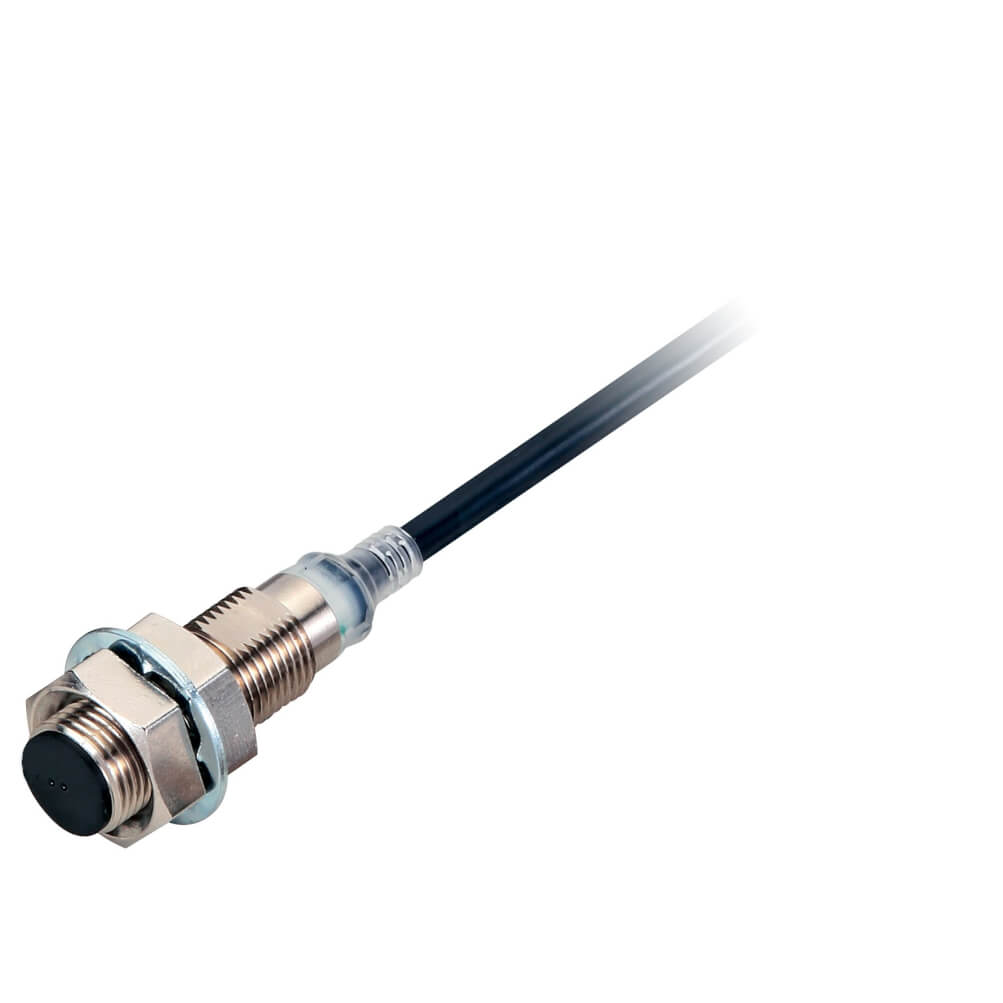
Omron E2E-X7D212-R 2M Inductive Proximity Sensor
| Feature | Value |
|---|---|
| Manufacturer | Omron |
| Model | E2E-X7D212-R 2M |
| Sensor Type | Inductive Proximity Sensor |
| Housing Size | M12 Cylindrical |
| Sensing Distance | 7 mm |
| Mounting Style | Shielded (Quasi-flush) |
| Output Configuration | 2-wire |
| Operation Mode | NO (Normally Open) |
| Connection Type | Pre-wired Cable |
| Cable Length | 2 m |
| Housing Material | Nickel-Plated Brass |
| Protection Rating | IP67 / IP67G / IP69K |
| Overall Length | 47.1 mm |
| Thread Diameter | M12 |
Technical Description
The Omron E2E-X7D212-R Inductive Proximity Sensor is a compact sensing device developed for reliable detection of metallic targets in automated equipment. As part of the E2E NEXT family, this sensor incorporates enhanced environmental resistance and stable detection characteristics while maintaining compatibility with common industrial control systems.
Featuring a 7 mm sensing distance and a normally open two-wire output, the sensor is intended for applications where metallic object presence must be monitored without direct mechanical contact. Its M12 cylindrical housing allows installation in machinery with limited mounting space while providing strong resistance to vibration and mechanical stress.
The Omron E2E-X7D212-R Inductive Proximity Sensor is commonly integrated into automated production lines, conveying systems, and equipment requiring accurate position monitoring.
Operating Principle
The sensor generates a high-frequency electromagnetic field at its sensing face. When a conductive metal object enters this field, induced eddy currents modify the oscillation characteristics of the sensor’s internal circuit.
These changes are continuously analyzed by the electronic control section. Once the target reaches the specified sensing range, the output changes state and provides a signal to connected control devices such as PLCs, motion controllers, or machine monitoring systems.
Because the detection process occurs without physical contact, the sensor minimizes wear and contributes to long operational service life.
Typical Areas of Use
The Omron E2E-X7D212-R Inductive Proximity Sensor is suitable for various industrial automation tasks requiring dependable metallic object detection.
- Automated conveyor systems
- Assembly line positioning
- Industrial machinery monitoring
- Packaging equipment
- Robotic handling cells
- Metal fabrication systems
- Material transport equipment
- Production process automation
Industrial Applications
Assembly Automation
In assembly facilities, the sensor can verify the arrival of metal components before automated fastening, pressing, or inspection operations are executed.
Conveyor Monitoring
Material handling systems often rely on inductive sensors to detect metal pallets, carriers, and fixtures moving between process stations.
Machine Building
Machine manufacturers use proximity sensors for position feedback, end-of-travel confirmation, and mechanical sequence verification.
Robotic Production Cells
Industrial robots frequently require confirmation that tooling, grippers, or fixtures are positioned correctly before executing programmed movements.
Benefits in Automation Systems
- Non-contact metal detection
- Stable sensing performance
- Compact M12 housing
- Reduced mechanical wear
- Two-wire wiring simplicity
- High environmental protection ratings
- Durable brass housing construction
- Suitable for demanding industrial conditions
These characteristics allow the Omron E2E-X7D212-R Inductive Proximity Sensor to operate effectively in environments where contamination, moisture, and mechanical vibration are present.
Sector-Specific Usage Examples
- Detecting steel carriers in automotive assembly systems
- Monitoring tooling position in machining centers
- Verifying pallet movement in logistics equipment
- Detecting metallic containers in packaging facilities
- Position monitoring in automated warehousing systems
- Monitoring machine guards and movable components
Engineers developing automation projects can also review Omron sensor series when selecting compatible sensing technologies for integrated machine designs.
Important Selection Criteria
Selecting the correct proximity sensor requires evaluation of both electrical and mechanical requirements.
- Required sensing distance
- Target dimensions and material
- Mounting limitations
- Output logic requirements
- Cable routing considerations
- Environmental exposure conditions
- Ingress protection requirements
- Control system compatibility
The Omron E2E-X7D212-R Inductive Proximity Sensor is particularly suitable where compact installation dimensions and reliable metallic object detection are essential.
Frequently Asked Questions
1. What does the sensor detect?
The sensor is designed for detecting metallic objects using inductive sensing technology.
2. What is the rated sensing distance?
The rated sensing distance is 7 mm.
3. Is the output normally open or normally closed?
This model provides a normally open (NO) output.
4. What type of wiring configuration is used?
The sensor uses a two-wire DC configuration.
5. What is the cable length?
The sensor is supplied with a 2-meter pre-wired cable.
6. Is the sensor suitable for washdown environments?
Its IP67, IP67G, and IP69K protection ratings support operation in harsh industrial environments where water exposure may occur.
7. What industries commonly use this sensor?
Automotive manufacturing, packaging, machine building, logistics, and metalworking industries frequently utilize this type of sensor.
8. Does the sensor require physical contact with the target?
No. Detection occurs through an electromagnetic field and does not require physical contact.
9. What housing material is used?
The body is manufactured from nickel-plated brass for improved durability.
10. Why choose an inductive sensor for metallic object detection?
Inductive sensing offers reliable operation, resistance to contamination, and long service life due to its non-contact detection method.