
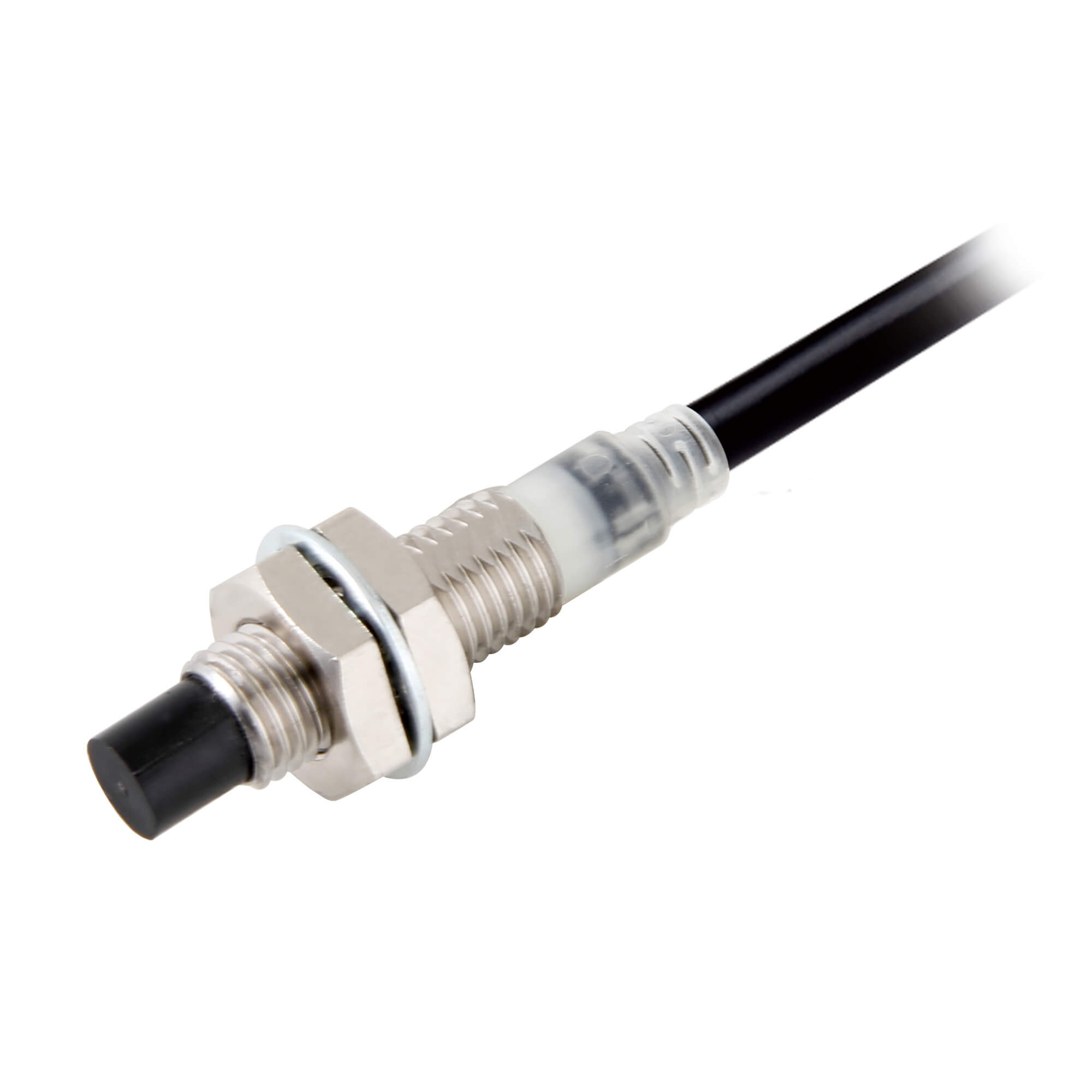
Omron E2E-X6MD18-R 5M Inductive Proximity Sensor
| Feature | Value |
|---|---|
| Sensor Type | Inductive Proximity Sensor |
| Series | E2E NEXT |
| Housing Diameter | M18 |
| Mounting Style | Non-Flush |
| Sensing Distance | 6 mm |
| Output Type | DC 2-Wire Normally Closed |
| Connection Method | Pre-Wired Cable |
| Cable Length | 5 m |
| Housing Material | Stainless Steel |
| Cable Material | Oil-Resistant PVC |
| Protection Rating | IP67 / IP67G / IP69K |
| Thread Length | 35 mm |
| Operating Principle | Electromagnetic Induction |
Position monitoring and metallic object detection are essential functions in modern automation systems. The Omron E2E-X6MD18-R 5M inductive proximity sensor is designed to provide stable non-contact detection of metal targets while supporting installation in industrial environments that demand mechanical durability and environmental protection.
As part of the E2E NEXT family, this sensor combines an extended 5-meter cable, a robust stainless-steel housing, and a 6 mm sensing distance. The design is suitable for machine builders, panel integrators, and maintenance engineers working with automated production equipment, transport systems, and industrial machinery.
The Omron E2E-X6MD18-R Inductive Proximity Sensor features a normally closed DC 2-wire output configuration. This operating mode is frequently selected in applications where continuous signal monitoring and circuit integrity verification are required.
Technical Overview
The sensor incorporates an M18 threaded cylindrical body that supports straightforward mechanical integration into industrial equipment. The stainless-steel housing provides protection against vibration, impact, and exposure to demanding production environments.
The 5-meter pre-wired cable allows installation over greater distances without requiring additional connector assemblies. This can simplify cable routing in large machinery, automated conveyor networks, and distributed sensing systems.
The Omron E2E-X6MD18-R Inductive Proximity Sensor utilizes a non-flush sensing design that enables the specified sensing distance while maintaining stable operation when installed correctly.
Operating Principle
The sensor generates a high-frequency electromagnetic field from its sensing surface. When a conductive metal object enters the sensing zone, eddy currents are induced within the target.
These currents alter the characteristics of the oscillation circuit inside the sensor. The electronics continuously monitor these changes and switch the output once the detection threshold is reached.
This detection method allows the sensor to operate without physical contact with the target object. As a result, wear-related issues associated with mechanical switches are significantly reduced.
Typical Areas of Use
- Automated manufacturing lines
- Conveyor transport systems
- Industrial robotics
- Machine tools
- Packaging equipment
- Material handling machinery
- Metalworking systems
- Assembly automation equipment
The sensor can verify the presence of metallic components before automated operations begin. It can also monitor actuator positions, machine movements, and transport mechanisms within industrial processes.
Industrial Applications
Large Conveyor Installations
The extended cable length is particularly useful in conveyor systems where control cabinets may be located at considerable distances from sensing points. The sensor can detect metallic carriers, fixtures, and transport elements throughout the production flow.
Automated Warehousing
Distribution centers often utilize metal-guided transport equipment and automated storage systems. The sensor can provide reliable detection of metallic positioning components and moving mechanical assemblies.
Heavy Machinery Manufacturing
Equipment manufacturers may integrate the sensor into production machinery to monitor machine positions, moving structures, and operational sequences that involve metallic components.
Automotive Component Production
Automotive suppliers frequently use inductive sensors to verify workpiece positioning and fixture engagement during assembly and inspection processes.
Advantages
- Non-contact metal detection.
- Extended 5-meter cable supports flexible installation.
- Durable stainless-steel housing.
- Suitable for demanding industrial environments.
- Normally closed output configuration.
- Resistance to moisture and washdown conditions.
- Stable sensing performance.
- Reduced maintenance compared to contact switches.
Sector-Specific Examples
In logistics automation, the sensor can monitor metallic guide structures used within sorting systems. In machinery production facilities, it may be integrated into automated fixtures to confirm proper positioning before machining operations commence.
Within process industries, the Omron E2E-X6MD18-R Inductive Proximity Sensor can support equipment monitoring functions where metallic moving parts require reliable position feedback.
Additional industrial sensing technologies and related products can be explored through Omron sensor products for broader automation system integration.
Selection Considerations
- Confirm that metallic targets are being detected.
- Verify suitability of the normally closed output configuration.
- Review cable routing requirements for the 5-meter lead.
- Ensure proper non-flush installation conditions.
- Evaluate environmental exposure requirements.
- Check compatibility with the control system.
- Confirm the required sensing distance.
Frequently Asked Questions
What is the sensing distance of the sensor?
The rated sensing distance is 6 mm.
What output configuration is provided?
The sensor uses a DC 2-wire normally closed output.
How long is the cable?
The sensor includes a factory-attached 5-meter cable.
Omron E2E-X6MD18-R Can it detect plastic or wood?
No. The sensor is designed for metallic object detection only.
What material is used for the housing?
The housing is manufactured from stainless steel.
Is the sensor suitable for washdown environments?
Yes. The sensor is rated IP67, IP67G, and IP69K.
Where is the Omron E2E-X6MD18-R Inductive Proximity Sensor commonly applied?
It is commonly used in conveyors, robotics, machine tools, packaging systems, and industrial automation equipment.
What mounting configuration does the sensor require?
The sensor is designed for non-flush mounting installations.
Why choose a 5-meter cable version?
The longer cable simplifies installation when sensing points are located farther from control panels or connection points.
How does the sensor detect metallic objects?
Detection occurs through electromagnetic induction and eddy current generation within conductive targets.