
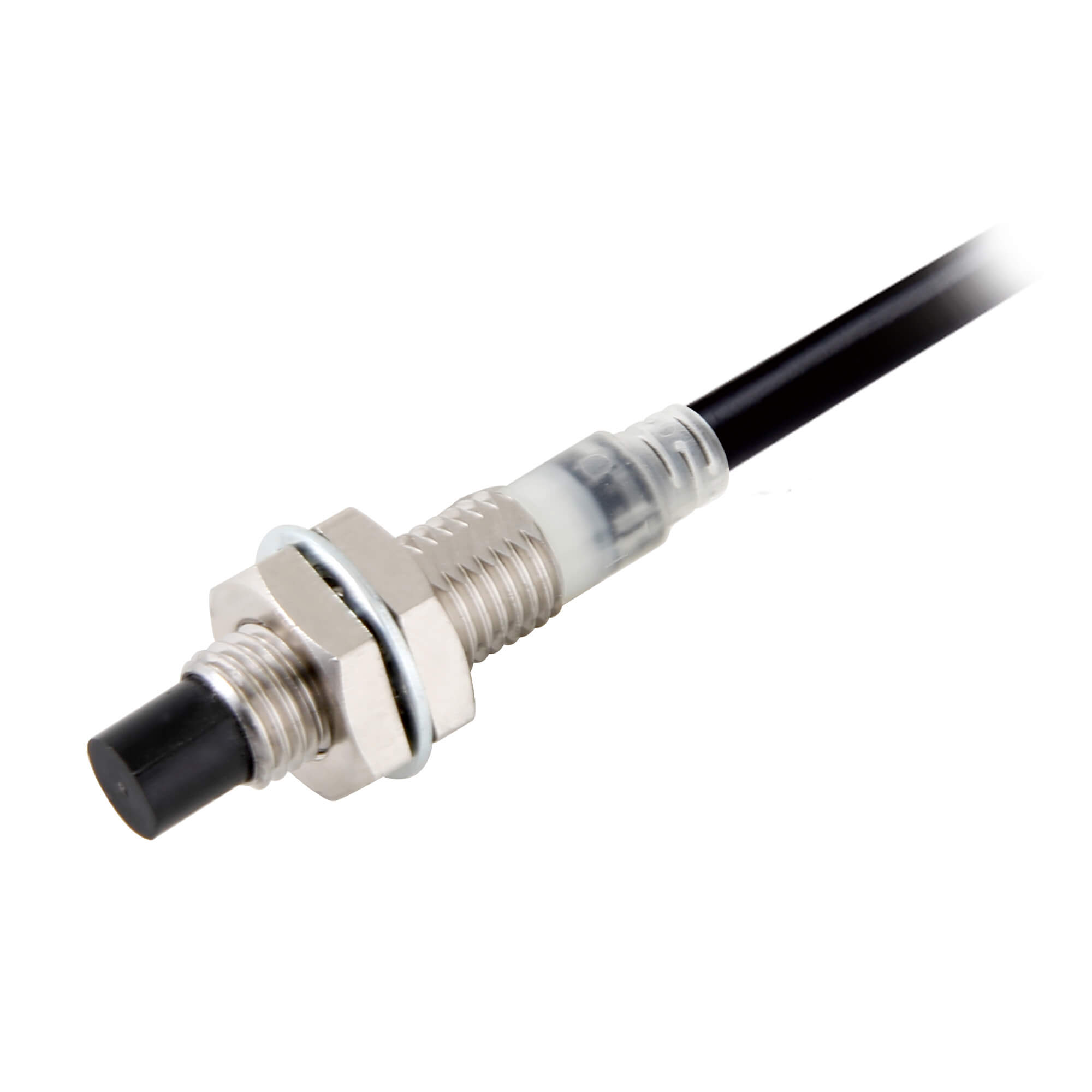
Omron E2E-X6MD18-TR 5M Inductive Proximity Sensor
| Feature | Value |
|---|---|
| Manufacturer | Omron |
| Model | E2E-X6MD18-TR 5M |
| Sensor Type | Inductive Proximity Sensor |
| Sensing Distance | 6 mm |
| Mounting Type | Non-flush |
| Output Type | DC 2-wire |
| Operation Mode | Normally Closed (NC) |
| Supply Voltage | 10 to 30 VDC |
| Response Frequency | 250 Hz |
| Housing Size | M18 |
| Housing Material | Nickel-plated Brass |
| Cable Length | 5 m |
| Protection Rating | IP67 / IP67G / IP69K |
| Operating Temperature | -25°C to +70°C |
Industrial automation systems frequently require dependable detection devices capable of operating in environments where physical contact is impractical. The Omron E2E-X6MD18-TR 5M Inductive Proximity Sensor is engineered for such applications, offering non-contact metal detection with a robust mechanical design and extended cable length for flexible installation.
As part of Omron’s E2E series, this sensor supports machine builders, automation integrators, and maintenance engineers who require stable switching performance in manufacturing facilities, handling systems, and process equipment. Its normally closed output configuration is particularly suitable for monitoring applications where signal continuity is important during standard operating conditions.
Technical Description
The Omron E2E-X6MD18-TR 5M Inductive Proximity Sensor is a cylindrical M18 inductive sensor designed to detect metallic targets within a 6 mm sensing range. The non-flush installation design enables a larger sensing field compared to shielded sensor variants.
The sensor operates from a 10 to 30 VDC supply and incorporates a DC 2-wire output structure. A 5-meter integrated cable simplifies installation where control panels or junction points are located at greater distances from sensing positions.
The Omron E2E-X6MD18-TR 5M Inductive Proximity Sensor is widely used in equipment where accurate metal object detection must be maintained despite exposure to dust, moisture, vibration, or industrial contaminants.
Operating Principle
The sensing face generates a high-frequency electromagnetic field. When a conductive metal object enters this field, eddy currents are produced within the target material. These currents absorb energy from the oscillator circuit inside the sensor.
The internal electronics continuously analyze changes in oscillation amplitude. Once the variation reaches the switching threshold, the output state changes and communicates the detection event to the connected control system.
This contactless operating principle eliminates mechanical wear and enables reliable performance across repetitive industrial sensing cycles.
Applications and Usage Areas
- Automated manufacturing systems
- Machine position monitoring
- Transfer and conveyor equipment
- Industrial assembly lines
- Material handling systems
- Metal component verification
- Robotic production cells
- Packaging machinery
Engineers evaluating alternative sensing technologies may also explore Daha fazla Omron sensör çözümü for broader automation requirements.
Industrial Applications
Robotic Production Systems
The sensor can monitor fixture positions and detect metallic workpieces before robotic handling operations are executed.
Automated Material Handling
Transfer stations and conveyor mechanisms frequently use inductive sensors to verify carrier presence and positioning.
Machine Tool Equipment
In machining centers, the sensor can detect fixture positions, moving machine elements, and mechanical status points.
Industrial Packaging Facilities
Packaging systems use inductive sensors to monitor metallic indexing components and synchronize machine movement.
Advantages
- Reliable metallic object detection
- Extended 5-meter cable for flexible installation
- Compact M18 threaded housing
- Non-contact sensing operation
- Normally closed switching configuration
- High resistance to industrial contaminants
- Suitable for washdown environments
- Reduced maintenance requirements
Industry-Specific Examples
In beverage production facilities, the sensor may be used to monitor metal transport components within packaging equipment.
In logistics centers, it can provide position feedback from conveyor transfer mechanisms.
Within automotive component manufacturing, the sensor can verify workpiece presence before assembly operations begin.
In industrial machinery, it may monitor actuator positions and machine sequence status signals.
Factors to Consider During Product Selection
- Required sensing distance
- Output logic requirements
- Installation space limitations
- Cable routing distances
- Environmental protection requirements
- Target material characteristics
- Electrical interface compatibility
- Machine operating conditions
Proper sensor selection requires evaluating both electrical and mechanical installation requirements to ensure consistent performance throughout the equipment lifecycle.
Frequently Asked Questions
What is the sensing distance of this sensor?
The rated sensing distance is 6 mm.
What output type does the sensor use?
The device utilizes a DC 2-wire output configuration.
What is the operating mode?
The sensor operates with a Normally Closed output.
Can the sensor detect non-metallic materials?
No. It is designed specifically for metallic target detection.
What cable length is included?
The sensor is supplied with a 5-meter integrated cable.
Is the sensor suitable for washdown environments?
Yes. Its protection ratings support operation in demanding industrial environments.
Which industries commonly use the Omron E2E-X6MD18-TR 5M Inductive Proximity Sensor?
Manufacturing, logistics, packaging, machine building, and material handling industries commonly utilize this sensor.
Does the sensor require maintenance?
Routine inspection is recommended, but the non-contact design minimizes wear-related maintenance.
What housing size does the sensor use?
The sensor features an M18 cylindrical threaded housing.
Why is the Omron E2E-X6MD18-TR 5M Inductive Proximity Sensor used in automation systems?
It provides reliable non-contact detection of metallic objects while maintaining stable operation under industrial conditions.