
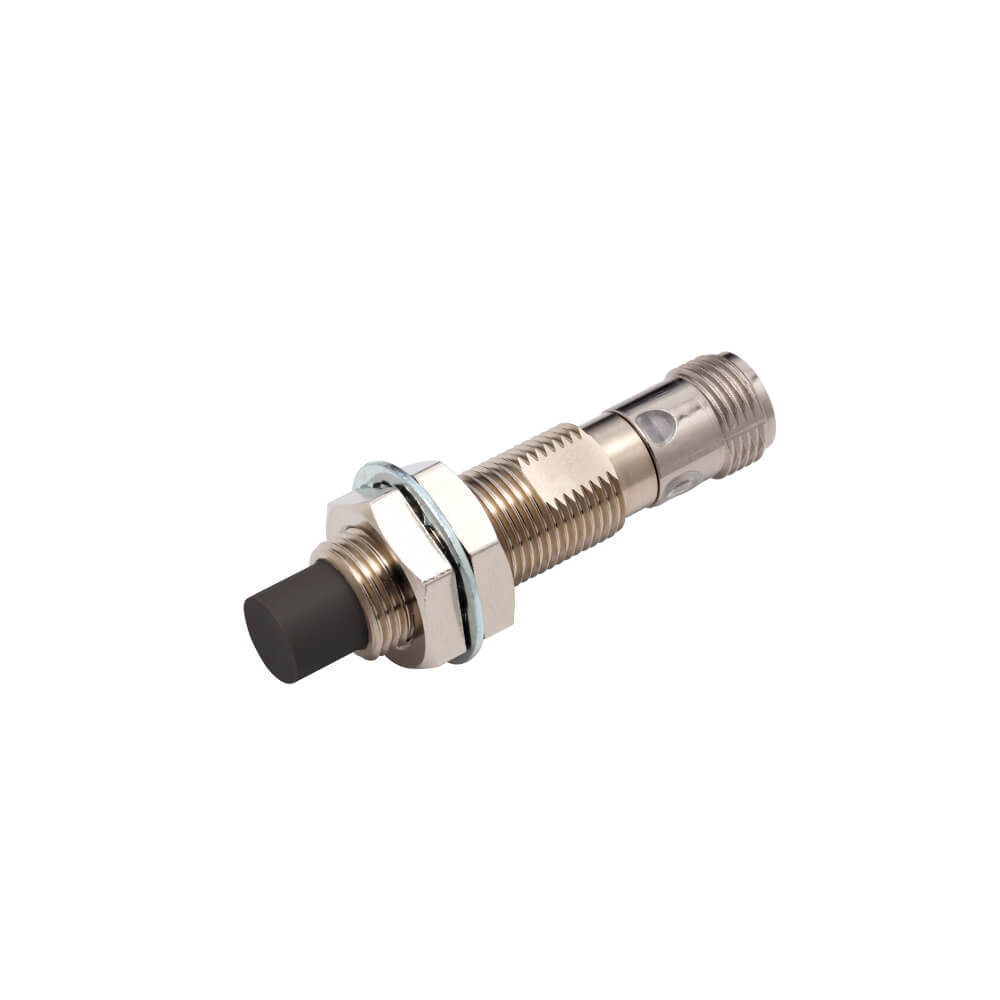
Omron E2E-X5MB212-M1 Inductive Proximity Sensor
| Feature | Value |
|---|---|
| Sensor Type | Inductive Proximity Sensor |
| Series | Omron E2E NEXT |
| Housing Diameter | M12 |
| Mounting Style | Non-Flush (Unshielded) |
| Sensing Distance | 5 mm |
| Output Type | NPN Normally Open (NO) |
| Connection Method | M12 Connector |
| Wiring Configuration | 3-Wire DC |
| Supply Voltage | 10 to 30 VDC |
| Response Frequency | 800 Hz |
| Housing Material | Nickel-Plated Brass |
| Operating Temperature | -40°C to +85°C |
| Protection Rating | IP67 / IP69K |
Industrial automation projects often require sensing devices that can be integrated quickly while maintaining long-term operational reliability. The Omron E2E-X5MB212-M1 Inductive Proximity Sensor is designed to address these requirements by combining non-contact metallic object detection with a connectorized installation approach. Its M12 cylindrical housing allows straightforward integration into machinery where compact dimensions and dependable sensing performance are required.
As a member of the E2E NEXT product family, this sensor is engineered to support stable operation in environments exposed to vibration, contaminants, temperature variations, and continuous production cycles. The connector-based design simplifies maintenance and replacement procedures compared to permanently wired alternatives.
Technical Description
The Omron E2E-X5MB212-M1 Inductive Proximity Sensor is an unshielded inductive sensor with a rated sensing distance of 5 mm. The non-flush mounting structure enables a longer sensing range than comparable shielded designs, making it suitable for installations where additional sensing distance is beneficial.
The sensor utilizes a three-wire DC electrical configuration and provides an NPN normally open output. The integrated M12 connector supports rapid installation and replacement, reducing machine downtime during maintenance activities.
The nickel-plated brass housing is designed to withstand demanding industrial environments while maintaining resistance to mechanical impacts and contamination. Protection ratings of IP67 and IP69K further support operation in applications where moisture and dust exposure are present.
Operating Principle
The sensor generates a high-frequency electromagnetic field through an internal oscillation circuit located near the sensing face. When a metallic object enters this field, eddy currents are induced within the target material.
These induced currents alter the characteristics of the oscillation circuit. The internal electronics continuously monitor these changes and trigger the output when the detection threshold is reached.
This method enables the Omron E2E-X5MB212-M1 Inductive Proximity Sensor to detect metallic objects without physical contact. As a result, mechanical wear is minimized and consistent detection performance can be maintained throughout extended operating periods.
Typical Usage Areas
- Machine position verification
- Industrial automation systems
- Robotic handling equipment
- Conveyor monitoring applications
- Assembly line automation
- Packaging machinery
- Metal processing systems
- Automated storage equipment
The Omron E2E-X5MB212-M1 Inductive Proximity Sensor is commonly installed in equipment where metallic machine elements must be monitored accurately during repetitive production cycles.
Industrial Applications
Robotic Manufacturing Cells
Industrial robots frequently rely on inductive sensors to confirm gripper positions, fixture locations, and workpiece presence before executing programmed movements.
Packaging Automation
Packaging machinery uses proximity sensors to monitor mechanical positions and synchronize machine functions throughout production sequences.
Automotive Assembly Lines
Manufacturing facilities use inductive sensing for fixture positioning, component verification, and transfer mechanism monitoring.
Warehouse Automation
Automated transport systems utilize proximity sensors to track carriers, positioning elements, and metallic transport structures.
Advantages
- Connectorized installation for simplified maintenance
- Reliable detection of metallic objects
- Extended sensing distance through non-flush construction
- IP67 and IP69K environmental protection
- Compact M12 housing dimensions
- Wide operating temperature range
- Compatibility with standard industrial control systems
- Reduced mechanical wear through non-contact sensing
The Omron E2E-X5MB212-M1 Inductive Proximity Sensor is particularly suitable for equipment where rapid sensor replacement and reduced maintenance time are important operational requirements.
Omron E2E-X5MB212-M1 Sector-Specific Use Cases
- Automotive body assembly stations
- Industrial conveyor transfer systems
- Food packaging equipment
- Electronics manufacturing machinery
- Industrial printing systems
- Material handling automation
- Machine tool equipment
- Distribution center automation
Machine designers often specify the Omron E2E-X5MB212-M1 Inductive Proximity Sensor when both reliable metallic target detection and simplified maintenance access are important design objectives.
Selection Considerations
Several technical factors should be reviewed before selecting an inductive proximity sensor:
- Required sensing distance
- Target material characteristics
- Available installation space
- Output type compatibility
- Connector or cable preferences
- Environmental protection requirements
- Operating temperature conditions
- Machine maintenance strategy
Engineers seeking additional sensing technologies can review Omron sensor solutions to evaluate related automation products for broader machine integration projects.
Frequently Asked Questions
What type of sensor is the E2E-X5MB212-M1?
It is an inductive proximity sensor designed for non-contact detection of metallic objects.
What is the rated sensing distance?
The sensor provides a nominal sensing distance of 5 mm.
Omron E2E-X5MB212-M1 Which output type is available?
This model uses an NPN normally open output configuration.
What connection method does the sensor use?
The sensor is equipped with an M12 connector for electrical connection.
Can it be connected to PLC systems?
Yes. The sensor is designed for integration with standard industrial PLC and controller inputs.
Does the sensor require contact with the target?
No. Detection is achieved through an electromagnetic sensing field.
Which industries commonly use this sensor?
Automotive manufacturing, packaging, logistics, robotics, and machine-building industries frequently utilize this sensor type.
What protection rating is provided?
The sensor offers IP67 and IP69K protection against dust and water ingress.
What maintenance is typically required?
Routine inspections should focus on connector integrity, mounting stability, and cleanliness of the sensing face.
Why choose a connectorized sensor instead of a cable version?
Connectorized models can simplify replacement procedures and reduce maintenance downtime in industrial installations.