
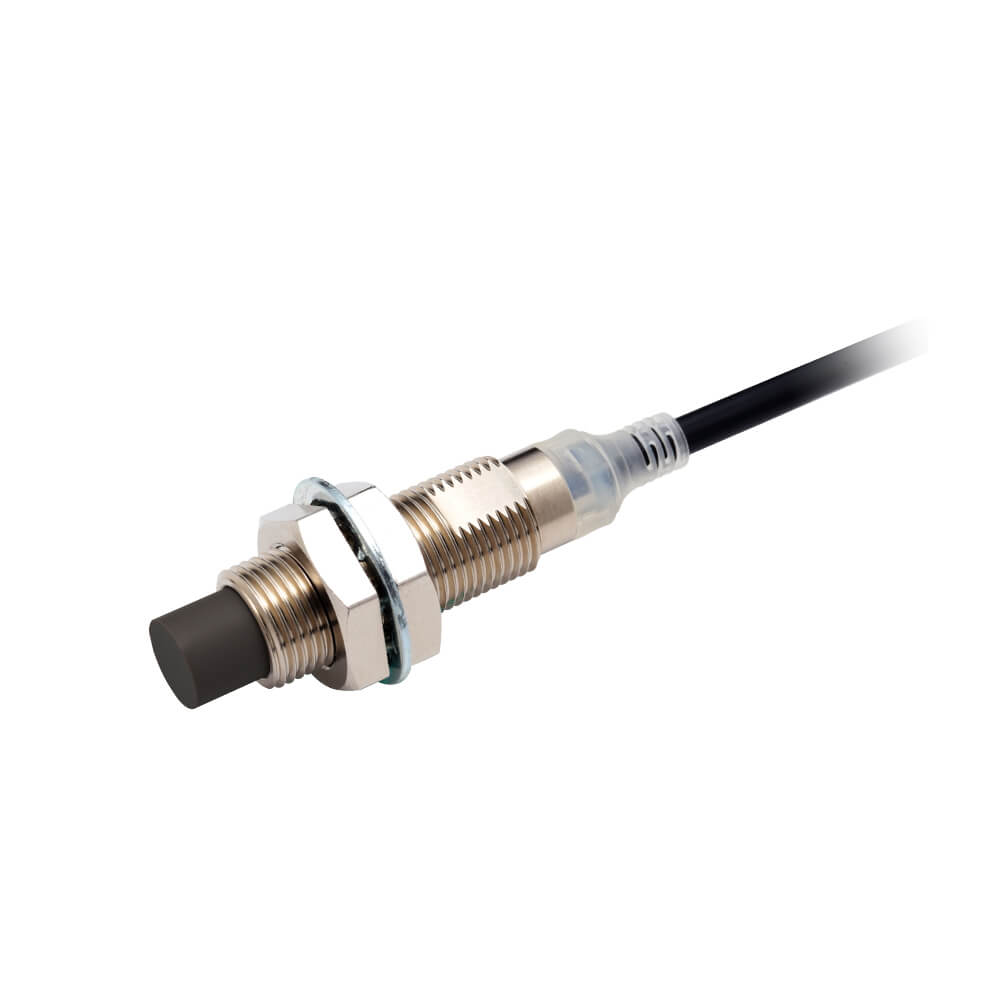
Omron E2E-X5MB212 5M Inductive Proximity Sensor
| Feature | Value |
|---|---|
| Sensor Type | Inductive Proximity Sensor |
| Series | Omron E2E NEXT |
| Housing Diameter | M12 |
| Mounting Method | Non-Flush (Unshielded) |
| Sensing Distance | 5 mm |
| Output Type | NPN Normally Open (NO) |
| Wiring System | 3-Wire DC |
| Cable Length | 5 m |
| Supply Voltage | 10 to 30 VDC |
| Response Frequency | 800 Hz |
| Housing Material | Nickel-Plated Brass |
| Operating Temperature | -40°C to +85°C |
| Protection Rating | IP67 / IP69K |
Accurate metal object detection is a fundamental requirement in modern automation systems. The Omron E2E-X5MB212 5M Inductive Proximity Sensor is designed to provide dependable sensing performance in applications where direct contact between the sensor and target is not desirable. Its compact M12 cylindrical housing enables installation in machinery with limited space while maintaining consistent detection characteristics.
Belonging to the E2E NEXT family, this model incorporates enhanced environmental protection and stable sensing behavior across a wide range of industrial operating conditions. The integrated 5-meter cable simplifies installation in large equipment where the sensing point is located far from the control cabinet.
Technical Description
The Omron E2E-X5MB212 5M Inductive Proximity Sensor uses inductive sensing technology to detect metallic targets at a rated distance of 5 mm. Its unshielded construction provides an extended sensing range compared to flush-mounted alternatives of the same housing size.
The sensor operates using a three-wire DC connection and features an NPN normally open output. This configuration supports integration with industrial controllers, programmable logic controllers, monitoring devices, and machine automation systems.
The nickel-plated brass housing offers mechanical durability while the IP67 and IP69K protection ratings help protect internal components against dust, moisture, and high-pressure cleaning environments.
Operating Principle
The sensor generates an electromagnetic field through an internal oscillation circuit located at the sensing face. When a conductive metallic object enters the sensing area, induced eddy currents affect the field generated by the sensor.
These electrical changes are continuously analyzed by the sensor electronics. Once the predefined threshold is reached, the output switches and sends a signal to the connected control system.
This non-contact detection method eliminates physical wear associated with mechanical switches and contributes to consistent long-term performance in repetitive industrial operations.
Common Usage Areas
- Machine position monitoring
- Metal object presence verification
- Conveyor system automation
- Industrial assembly equipment
- Transfer mechanism control
- Automated sorting systems
- Production line synchronization
- Industrial robotics applications
The Omron E2E-X5MB212 5M Inductive Proximity Sensor is frequently used in machinery where metallic components must be detected repeatedly and accurately during continuous production cycles.
Industrial Applications
Automotive Production Facilities
Automotive assembly lines rely on proximity sensing for fixture verification, position monitoring, and workpiece detection throughout manufacturing processes.
Logistics and Material Handling
Automated transport systems use inductive sensors to track carriers, pallets, and metal fixtures moving through conveyor networks.
Packaging Equipment
Packaging machines utilize proximity sensing to monitor mechanical movement, detect machine positions, and coordinate automated operations.
Metal Manufacturing
Fabrication equipment benefits from reliable position detection for moving machine elements, safety interlocks, and production sequence control.
Advantages
- Reliable metallic target detection
- 5 mm sensing distance
- Extended 5-meter cable length
- High resistance to environmental exposure
- Compact M12 housing design
- Wide operating temperature range
- Suitable for high-cycle automation systems
- Reduced maintenance requirements due to non-contact operation
The Omron E2E-X5MB212 5M Inductive Proximity Sensor supports automation projects that require dependable switching performance under demanding operating conditions.
Sector-Specific Examples
- Automotive body welding systems
- Industrial conveyor installations
- Packaging and filling machinery
- Robotic handling cells
- Warehouse automation systems
- Metal stamping equipment
- Industrial assembly stations
- Machine-building projects
Engineers frequently specify the Omron E2E-X5MB212 5M Inductive Proximity Sensor in systems where durability, environmental protection, and accurate metal detection are critical design considerations.
Important Selection Factors
- Required sensing distance
- Electrical interface compatibility
- Installation space availability
- Target material characteristics
- Environmental protection requirements
- Operating temperature range
- Cable routing distance
- Machine operating speed
Omron E2E-X5MB212 5M For broader sensing solutions and complementary automation technologies, engineers may also review Omron sensor products for related industrial applications.
Omron E2E-X5MB212 5M Frequently Asked Questions
What type of object can this sensor detect?
The sensor is designed to detect metallic objects using inductive sensing technology.
What is the rated sensing distance?
The nominal sensing distance is 5 mm.
Which output type does this model use?
The sensor provides an NPN normally open output.
Omron E2E-X5MB212 5M What supply voltage is required?
The operating voltage range is 10 to 30 VDC.
Can it be installed in washdown environments?
Its IP67 and IP69K ratings provide protection against water and dust exposure encountered in industrial environments.
Does the sensor require contact with the target?
No. Detection occurs through an electromagnetic field without physical contact.
How long is the attached cable?
This model includes a factory-installed 5-meter cable.
Which industries commonly use this sensor?
Automotive manufacturing, packaging, logistics, machine building, and metal processing industries commonly employ this type of sensor.
How does the sensor communicate detection?
The output changes state when a metallic target enters the sensing zone.
What maintenance is recommended?
Periodic inspection of mounting hardware, cable condition, and sensing surface cleanliness is generally sufficient.