
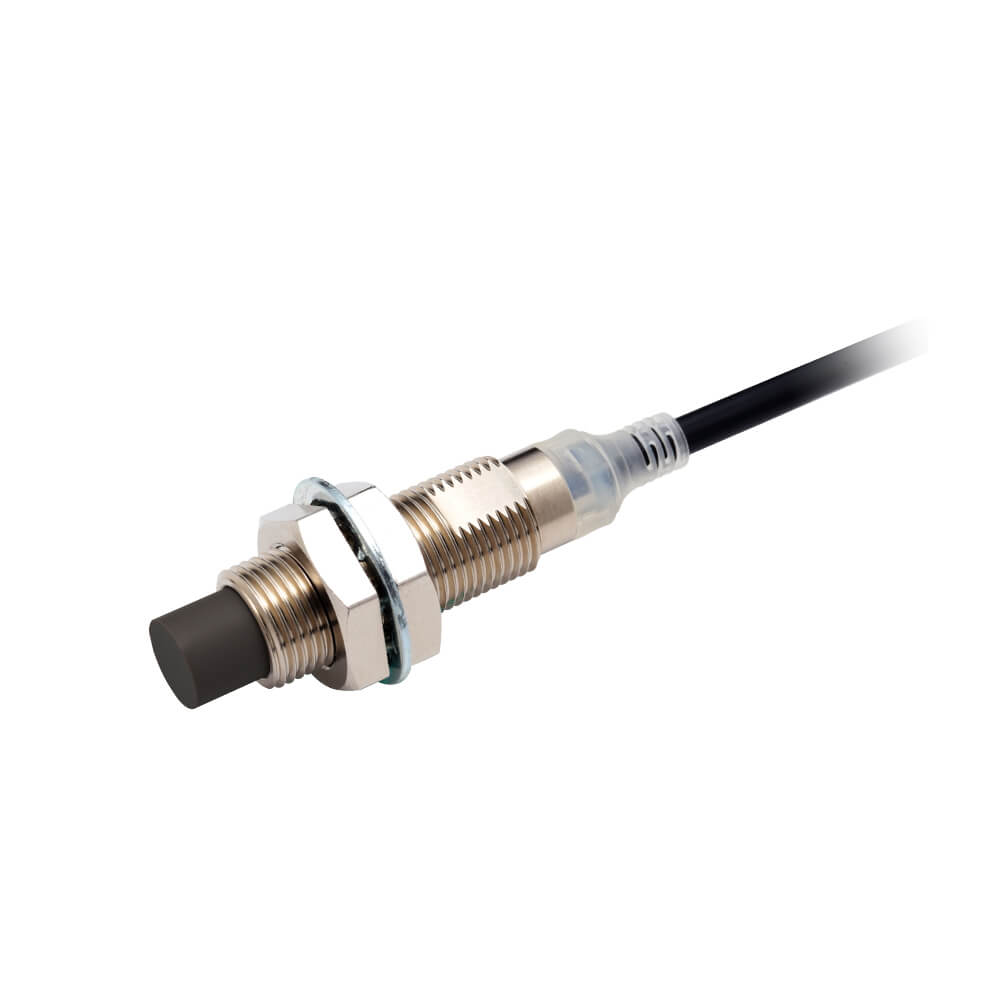
Omron E2E-X5MB212 2M Inductive Proximity Sensor
| Feature | Value |
|---|---|
| Sensor Type | Inductive Proximity Sensor |
| Series | Omron E2E NEXT |
| Housing Diameter | M12 |
| Mounting Style | Non-Flush (Unshielded) |
| Sensing Distance | 5 mm |
| Output Type | NPN Normally Open (NO) |
| Wiring Configuration | 3-Wire DC |
| Cable Length | 2 m |
| Supply Voltage | 10 to 30 VDC |
| Response Frequency | 800 Hz |
| Housing Material | Nickel-Plated Brass |
| Operating Temperature | -40°C to +85°C |
| Protection Rating | IP67 / IP69K |
Industrial automation systems depend on accurate object detection to maintain process consistency and machine coordination. The Omron E2E-X5MB212 2M Inductive Proximity Sensor is developed to provide reliable metallic target detection in applications where non-contact sensing is preferred. Its M12 cylindrical housing supports installation in compact machinery while maintaining dependable performance under demanding operating conditions.
As part of the Omron E2E NEXT family, this sensor incorporates enhanced environmental resistance and stable sensing characteristics. The design is suitable for manufacturing environments where equipment is exposed to vibration, contaminants, and frequent operation cycles.
Technical Description
The Omron E2E-X5MB212 2M Inductive Proximity Sensor is an unshielded inductive sensor designed for detecting metallic objects at a rated sensing distance of 5 mm. The non-flush construction allows a greater sensing range than equivalent shielded versions, making it suitable for installations where increased detection distance is beneficial.
The sensor uses a three-wire DC configuration with an NPN normally open output. This arrangement allows integration with PLC input modules, industrial controllers, machine monitoring systems, and distributed automation architectures.
The nickel-plated brass housing enhances resistance to mechanical stress and industrial contaminants. Combined with IP67 and IP69K protection ratings, the sensor can be deployed in challenging production environments.
Operating Principle
Inductive sensing technology operates by generating an electromagnetic field at the active sensing face. When a conductive metallic object enters this field, eddy currents are induced within the target.
The generated eddy currents absorb energy from the oscillation circuit, causing measurable changes within the sensor electronics. Once the variation reaches the switching threshold, the output changes state and signals target presence to the connected control system.
This operating method allows the Omron E2E-X5MB212 2M Inductive Proximity Sensor to detect metal objects without physical contact, minimizing wear and supporting long-term operational stability.
Key Features and Characteristics
- 5 mm sensing distance
- NPN normally open output
- Three-wire DC electrical connection
- M12 cylindrical housing
- 800 Hz response frequency
- IP67 and IP69K protection ratings
- Wide operating temperature range
- 2-meter integrated cable
The Omron E2E-X5MB212 2M Inductive Proximity Sensor is engineered to maintain consistent switching behavior even in environments where temperature variations and mechanical vibrations are present.
Industrial Applications
Automated Assembly Equipment
Production systems frequently use inductive sensors to verify the presence and position of metallic parts before assembly operations begin.
Conveyor Transport Systems
Metal carriers, fixtures, and transfer components can be monitored continuously to support synchronized material movement.
Machine Building
OEM machine manufacturers integrate proximity sensors into equipment for position monitoring, limit detection, and process sequencing.
Metal Processing Operations
Presses, cutting equipment, and fabrication machinery often rely on inductive sensing to verify mechanical positions and component movement.
Advantages in Automation Systems
- Non-contact operation reduces mechanical wear
- Reliable metallic object detection
- High environmental protection against dust and water
- Stable sensing performance across varying temperatures
- Suitable for compact machine layouts
- Compatible with common industrial control systems
- Durable housing construction
- Fast switching capability for dynamic processes
These characteristics make the Omron E2E-X5MB212 2M Inductive Proximity Sensor suitable for installations requiring dependable object detection over extended operational periods.
Sector-Specific Examples
- Automotive welding fixtures
- Packaging machinery position sensing
- Warehouse conveyor tracking systems
- Robotic transfer stations
- Industrial printing equipment
- Food packaging machinery
- Material handling automation
- Industrial assembly cells
Engineers often deploy the Omron E2E-X5MB212 2M Inductive Proximity Sensor in locations where metallic machine elements must be monitored accurately while maintaining resistance to environmental exposure.
Omron E2E-X5MB212 2M Factors to Consider During Product Selection
Several technical parameters should be evaluated before selecting an inductive proximity sensor:
- Required sensing distance
- Available installation space
- Electrical output requirements
- Target material characteristics
- Environmental protection needs
- Temperature conditions
- Cable routing requirements
- Machine cycle speed
Additional sensing technologies and related automation solutions can be explored through Omron sensor series when designing broader machine automation systems.
Frequently Asked Questions
What type of targets can this sensor detect?
The sensor is designed to detect metallic objects using inductive sensing technology.
What is the rated sensing distance?
The rated sensing distance is 5 mm under standard operating conditions.
Omron E2E-X5MB212 2M What output configuration does the sensor provide?
The device uses an NPN normally open output.
Can it be connected to a PLC?
Yes. The three-wire DC design supports integration with PLC digital input modules.
What protection rating does the sensor have?
The sensor is rated IP67 and IP69K for resistance to dust and water ingress.
Is physical contact required for detection?
No. Detection occurs through an electromagnetic sensing field.
Which industries commonly use this model?
Automotive manufacturing, logistics, packaging, machine building, and metal processing industries commonly use inductive proximity sensors of this type.
What is the cable length?
The model includes a factory-attached 2-meter cable.
How often should the sensor be inspected?
Routine inspections should verify mounting integrity, cable condition, and cleanliness of the sensing face.
Why choose an unshielded design?
Unshielded sensors generally provide a longer sensing distance than shielded versions of comparable size.