
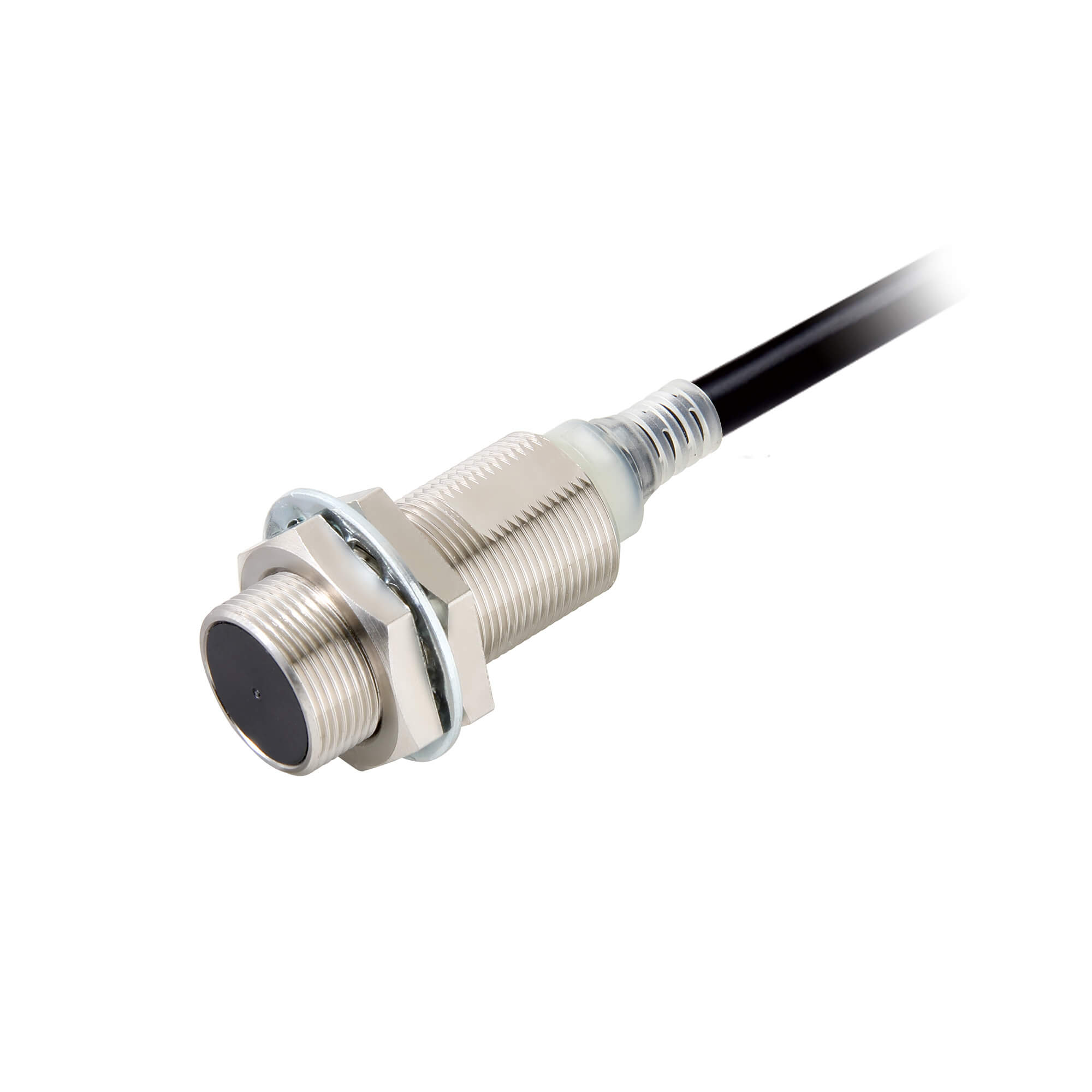
Omron E2E-X5D2-TR-N 2M Inductive Proximity Sensor
| Feature | Value |
|---|---|
| Sensor Type | Inductive Proximity Sensor |
| Series | E2E NEXT |
| Housing Size | M18 |
| Mounting Type | Flush |
| Sensing Distance | 5 mm |
| Output Type | DC 2-Wire |
| Operation Mode | Normally Closed |
| Connection Method | Flexible Robotic Cable |
| Cable Length | 2 m |
| Housing Material | Nickel-Plated Brass |
| Thread Length | 37 mm |
| Overall Length | 54.3 mm |
| Protection Rating | IP67, IP67G, IP69K |
Technical Description
The Omron E2E-X5D2-TR-N 2M Inductive Proximity Sensor is engineered for metal target detection in applications involving continuous cable movement. Unlike standard cable variants, this model incorporates a highly flexible robotic cable designed to withstand repetitive bending and motion commonly found in robotic systems, transfer mechanisms, and automated production equipment.
As part of the E2E NEXT family, the sensor features a flush-mount M18 cylindrical housing and a rated sensing distance of 5 mm. The rugged nickel-plated brass construction and advanced environmental protection ratings make it suitable for demanding industrial environments where vibration, contamination, and mechanical stress are present.
The Omron E2E-X5D2-TR-N 2M Inductive Proximity Sensor combines reliable metal detection with installation flexibility, making it a practical solution for moving machinery and dynamic automation systems.
Working Principle
The sensor generates a high-frequency electromagnetic field at its sensing face. When a metallic target enters this field, eddy currents develop within the object. These currents influence the sensor’s internal oscillation circuit, allowing the electronics to determine whether a metal object is present.
This non-contact detection principle eliminates physical wear on both the sensor and the target, supporting consistent operation across millions of machine cycles.
Applications in Automation Systems
- Robot arm position monitoring
- Automated gripper verification
- Transfer shuttle positioning
- Metal carrier detection
- Assembly fixture confirmation
- Conveyor stop-point sensing
- Linear actuator monitoring
- Machine safety interlock feedback
Industrial Applications
Industrial robots often require sensors capable of withstanding continuous cable flexing. The Omron E2E-X5D2-TR-N 2M Inductive Proximity Sensor addresses this requirement through its robotic cable design, reducing the risk of cable fatigue in moving installations.
In automotive manufacturing, the sensor may monitor fixture positions during body assembly operations. In electronics assembly equipment, it can verify metallic tooling positions before automated processes begin. Material handling systems can utilize the sensor to detect shuttle alignment and pallet positioning.
Advantages
- Flexible robotic cable for moving applications
- Reliable non-contact metal detection
- Flush mounting compatibility
- Compact M18 design
- Resistance to industrial contaminants
- Suitable for repetitive motion environments
- High environmental protection ratings
- Reduced maintenance compared to mechanical switches
Sector-Specific Use Cases
In robotic welding cells, the sensor can confirm fixture locations before welding begins. Packaging automation systems may use the sensor to monitor moving transfer components subjected to repeated motion. In warehouse automation, it can verify carriage positions in automated storage and retrieval systems.
The Omron E2E-X5D2-TR-N 2M Inductive Proximity Sensor is particularly useful in installations where cable movement is unavoidable and long-term reliability is required.
Additional information about Omron sensor series can help engineers compare sensing technologies for dynamic automation applications.
Selection Considerations
When selecting a sensor for robotic or moving machinery, engineers should evaluate cable durability, bending radius requirements, mounting configuration, and environmental conditions. A robotic cable version is generally preferred when frequent motion could shorten the lifespan of standard cable constructions.
Proper routing and strain relief practices should also be implemented to maximize cable life and maintain stable signal transmission.
Frequently Asked Questions
What makes this model different from standard cable versions?
It uses a flexible robotic cable designed for repeated movement and bending.
What is the sensing distance?
The rated sensing distance is 5 mm.
Can it be installed in robotic systems?
Yes. The flexible cable is specifically intended for moving automation equipment.
What type of target can it detect?
It detects metallic objects using inductive sensing technology.
What is the cable length?
The integrated cable length is 2 meters.
Does it support flush mounting?
Yes. The sensor is designed for flush installation.
What environmental ratings does it provide?
It is rated IP67, IP67G, and IP69K.
Which industries commonly use this sensor?
Automotive, robotics, logistics, packaging, and factory automation industries frequently use this type of sensor.