
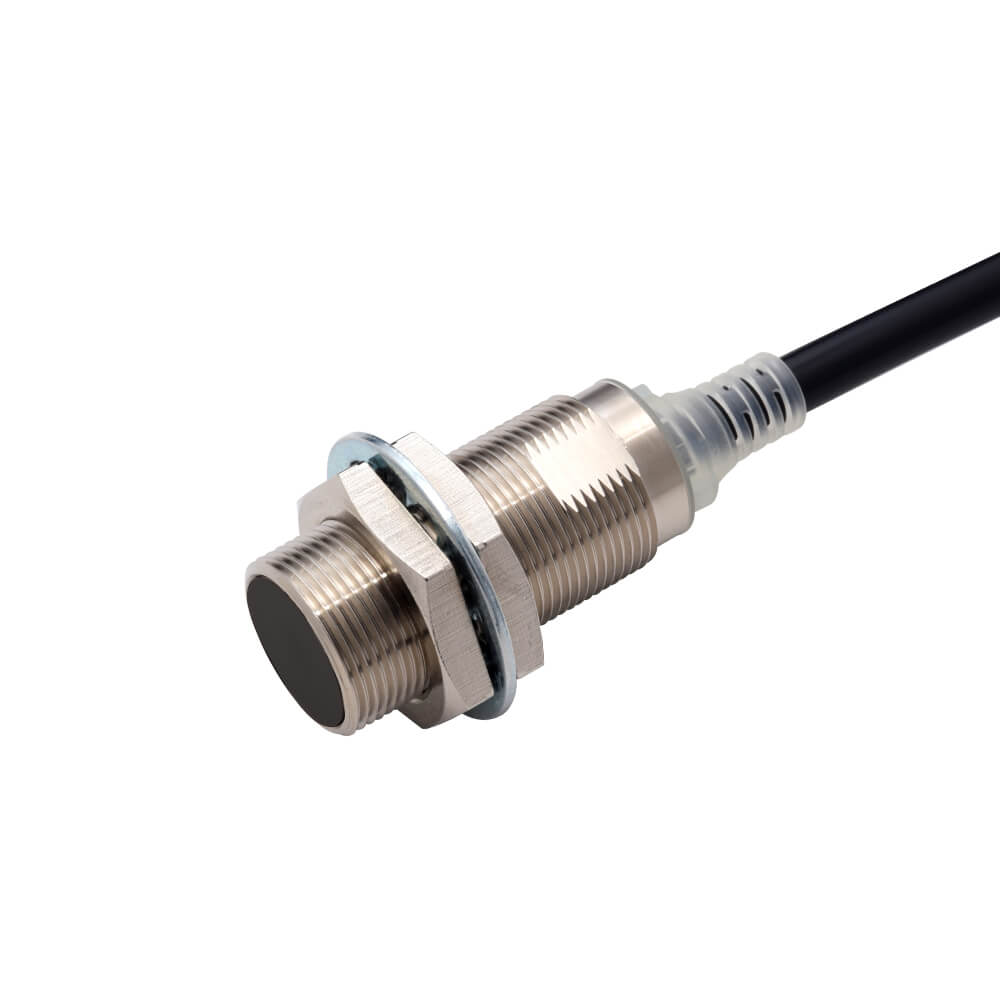
Omron E2E-X5C218 5M Inductive Proximity Sensor
| Feature | Value |
|---|---|
| Sensor Type | Inductive Proximity Sensor |
| Series | E2E NEXT |
| Sensing Distance | 5 mm |
| Mounting Style | Flush Shielded |
| Housing Diameter | M18 |
| Housing Material | Nickel-Plated Brass |
| Output Configuration | PNP Normally Open (NO) |
| Supply Voltage | 10 to 30 VDC |
| Connection Type | 5 m PVC Oil-Resistant Cable |
| Response Frequency | 600 Hz |
| Operating Temperature | -40°C to +85°C |
| Protection Rating | IP67 / IP67G / IP69K |
| Overall Length | 77.3 mm |
Industrial control systems depend on precise position feedback to maintain process continuity and equipment reliability. The Omron E2E-X5C218 5M Inductive Proximity Sensor is developed to detect metallic objects without physical contact, providing dependable switching performance across a broad range of automation environments.
Its extended 5-meter cable configuration supports installations where sensors are positioned at significant distances from PLC input modules, control panels, or remote I/O stations. This configuration can simplify cable management and reduce the need for additional extension connections.
The Omron E2E-X5C218 5M Inductive Proximity Sensor is commonly applied in automated machinery, production systems, logistics equipment, and industrial handling applications requiring reliable metal detection.
Technical Description
This sensor belongs to the Omron E2E NEXT series and incorporates a cylindrical M18 threaded housing with a flush-mounted shielded sensing structure. The rated sensing distance is 5 mm, and the sensor provides a PNP normally open output signal suitable for a wide range of industrial controllers.
The nickel-plated brass housing enhances mechanical durability, while the oil-resistant cable construction supports use in environments where lubricants, coolants, and cleaning agents may be present.
Working Principle
The sensing face generates a high-frequency electromagnetic field. When a metallic object enters the sensing range, eddy currents are induced within the target material. These currents affect the sensor’s oscillation circuit, allowing the electronics to recognize target presence and switch the output state.
This non-contact detection principle eliminates mechanical wear and enables consistent operation even in applications involving continuous movement or frequent switching cycles.
Typical Areas of Use
- Automated conveyor systems
- Material transport equipment
- Packaging machinery
- Industrial assembly lines
- Machine tool automation
- Warehouse handling systems
- Sorting equipment
- Position monitoring applications
Industrial Applications
Logistics and Distribution Centers
The sensor can verify the position of metallic carriers, transfer units, and automated transport mechanisms throughout distribution operations.
Machine Building
Equipment manufacturers frequently integrate inductive sensors for motion feedback, actuator monitoring, and position confirmation functions.
Packaging Production
The sensor may be used to monitor metallic indexing components and machine movements that support packaging processes.
Automotive Component Manufacturing
Production cells can utilize the sensor to verify fixture positions and detect metal workpiece presence during automated assembly operations.
Advantages
- Extended 5-meter cable for flexible installation
- PNP output compatibility with industrial controllers
- Shielded sensing structure for flush mounting
- High resistance to moisture and contaminants
- Wide operating temperature range
- Reliable non-contact metal detection
- Durable nickel-plated brass housing
- Suitable for continuous-duty applications
Sector-Specific Use Cases
In warehouse automation systems, the sensor can monitor shuttle positions and metallic transfer assemblies moving between storage locations.
Within packaging facilities, it may be installed to verify machine indexing positions before product transfer sequences begin.
In metalworking operations, the sensor can confirm the movement of fixtures and machine mechanisms exposed to industrial oils and coolants.
In automated assembly lines, it can provide accurate positional feedback for production equipment handling metallic components.
Omron E2E-X5C218 5M Important Selection Considerations
- Confirm compatibility with PNP input circuits.
- Verify required sensing distance for the target.
- Evaluate environmental exposure conditions.
- Consider installation space and mounting requirements.
- Determine whether an extended cable length is beneficial.
- Review operating temperature expectations.
- Assess maintenance accessibility requirements.
Additional Omron Sensor Resources
Engineers interested in expanding machine sensing capabilities can explore Omron sensor products for additional automation and industrial control applications.
Frequently Asked Questions
What type of output does this sensor provide?
The sensor provides a PNP normally open output configuration.
What is the rated sensing distance?
The rated sensing distance is 5 mm.
What cable length is supplied?
This version includes a permanently attached 5-meter oil-resistant cable.
Omron E2E-X5C218 5M Can the sensor detect aluminum and steel?
Yes. Inductive sensors detect conductive metallic materials, although sensing characteristics may vary depending on the target material.
Is flush mounting supported?
Yes. The shielded sensing design allows flush installation within metallic mounting structures.
What environmental protection ratings are available?
The sensor is rated IP67, IP67G, and IP69K.
Where is the Omron E2E-X5C218 5M Inductive Proximity Sensor commonly used?
The Omron E2E-X5C218 5M Inductive Proximity Sensor is commonly installed in conveyors, packaging equipment, assembly systems, and logistics automation applications.
What voltage range is required for operation?
The sensor operates with a supply voltage ranging from 10 to 30 VDC.
How does the Omron E2E-X5C218 5M Inductive Proximity Sensor detect objects?
The Omron E2E-X5C218 5M Inductive Proximity Sensor detects metallic targets by monitoring changes in an electromagnetic field generated at the sensing face.