
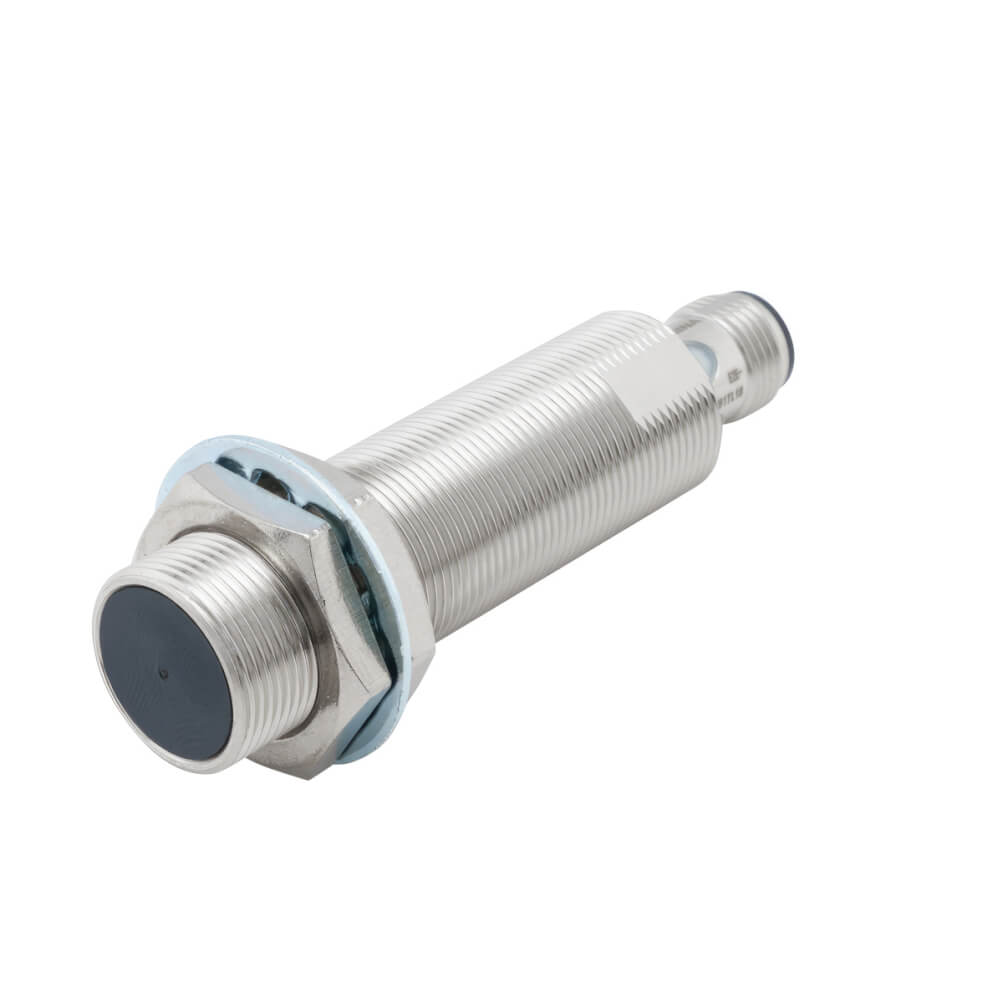
Omron E2E-X5B2L18-M1 Inductive Proximity Sensor
| Feature | Value |
|---|---|
| Product Type | Inductive Proximity Sensor |
| Series | Omron E2E NEXT |
| Sensing Distance | 5 mm |
| Housing Diameter | M18 |
| Mounting Method | Flush Shielded |
| Output Type | PNP Normally Open (NO) |
| Wiring Configuration | 3-Wire DC |
| Supply Voltage | 10 to 30 VDC |
| Response Frequency | 600 Hz |
| Connection Type | M12 Connector |
| Housing Material | Nickel-Plated Brass |
| Protection Rating | IP67 / IP67G / IP69K |
| Operating Temperature | -25°C to +70°C |
| Overall Length | Approx. 55 mm |
Technical Overview
The Omron E2E-X5B2L18-M1 Inductive Proximity Sensor is designed for reliable detection of metallic objects in industrial automation systems. Built within the Omron E2E NEXT product family, the sensor combines robust environmental protection, stable sensing performance, and simplified installation through an integrated M12 connector interface.
Industrial machinery frequently requires accurate object detection without physical contact. The Omron E2E-X5B2L18-M1 Inductive Proximity Sensor fulfills this requirement by utilizing electromagnetic sensing technology that identifies metallic targets while eliminating mechanical wear associated with traditional limit switches.
Its M18 threaded cylindrical housing supports flush mounting in machine structures, while the PNP normally open output enables integration with modern PLCs, industrial controllers, and automation networks.
Operating Principle
The sensor operates by generating a high-frequency electromagnetic field at its sensing surface. When a conductive metal object enters the detection zone, eddy currents are created within the target.
These induced currents absorb energy from the oscillator circuit, resulting in measurable changes in the electromagnetic field. The internal electronics continuously evaluate these changes and switch the output when the sensing threshold is reached.
Because there is no physical contact between the sensor and the target, the sensing process remains highly reliable even during repetitive production cycles and continuous machine operation.
Main Features
- 5 mm sensing distance
- M18 cylindrical threaded housing
- Flush-mounted shielded construction
- PNP normally open output
- M12 connector interface
- 3-wire DC operation
- 600 Hz switching frequency
- Nickel-plated brass housing
- IP67, IP67G, and IP69K protection levels
- Suitable for demanding industrial environments
Applications Across Industrial Systems
The Omron E2E-X5B2L18-M1 Inductive Proximity Sensor is used throughout industrial facilities where accurate detection of metallic machine components is required for monitoring, positioning, and control functions.
- Automated production lines
- Industrial robotics
- Assembly systems
- Machine tool equipment
- Material handling systems
- Packaging machinery
- Conveyor automation
- Warehouse logistics equipment
The connectorized design is particularly useful in installations where maintenance accessibility and rapid sensor replacement are important operational requirements.
Industrial Use Cases
Robotic Manufacturing Cells
Industrial robots require accurate feedback regarding fixture locations and component positioning. Inductive sensors provide dependable signals that support automated operations.
Conveyor Position Verification
Conveyor systems frequently use proximity sensors to detect carriers, pallets, and metallic transfer mechanisms for process synchronization.
Omron E2E-X5B2L18-M1 Machine Tool Monitoring
CNC machines and automated machining centers use inductive sensors to verify positions of tooling components, fixtures, and mechanical assemblies.
Automated Packaging Equipment
Packaging machines incorporate sensors to monitor moving parts, indexing mechanisms, and operational sequences throughout production cycles.
Advantages for Engineering Projects
Selecting the appropriate sensing technology can influence equipment reliability and maintenance requirements. This sensor provides several practical advantages in industrial installations.
- Non-contact operation minimizes wear
- Stable sensing performance in metallic environments
- High resistance to contamination and moisture
- Fast installation through M12 connector technology
- Reduced downtime during replacement procedures
- Suitable for continuous industrial operation
The Omron E2E-X5B2L18-M1 Inductive Proximity Sensor is commonly implemented in systems where long service life and consistent switching performance are critical operational requirements.
Selection Considerations
Before specifying an inductive sensor, engineers should evaluate several technical and environmental factors.
- Required sensing distance
- Control system compatibility
- Available mounting space
- Environmental exposure conditions
- Connector and cable requirements
- Target material characteristics
- Required switching frequency
Proper installation and alignment help ensure reliable sensing performance throughout the operational life of the system.
Additional Omron Sensor Technologies
For applications requiring different sensing principles, engineers can review Daha fazla Omron sensör çözümü including photoelectric, fiber optic, displacement, and measurement technologies.
Frequently Asked Questions
1. What type of objects can this sensor detect?
The sensor is designed to detect metallic objects using inductive sensing technology.
2. What is the rated sensing distance?
The rated sensing distance is 5 mm.
3. Which output type is included?
The sensor provides a PNP normally open output.
4. What connection method is used?
The device uses an M12 connector for electrical connection.
5. Is flush mounting supported?
Yes. The sensor is designed for flush installation in metallic mounting structures.
6. Can the sensor operate in washdown environments?
Yes. Its IP67, IP67G, and IP69K ratings support use in demanding industrial environments.
7. What voltage range does the sensor require?
The operating voltage range is 10 to 30 VDC.
8. Which industries commonly use this sensor?
Automotive manufacturing, packaging, logistics automation, machine building, robotics, and material handling industries frequently use this sensor.