
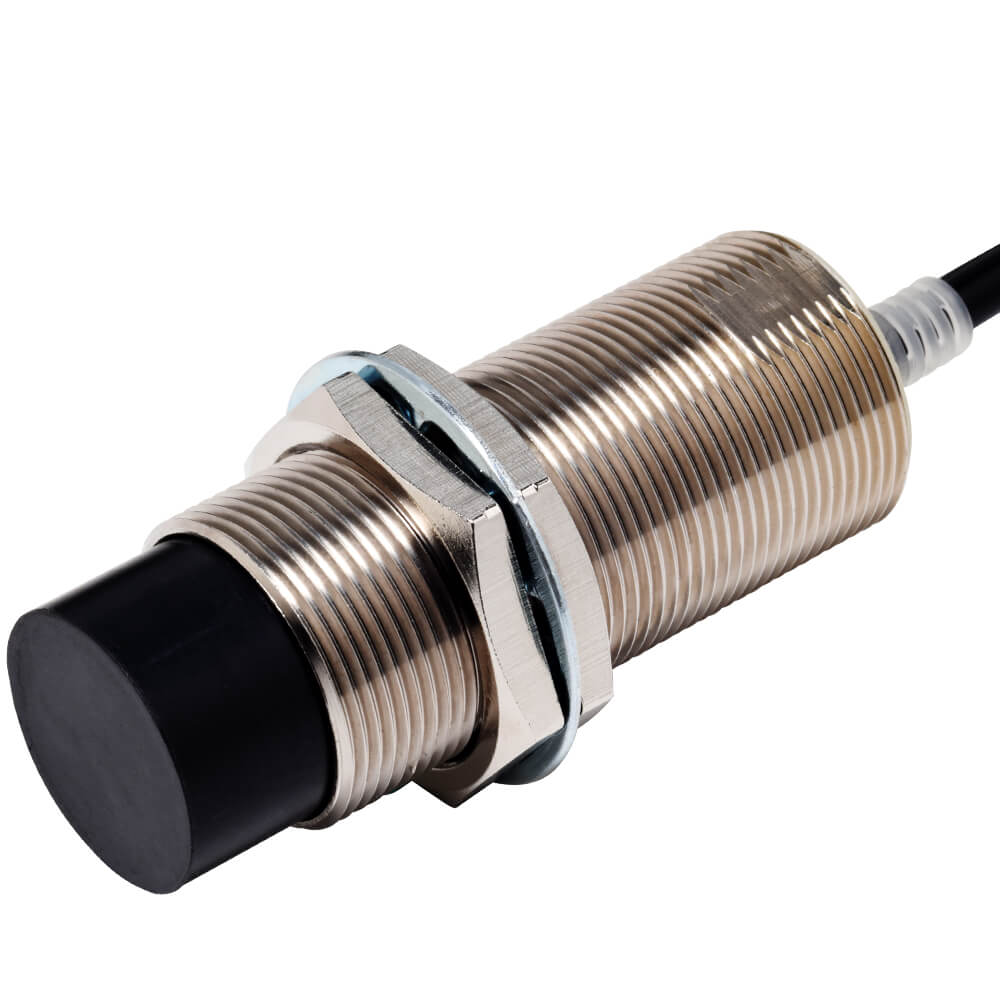
Omron E2E-X50MC1L30 2M Inductive Proximity Sensor
| Feature | Value |
|---|---|
| Sensor Type | Inductive Proximity Sensor |
| Series | Omron E2E NEXT |
| Housing Size | M30 |
| Mounting Style | Non-flush (Unshielded) |
| Sensing Distance | 50 mm |
| Output Type | NPN |
| Operation Mode | Normally Open (NO) |
| Connection Type | 2 m Cable |
| Supply Voltage | 10 to 30 VDC |
| Response Frequency | 100 Hz |
| Housing Material | Nickel-plated Brass |
| Protection Rating | IP67 / IP67G / IP69K |
| Operating Temperature | -25°C to +70°C |
| Cable Material | Oil-resistant PVC |
Technical Description
The Omron E2E-X50MC1L30 2M Inductive Proximity Sensor is engineered for reliable detection of metallic targets in industrial automation environments. As part of the E2E NEXT series, this model provides a long sensing distance of 50 mm while maintaining stable operation under demanding production conditions. Its cylindrical M30 housing and rugged construction make it suitable for applications where durability and detection consistency are important.
The sensor incorporates an NPN normally open output and a fixed 2-meter cable connection. Designed for non-contact operation, the Omron E2E-X50MC1L30 2M Inductive Proximity Sensor can be used for object detection, machine positioning, sequence monitoring, and automated process control in various manufacturing sectors.
Operating Principle
The sensor generates an electromagnetic field at its sensing surface using an internal oscillator. When a metallic object enters this field, induced eddy currents create changes in the oscillation amplitude. The sensor electronics detect these changes and activate the output signal.
Because detection is performed without physical contact, the sensor avoids mechanical wear associated with conventional switches. This characteristic supports long operational life and dependable performance in repetitive industrial processes.
Key Features
- 50 mm extended sensing range
- NPN normally open output configuration
- M30 threaded cylindrical housing
- Oil-resistant PVC cable connection
- Nickel-plated brass construction
- High resistance to industrial contaminants
- IP67, IP67G, and IP69K protection ratings
- Non-contact metal object detection
Typical Applications
Long-range inductive sensors are frequently selected for installations where equipment vibration, large mechanical tolerances, or extended mounting distances are present.
- Conveyor tracking systems
- Automated assembly equipment
- Packaging machinery
- Robotic manufacturing cells
- Metal forming equipment
- Warehouse automation systems
- Transfer and sorting equipment
- Industrial transport systems
Industrial Applications
Conveyor Automation
In conveyor systems, the sensor can detect metal carriers and transport fixtures while maintaining reliable switching performance despite vibration and continuous movement.
Automated Welding Lines
Manufacturers often use proximity sensors to verify fixture positioning before welding operations begin. Accurate detection helps maintain production sequence control.
Machine Tool Equipment
Machining centers frequently require confirmation of moving machine components and workpiece positioning. The sensor provides reliable feedback for automated control systems.
Storage and Retrieval Systems
Automated warehouses use inductive sensors to monitor metallic transfer mechanisms and carrier positions throughout transport operations.
Advantages
- Extended sensing distance improves installation flexibility
- Non-contact detection reduces maintenance requirements
- Robust housing supports industrial operation
- Stable performance in harsh environments
- Suitable for continuous-duty applications
- High environmental protection ratings
- Reliable detection of metallic objects
Omron E2E-X50MC1L30 2M Sector-Specific Usage Examples
In automotive manufacturing plants, the sensor may be installed near transfer fixtures to verify vehicle body carrier positions before robotic operations begin.
In packaging facilities, the device can monitor metallic actuator components and indexing mechanisms during high-speed production cycles.
Metal fabrication workshops often use inductive sensors to detect sheet metal movement between processing stations and handling systems.
Distribution centers can integrate the sensor into conveyor infrastructure for monitoring pallet transfer mechanisms and automated sorting equipment.
Omron E2E-X50MC1L30 2M Considerations When Selecting a Sensor
Selecting an inductive proximity sensor requires evaluation of application requirements, environmental conditions, and electrical compatibility.
- Required sensing distance
- NPN output compatibility
- Installation environment
- Mounting configuration
- Cable routing requirements
- Mechanical clearance availability
Omron E2E-X50MC1L30 2M Engineers looking for additional sensing technologies may review Omron sensor product ranges for complementary automation solutions.
Frequently Asked Questions
1. What type of target can this sensor detect?
The sensor is designed to detect metallic objects through inductive sensing technology.
2. What is the nominal sensing distance?
The nominal sensing distance is 50 mm.
3. What output type does this model provide?
The sensor provides an NPN normally open output.
4. Is physical contact required for detection?
No. Detection is achieved through an electromagnetic field.
5. What connection method is used?
The sensor is equipped with a 2-meter oil-resistant PVC cable.
6. Can the sensor operate in wet environments?
Its IP67, IP67G, and IP69K ratings support operation in demanding industrial environments.
7. What supply voltage range is supported?
The operating voltage range is 10 to 30 VDC.
8. What housing material is used?
The housing is manufactured from nickel-plated brass.
9. Which industries commonly use this sensor?
Automotive, logistics, packaging, machine building, and metal processing industries commonly use this type of sensor.
10. Why is a 50 mm sensing range beneficial?
It allows greater installation flexibility and increased separation from moving machine components.